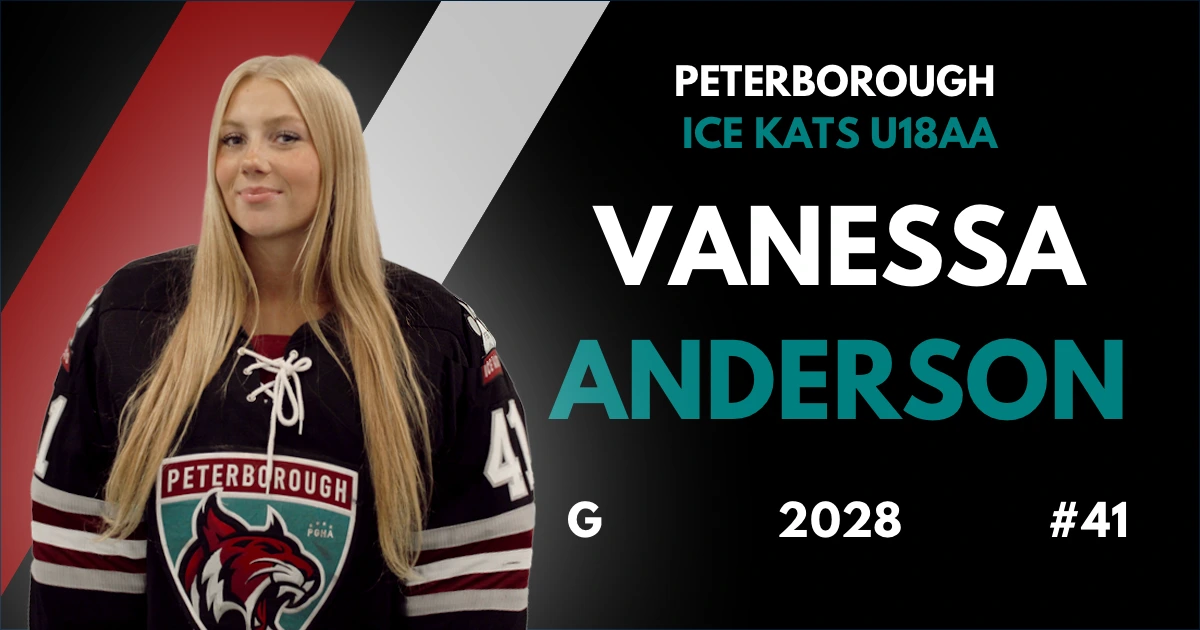
Vanessa Anderson
Goalie Overview
Height
5’6″
Position
Goalie
Glove
Left
Team
Peterborough Ice Kats U18AA
School
Thomas A. Stewart Secondary School
Grad Class
2028
Programs of Interest
- Education
- Physiotherapy
Academic Record
Scouting Report
Positional Foundation
Key Strengths
- Relaxed Readiness: Vanessa Anderson is comfortable before the game asks anything of her. When the puck is outside, she stays tall and loose, not forcing a low set just to look prepared. There’s no tension in her stance and no urgency to declare readiness early. Her body stays available, alive, waiting for the moment to actually earn a response.
- Style Ownership: This stance belongs to Vanessa. She sets up upright, then sinks when space closes, not because a rule tells her to, but because the moment does. She doesn’t label herself stand-up or butterfly. She chooses. That choice happens without hesitation and without apology, and it’s consistent enough to tell you this isn’t experimentation — it’s identity.
- Distance Comfort: From range, she’s content to use height. Shooters don’t get a clean look, and they don’t get one for free. She waits. She doesn’t rush to compress just because the puck is on a stick. When she sinks, it’s because the play has earned it, not because she’s been taught to arrive there early.
- Hand Awareness: Her hands reflect what her body is doing. In the taller setup, the glove sits a little higher and the blocker a little lower. As she sinks, they level and open, not flaring and not locking in. The changes are quiet, but they’re intentional, and they stay connected to how she’s reading the play.
- Athletic Freedom: Nothing about her stance pins her in place. She isn’t trying to hold a picture. She’s trying to stay available. That freedom shows in how easily she reacts, recovers, and adjusts when plays change. The setup gives her room to be who she is instead of forcing her to look like something else.
Areas to Refine
- Baseline Etching: Because her stance is self-authored, the work now is repetition. The foundation is clear. The next step is carving the same starting picture into every shift so it holds under longer pressure and higher demand.
- Transition Timing: The move from tall to compressed isn’t rushed, but it isn’t identical every time either. Tightening when that sink happens will sharpen efficiency without changing the stance itself.
- Identity Clarity: Vanessa’s stance won’t make sense in a glance. It asks to be watched. When it’s seen consistently, the value shows. Helping others understand what they’re looking at matters, because this isn’t about fitting expectations — it’s about seeing what’s actually there.
Key Strengths
- Chosen Depth: Vanessa Anderson begins sequences a little farther out than most, and it’s intentional. She’s not guessing or drifting — she’s choosing depth that complements her upright stance and takes time and space away early. The setup makes sense because she understands when to hold ground and when to give it back.
- Middle Compression: When play comes straight down the middle, her depth responds immediately. She mirrors the puck carrier, narrowing space without overcommitting, and arrives where she needs to be as the threat actually forms rather than arriving early and waiting.
- Wing Patience: On wide rushes, she stays out longer than many goaltenders are taught to. The depth doesn’t retreat just because the puck is outside. She trusts her angle, her stance, and her edges, allowing the play to declare itself before conceding ice.
- Edge Engagement: As plays close, her edges take over. She glides with precision, left to right, staying connected to the puck carrier rather than sliding into depth passively. That movement confirms that her relaxed posture earlier in the sequence isn’t disengagement — it’s preparation.
- Below-Goal-Line Control: Her depth control is at its best when the puck is worked below the goal line. Whether she’s on her pads, crouched, or upright, she closes east-to-west space decisively. Post-to-post threats are managed through timing and positioning rather than panic or reach.
Areas to Refine
- Slot Entry Timing: When puck carriers transition from the wing into the slot, her depth initiation can arrive a beat late. Tightening that moment helps seal space before it opens rather than reacting after it’s exposed.
- Angle Matching: On lateral slot entries, mirroring the carrier’s travel line more precisely will reduce the small windows that can appear if she’s beaten to the moment.
- Exposure Reduction: Because she’s comfortable playing farther out, isolated sequences can leave more net visible if timing slips. The ability is there — refining recognition in these specific circumstances limits opportunities for outside critique rather than correcting a persistent flaw.
Key Strengths
- Selective Coverage: Vanessa Anderson doesn’t arrive on angle automatically — she arrives by choice. Whether she’s upright, crouched, or on her pads, her angle coverage reflects decisions made in real time. She’s not defaulting to a single look; she’s selecting the one that fits the moment, and that selectiveness shows her focus throughout a game.
- Calculated Risk: Her style can give the impression of looseness to untrained eyes. She can track slightly wide on rushes toward the wall and arrive a beat later when play cuts back through the middle, but this isn’t awareness slipping. It’s a calculated decision to challenge shooters, invite movement, and pull them into her athletic game.
- Distance Expression: This approach shows most when the puck is higher in the zone, above the top of the faceoff circles. From there, she’s willing to live with a little discomfort in her angle if it allows her to dictate how the play unfolds rather than simply react to it.
- Down-Low Precision: When the puck moves below the circles, her angle coverage tightens noticeably. The technician comes out. Her body lines up clean, her seal improves, and the game simplifies. The switch is immediate and intentional, not reactive.
- Unorthodox Comfort: Vanessa is comfortable being unorthodox. She doesn’t force uniformity across situations, and she doesn’t chase visual cleanliness. That freedom allows her to play loose and expressive, because it aligns with who she is rather than who she’s supposed to be.
Areas to Refine
- Perception Management: Her willingness to live slightly outside textbook angles can create uneasiness for viewers who don’t understand her intent. Continued clarity in execution helps separate choice from perceived error.
- Middle-Lane Arrival: When plays transition quickly from wide to central, tightening her timing on angle arrival reduces the brief windows that can appear before her body is fully set.
- Risk Calibration: Her willingness to challenge and invite plays into her game is part of who she is. The work here isn’t removing that risk; it’s recognizing the few moments where simplifying earlier keeps her in control without taking away what makes her effective.
Key Strengths
- Puck-Driven Alignment: Vanessa Anderson’s post positioning starts with her tracking. As the puck enters the zone, she stays in line with it through the rush, arriving at her posts based on read rather than habit. Her positioning isn’t preloaded — it’s earned through attention.
- Strong-Side Presence: When play settles low on the strong side, she stays tall and tight. There’s no panic drop and no early concession of space. The post is sealed through posture first, encouraging patience instead of reaction.
- Release Anticipation: When the puck moves behind the net, she doesn’t just follow where it is — she tracks where it’s going next. If the play is likely to come back to the perimeter or up high, she stays upright, posts with intention, and squares to the next threat before it forms.
- Situational Patience: If the puck stays below the goal line, she doesn’t drop unless the moment demands it. That restraint shows confidence in her reads and trust in her seal, rather than defaulting to coverage out of fear.
- Technical Maturity: This is where the technician shows. Her post work reflects emotional awareness — knowing when to play it clean and traditional, and when instinct can lead. The decisions are calm, deliberate, and grounded in understanding pressure rather than reacting to it.
Areas to Refine
- Speed Translation: As the level rises and plays develop faster below the goal line, tightening the timing of her post decisions becomes more important. The reads are there — matching them consistently to higher speed is the next step.
- Creative Pressure Reads: At higher levels, puck carriers will disguise intent longer and use more deception below the goal line. Staying locked into where the play is actually going — not where it looks like it’s going — is where this habit gets sharper.
- Precision Layer: There’s nothing broken here. This is refinement. Small, quiet adjustments in timing and seal can turn what already works into something that separates her from other goalies competing for the same net.
Movement Patterns
Key Strengths
- Compact Tracking: When the puck is outside, Vanessa Anderson moves with short, controlled pushes while staying upright. The movement is compact by choice, not stiffness. She’s keeping herself lined up with what she sees, moving only as much as the play asks for and no more.
- Internal Precision: Her crease movement reflects an internal sense of where she needs to be. She’s not drifting or filling space for appearance. She’s moving based on what her eyes are telling her, trusting her own tracking rather than exaggerating motion for comfort.
- Situational Shift: As plays close in — breakaways, odd-man rushes, pressure off the wall — her movement changes with the moment. The stance compresses, the crouch loads, and her body prepares for lateral response instead of positional holding.
- Athletic Release: Once the opposition commits, she releases into her movement. The drop and slide come cleanly, allowing her agility and reflexes to take over. The transition feels natural, not forced, and it draws the play into her game rather than chasing it.
- Fluid Response: Her crease mobility stays connected to situation. Upright when time exists, dynamic when it doesn’t. That flexibility lets her stay fluid instead of locked into one movement identity.
Areas to Refine
- Upper-Crease Lightness: In upright tracking, her movement can stay compact to the point of appearing tight. As the game demands more speed, allowing her feet and body to feel lighter will help her stay ahead of rapid puck movement.
- Whole-Body Flow: At times, movement happens in pieces — feet first, body second. Letting the body travel as a single unit through transitions will smooth recovery and reduce effort in extended sequences.
- Next-Level Adjustment: There’s no fix needed here. Refinement will come when higher-level speed forces the question. When that happens, she’ll know exactly what needs tuning — and how much.
Key Strengths
- Adaptive Edges: Vanessa Anderson’s edge control mirrors how she chooses to play the position. She moves easily between technical precision and instinctive athleticism, using her edges differently depending on what the moment asks for rather than forcing a single movement style.
- Movement Variety: Her edges support a wide range of movement — short, compact adjustments; hard stops followed by immediate re-engagement; and seamless travel from one point to another. Nothing looks accidental. Each movement feels selected rather than improvised.
- Post-to-Post Flow: When plays work below the goal line and she drops into movement, her edges take over. She travels freely across the crease, closing space without effort. It often looks like she’s sailing post to post, staying connected without rushing or reaching.
- Breakaway Precision: On breakaways, her edge control shows up in timing. She doesn’t over-slide or chase dekes. Her execution reflects clear decision-making, allowing her movement to stay controlled even when the play demands patience.
- Quiet Flash: Her edge work carries a contradiction that works in her favor. It can look flashy in motion, yet restrained in intent. She moves decisively without showing excess, which keeps shooters unsure of what she’s committing to.
Areas to Refine
- Edge Priority: There are moments, especially on high drifting shots, where her body tries to solve the save before her feet do. Letting her edges lead those adjustments keeps her movement simpler and puts her back in control sooner.
- Unit Movement: Letting her body move as a single unit — edges, torso, hands together — will reduce late adjustments and effort. The ability is already there; it’s about trusting her skating to solve the problem first.
- Efficiency Gain: This isn’t about adding movement. It’s about letting what already works do more of the work, especially as the pace and precision of shooters increase.
Key Strengths
- Athletic Arrival: Recovering to or from the post is where Vanessa Anderson’s athleticism shows clearly. Her speed and agility force second efforts from shooters, because she arrives ready to deal with the next problem, not just finish the first one.
- Poised Continuation: What stands out most is her calm. Post recovery doesn’t look like panic to her — it looks like continuation. One movement ends, the next begins. There’s no emotional spike in the exchange, just execution.
- Situational Awareness: She understands that not every recovery is a scramble. Sometimes it’s about staying focused, staying technical, and executing clean habits with intent. That awareness separates meaningful recovery from empty urgency.
- Compete Expression: When plays break down and precision gives way to survival, Vanessa finds her post anyway. The path there isn’t always clean, but the result matters. That willingness to arrive, even imperfectly, shows compete level more than technical failure.
- Pressure Response: In difficult moments, her recovery adapts to what the play demands. She doesn’t freeze trying to look right. She finishes the job first.
Areas to Refine
- Form Selection: There are moments where urgency overrides efficiency. Adding the option to default back to cleaner recovery mechanics — when time allows — gives her another answer without taking away her compete.
- Recovery Economy: As the game speeds up, finding ways to arrive with less excess movement preserves energy and improves readiness for the next sequence.
- Profile Expansion: This isn’t about removing what makes her effective. It’s about letting a more textbook recovery option live alongside her instinctive one, so she has access to both when the level demands it.
Key Strengths
- Balance as Catalyst: Vanessa Anderson’s body balance isn’t about holding a pose or looking composed for long stretches. It’s the catalyst that allows her to move in ways that fit her ability, her reads, and her identity. Balance, for her, is what makes everything else possible.
- Dual-Style Control: She’s comfortable operating at both ends of the spectrum — upright and butterfly — without losing herself in either. Her balance supports that range, letting her switch styles without disconnecting from the play or overthinking how she should look.
- Reactive Strength: Her balance feeds a reactive, reflex-driven game. The more volume and movement she sees, the more effective she becomes. Instead of breaking down under pressure, her balance allows her to respond, adjust, and grow stronger within the flow of the game.
- Situational Flexibility: She can be rigid when the moment demands it, loose when space opens, and somewhere in between when the play isn’t fully declared. That flexibility isn’t accidental — it’s awareness showing through her body.
- Identity Alignment: Her balance works because it matches who she is. She isn’t forcing herself into formal shapes that don’t fit her instincts. She’s using balance as a tool, not a rule, which allows her game to breathe.
Areas to Refine
- Trade-Offs: The work here isn’t recreating balance or locking into one look. It’s recognizing when one form of balance costs her efficiency, and consciously trading it for its counterpart in that moment.
- Attention to Detail: The opportunity here is awareness. Recognizing the small moments when her balance can shift from helpful to costly — and making the adjustment without forcing it — is what turns instinct into control.
- College Fit: Because she doesn’t live inside traditional goaltending formality, refinement won’t come from conformity. It will come from shaping her balance to meet the next level without stripping away what makes it effective in the first place.
Save Execution
Key Strengths
- Eyes Lead Body: Vanessa Anderson tracks with intent. On rushes and along the wall, her eyes move first and her body follows. The tall, square posture stays alive, and those short, compact push-steps keep her lined up without over-moving. What she sees, she follows.
- Unified Movement: When tracking is clean, her body works as one piece. Head, shoulders, and feet stay connected, and her posture reflects focus rather than effort. The language of her movement tells you she’s dialled in.
- Traffic Engagement: In front traffic doesn’t shut her down — it wakes her up. Her upper body stays active, finding sightlines around bodies, and if a screener gets too comfortable, she’ll make him uncomfortable. She’s committed to seeing the puck, not hoping it comes through.
- Reflex Support: When sightlines are challenged, her reflexes take over seamlessly. Tracking doesn’t disappear — it hands off to reaction. That handoff is smooth, not frantic, and it allows her to survive broken sightlines without guessing.
- Competitive Edge: There’s an edge to how she tracks. She doesn’t accept being screened. She competes for vision, space, and ownership of her crease, and that engagement shows up in how hard she is to beat clean.
Areas to Refine
- Height Discipline: In heavy traffic, she’ll sometimes crouch as if the lane is clean. Exploring moments where staying taller longer could preserve sightlines adds another layer without taking away her ability to drop and recover.
- Misdirection Recognition: The cleanest way to beat her tracking is through deception. Learning to read the setup — not just the release — helps her arrive at the shot before it’s shown.
- Anticipatory Tracking: The next step isn’t seeing more, it’s seeing sooner. Tracking one move ahead turns shooting lanes into dead ends and forces plays to break down before they become shots.
Key Strengths
- Quiet Outcomes: Vanessa Anderson’s rebound control is conservative in the best way. Compared to the rest of her game, it’s calm and understated. Shots don’t turn into adventures. The puck goes where it’s supposed to go, or it stops.
- Directional Control: Whether she’s standing or dropping, she shows intent with her rebounds. Pucks are steered to the weak side, absorbed into her chest, or kicked into open ice. There’s a plan behind the result, not a hope.
- Blocker Re-directs: On high shots, she uses her blocker to send pucks with intent. The rebound doesn’t float or die behind her — it goes somewhere her team can read and retrieve, instead of becoming a bounce off the glass or boards that turns unpredictable.
- Team Awareness: Her rebound choices support the five players in front of her. Defensemen know where pucks are likely to end up, which shortens second efforts and keeps sequences from turning into extended pressure.
- Controlled Simplicity: Nothing about her rebound control tries to be impressive. It’s built to end plays, slow the game down, and reset possession — exactly what coaches want from the position.
Areas to Refine
- Low-Shot Absorption: The next challenge is killing low shots at the pad. Letting pucks die instead of rebound keeps second and third attempts from ever forming.
- Cover Recognition: Developing the instinct to smother certain low shots — even when a kick-out is available — reduces scoring chances before they exist.
- Puck Management: The goal isn’t to eliminate rebounds entirely. It’s knowing when to absorb and when to place the puck away from traffic. Killing certain low shots removes follow-up chances, while controlled kick-outs still have value when they land in space.
Key Strengths
- Territory Control: Vanessa Anderson sets her depth early in an upright stance, heels near the top of the paint, meeting the rush instead of backing into her net. Shooters feel her presence immediately because she doesn’t give away space before they earn it.
- Post Discipline: Along the goal line in her stand-up stance, post-to-pad is airtight. There’s no daylight short side. Attempts that rely on sneaking pucks inside the post die because the seal is already established.
- Rhythm Matching: She mirrors puck carriers with compact, precise movement, staying plumb to her post as play shifts side to side. Clear looks from distance turn into routine saves because she arrives set, not scrambling.
- Quiet Calibration: As pressure closes, she shifts smoothly from stand-up to butterfly, adjusting depth back without losing angle. The intent stays aggressive, but the adjustment is calm and controlled.
- Low-Lane Denial: East-to-west attempts below the dots play directly into her strengths. Her width holds, her body stays square, and plays meant to open space end with nothing available.
Areas to Refine
- Down Coverage: When she’s already down, the net feels taller. If the puck moves laterally before she can reset, high blocker and glove are the first areas that can show.
- Drop Timing: There are moments where she goes down before the play fully asks for it. That gives teams permission to look over her instead of being forced to beat her through the body.
- Butterfly Reads: When plays stretch out in front and traffic builds, reads get tougher from the butterfly. Pucks change lanes late, bodies stack up, and recovery options shrink.
Key Strengths
- Bottom-Up Seals: Whether she stays upright or drops, Vanessa Anderson seals from the ice up. Nothing feels left to chance. She reads when to stay tall and close the net bottom to top, and when to go down and let pad-to-ice take over.
- Post Recovery: This goes back to her post positioning and recovery. When the puck is worked behind or to the side of the net, she’s a beat ahead when the read is clear. Calm arrival. Seal already living there before the play fully shows.
- Angle Integrity: Even when she cuts down the angle on a rush and her depth moves out, the seal still exists. You don’t see leaks created just because she’s being aggressive with her depth.
- Pad-to-Ice: When she drops, pad contact is airtight. Slipping pucks by her down low feels like a small-percentage hope. The ice is closed and stays closed.
- Old-School Utility: Paddle-down still has real value in her game. Basics prevail here. In the right moments, that traditional answer is more useful than chasing the modern one.
Areas to Refine
- Motion Gaps: The rare breaks in her seal show up when she’s asked to seal while already moving, where the play pulls her body open before she can arrive fully set and small openings appear through the stance.
- Far-Side Reach: On sharp far-side plays that demand full extension, arm and leg can separate as she stretches to match the speed and direction of the puck, creating brief space as the body opens to get there.
- Break Awareness: When seals do fail, they’re familiar moments — not habits. For Vanessa, the growth isn’t changing how she seals, but understanding why it broke in that moment and carrying that awareness forward. That’s evolution, not correction.
Game Situations
Key Strengths
- Early Challenge: Vanessa Anderson meets rushes with intent. She comes out early, tall and square, showing her hand right away — I’m here, I’m set, and I’m not retreating. That initial depth sends a message to the carrier and reflects real confidence in her game.
- Angle Closure: In her stand-up stance, her positioning seals the short side cleanly. The space between her body and the post disappears from the shooter’s view, not through tension but through calm placement. Her body language stays relaxed because she knows the net is covered.
- Depth Awareness: When the rush reaches the top of the circles, her depth begins to adjust naturally. That moment tells the story — she recognizes a shot is coming or that lateral movement is about to matter. Either way, she’s already preparing, not reacting late.
- Automatic Transitions: Her shift into butterfly arrives without hesitation. Hands rise with intention, posture adapts, and elevated shots are accounted for. Nothing looks forced. Her body responds like it’s already been there before.
- Threat Recognition: She knows where she is in her crease and what’s developing around her. Shots from distance are handled cleanly, and passing plays are followed on time. Rushes end without extra movement because her read finishes the sequence.
Areas to Refine
- Wide Carry Angle: When a rush stays wide for an extra beat, Vanessa can overcommit by a step. The short side remains protected, but added space opens through the lower slot and crease, allowing back-door options more time to breathe.
- Odd-Man Reads: On odd-man rushes, her initial commitment to the shot is strong. As the play moves laterally below the dots, anticipation can lag. Posture shrinks, net coverage opens, and additional scoring options appear for a moment longer than ideal.
- Late-Stage Feel: At higher levels, rush reads become less about mechanics and more about feel. Knowing how her body wants to move — and when — will come through exposure to more deceptive, creative playmaking. That growth will be earned through experience, not adjustment alone.
Key Strengths
- Point-Blank Patience: When challenged right on top of her, Vanessa Anderson doesn’t blink first. On breakaways or slot shots from close range, she stays patient, tracks cleanly, and forces the shooter to commit before she does. It’s hard to make the first move against her because she’s already waiting for it.
- Foundation First: In tight slot shots, her positional foundation takes over. She doesn’t need extra motion or desperation — her body is already where it needs to be, allowing saves to happen through positioning rather than reaction alone.
- Scramble Quickness: Her reflexes show up sharply in slot scrambles. There’s a cat-like quickness to her movement — short, explosive, alive. When those saves land, the bench lifts immediately, and when goals do go in, no one questions her effort.
- No Single Way: Vanessa moves comfortably between technician and athlete. She isn’t locked into one identity. When the moment calls for precision, she’s controlled and technical. When it calls for reaction, she’s fast and fearless. That ability to swing between modes is rare and valuable.
- Competitive Reveal: The slot is where her personality surfaces most clearly. Pressure doesn’t mute her — it draws her out. Her commitment is visible, and teammates feed off the fact that she gives everything when the game is right on her doorstep.
Areas to Refine
- Depth Alignment: In some slot situations, her depth can drift a touch deep. When that happens, her stance compresses, seams open in traditional scoring areas, and the shooter gains visual space that otherwise wouldn’t exist.
- Stance Compression: When depth slips, her crouch can become too tight. It’s not a recurring habit — it’s situational — but it gives skilled shooters a window that isn’t normally there against her.
- Moment Judgment: Vanessa's lapses aren’t effort-based or technical flaws. They’re moments of judgment under extreme proximity. Defending the net from the slot is where confidence, risk, and restraint collide — and with experience, that balance will sharpen naturally.
Key Strengths
- Tall and Trusting: When the puck is at the top of the zone, Vanessa Anderson stays tall and relaxed. She lets her defense work to box out traffic and commits to tracking the puck. There’s trust there — in her teammates and in her own ability to stay connected to the play without forcing herself into it.
- Feels the Angle: As the puck moves down the wall, you see the adjustment arrive. Her angle shifts. Her depth comes forward. Her body braces without tightening. There’s no shortcut to the post or pad — she’s choosing to stay present to the puck instead of hiding behind position.
- Tracking Over Searching: Even with bodies in front, she tracks. She doesn’t hunt for the puck — she stays with it. As the play cycles low, her vision stays attached. If she needs to change levels, she does. Stand-up to butterfly. Butterfly to down. Each move is deliberate, step by step, to keep her sightline alive.
- Full-Zone Awareness: When the puck moves around the perimeter, her read doesn’t reset. It carries. You can feel the continuity in how she stays with the play as it works its way around the zone. Nothing feels rushed or disconnected.
- Holding the Line: When the play shifts toward the middle lane, her engagement with traffic shows. Her head stays active. Her body works side to side to see through the screen. She’ll use her body to bump or disrupt if needed — but only when it becomes the last option. She doesn’t shy away from traffic, and she doesn’t overplay it either.
Areas to Refine
- Arrival Moment: When the puck finally comes through traffic, that instant is the hardest one to own. It’s not about where she is positionally — she’s almost always there — it’s about the speed of recognition when vision suddenly returns and the puck demands an answer right now.
- Decision After: Once the puck arrives, the next choice compresses everything. Smother or handle. End the play or keep it moving. The save is often made — it’s the decision that follows where complexity lives and where certainty can still sharpen.
- Prepared Answer: This isn’t about instinct alone. It’s about knowing the answer before the moment ever happens. Before the game. Before the rink. Before the day begins. When the puck breaks through a screen, having that response already decided is what will elevate her composure and separate her as the level rises.
Key Strengths
- Post Seal Awareness: Vanessa Anderson seals the post with intent and choice. She moves between stand-up, crouched, and pad-down based on what the play is asking for along the goal line and below it. She knows what she has to take away and what she can afford to give up, and that awareness shows up before the puck ever forces the issue.
- Behind-Net Vision: When the puck moves behind her, her upper-body mobility takes over. She sees through the play, slides post-to-post, and resets square without rush or reaction. The movement feels subconscious — quiet, continuous, and unaffected by the noise around her. For her age, her vision back there stands out.
- Post-to-Post Strength: Wrap-arounds and jams rarely beat her on ground. Her agility and power give her an advantage, and she anchors herself in those moments in a way that’s hard to move. She doesn’t lose her footing or her confidence when pressure lives right at the post.
- Net-Front Closure: When the puck comes back into the middle, she closes the space she’s given. The depth change is subtle, but it’s there — positioning herself to smother if the chance appears. When it doesn’t, she’s already prepared for what comes next.
- Welcoming the Fight: Scrambles don’t scare her. Where some benches feel panic, Vanessa leans in. Down low, that’s where her aggression, compete level, and emotional maturity surface. She’s willing to take on the hardest moments and end them herself.
Areas to Refine
- Knowing the Sure Thing: Against elite puck movement down low, there are moments where the simpler, technical answer would neutralize the play sooner. Knowing when to freewheel and when to stay true will be the next challenge of growth.
- Presence over Energy: This isn’t about changing who she is. It’s about recognizing when working within the rule gives her team the best chance to win — using her net, her crease, and her body to remove options instead of matching energy.
- Next Summit: The next step in her low play will come from decision clarity. How she challenges herself mentally to choose between instinct and execution, moment by moment, will shape how far her game can climb.
Puck Management
Key Strengths
- Dead Stop: When the puck hits her chest protector, it stays there. No bounce. No loose puck sitting in front. The save finishes immediately, and the whistle comes because there’s nothing left to play.
- Uses Her Frame: In true 1-on-1 situations, Vanessa Anderson trusts her body. She holds her ice, stays square, and lets the shot come into her frame. There’s no extra movement and no need to chase the puck. The save is firm and contained, and shooters leave knowing the net wasn’t as open as it looked.
- Play Ending: Her puck stops don’t extend plays. Clean saves stay clean. Redirected pucks don’t come back into danger. Whether she holds it or moves it, the sequence ends where it should, without second chances being created.
- Shot Re-Directs: It’s not a rebound — it’s placement. She uses her pads to guide pucks into open ice, away from traffic. That choice gives her team time to reset or regain possession instead of defending another immediate threat.
- Goalie IQ: This work starts before the shot is taken. She reads the rush, understands who’s shooting, and recognizes where the puck is likely to go. By the time it arrives, she already knows whether she’s holding it or directing it away.
Areas to Refine
- Glove Reach: There are moments where her glove goes toward the puck instead of letting the puck come to the glove. The save is still there, but the finish isn’t as clean as it can be.
- Far-Side Read: At times, her read can pull her a little too wide as the rush develops. When that happens, the far side opens more than it needs to, which invites the glove to travel outward. Becoming more aware of that drift in real time — and finding the feel for where her best angle lives — will reduce how often that window appears.
- Set Position: Once she’s set, keeping her frame stacked allows the glove to stay where it belongs. When her body stays centered and tall through the release, the glove only has to lift, not travel. Maintaining that relationship between her stance and her hands will help those saves finish with less movement.
Key Strengths
- Read First: Before she leaves her net, Vanessa Anderson reads the full picture. She recognizes whether the dump-in is coming with pressure, part of a line change, or meant to set a forecheck. Time, space, and intent are processed before her feet move, which keeps her decisions connected to what the play is actually asking for.
- Right Choice: She doesn’t retrieve pucks just because she can. She retrieves them because it is the right play in that moment. If the risk isn’t there, she stays home. If the opportunity is clean, she takes it. That restraint keeps her team out of trouble and prevents situations from turning against them before they even start.
- No Hesitation: Once the decision is made, there’s no second guessing. She commits fully, skates decisively, and handles the puck like it’s routine work. That confidence removes uncertainty for her defenders, who know exactly what’s coming and can position accordingly.
- Play Slow: Her main objective on retrievals is to calm the game down. She doesn’t rush the next touch. She settles the puck, buys time, and allows her unit to reset their spacing. The composure she shows in her net carries outward, and you can see her group relax because they trust the outcome.
- Breakout Start: A lot of breakouts begin with what looks like a simple goalie play. Vanessa deserves credit there. Her placement sets the first real pass of the sequence, giving her team a chance to exit cleanly instead of surviving another wave of pressure. The transition starts with her.
Areas to Refine
- Own It: When the puck dies between the slot and her blue line during line changes, that’s her puck. Stepping out and playing it herself can stop the opposition from re-engaging and let her team come through the change clean.
- Handle & Move: When she receives the puck, she doesn’t always need to stay stationary. Carrying it a few strides can improve angles and give her regrouping unit a better starting position for the transition.
- Rim Interruption: When the puck is rimmed to activate the weak-side forecheck, seeing that setup earlier and stepping below the goal line to stop the rim can kill the play entirely. That intervention can turn a set attack into a neutral reset.
Key Strengths
- Keeps It Safe: Once Vanessa Anderson has the puck, her first priority is possession. She makes the simple play, places the puck where it needs to be, and keeps her team connected through the breakout. Nothing here puts her group in trouble.
- Sets the Play: Her decisions give her teammates clarity. As defenders get back into position, they read off her tendencies and know where the puck is going to go. That consistency allows the play to restart clean instead of feeling rushed or unsure.
- Stays Patient: She doesn’t feel rushed just because the puck is on her stick. She allows the play to form, lets options present themselves, and waits until the right one is there. That patience keeps her from forcing decisions that don’t need to be made.
- Consistent Habits: Her decisions stay consistent shift to shift. Defenders don’t hesitate when they turn back for the puck because they know what to expect. That reliability helps spacing, timing, and clean exits through the regroup.
- Within Herself: Vanessa plays this part of the game inside her ability. She’s willing to handle responsibility, but she doesn’t push beyond what the moment calls for. That balance shows a goalie who understands where she is in her development and is committed to growing it.
Areas to Refine
- Passing Growth: Her passing game is still developing. The foundation is there, but this is an area that will continue to grow with experience and repetition as she becomes more comfortable making different plays.
- Drawing Pressure: There are moments where holding the puck a beat longer can bring pressure toward her and open better options. Learning when to invite that pressure will give her more control over how the play begins.
- Next Option: Once pressure is managed, continuing to build comfort with second and third options will help her shape how the breakout unfolds. Seeing the next play beyond the first outlet will allow her to influence the start of possession more deliberately.
Key Strengths
- Eyes Behind: Vanessa Anderson gives her teammates vision they don’t have. When pucks are retrieved under pressure, her information fills in the blind spots. She tells them whether to go, whether to hold, whether to reverse — and that guidance arrives before panic does. Plays stay alive because someone is already seeing the next touch.
- Silent Signals: A lot of her communication lives in what she does, not just what she says. Her puck placements, her habits, her consistency tell her team where the next play is going. Defenders move early because they already know what’s coming. That kind of clarity only comes when trust has been built over time.
- Net Presence: The way she performs in the crease speaks loudly. When saves come clean, controlled, and repeatable, her team feels it. There’s no wondering what kind of night it’s going to be. The message is simple — I’m here. That allows five players in front of her to focus on their own jobs instead of the net behind them.
- Competitive Message: When her aggressive side shows up, it carries intent. It’s not for show. It’s a warning. Opponents feel that nothing will come easy, and her bench feels that their goalie is ready for the fight. That kind of signal changes the temperature of a game.
- Emotional Stability: After goals against, there’s no spillover. No visible frustration. No loss of self. She resets to zero and gets back to work, and that response calms everyone watching. Coaches trust it. Teammates feel it. The game keeps moving forward.
Areas to Refine
- Taking the Lead: Her communication already supports her team. The next step would be choosing moments to take ownership of it — directing play instead of just guiding it. That leadership doesn’t need volume, just intent.
- Shared Language: Building quicker, cleaner cues with her defense — words everyone agrees on and reacts to instantly — would tighten sequences under pressure. That shared understanding would let her influence plays with fewer words and faster outcomes.
- Learning from Others: Talking with goalies she admires and learning how they communicate would add new perspective. Taking what works for them and blending it into her own style feels like the natural next step.
Mental Game
Key Strengths
- Identity Constant: Vanessa Anderson is the same goalie regardless of situation. Even strength, power play, penalty kill. Up a goal, down a goal. Overtime. Shootout. The goalie you see on the opening faceoff is the same one you get when the game is on the line and everything matters more.
- Situation Blindness: High-leverage moments don’t pull her out of herself. She doesn’t chase urgency or react to noise. The score, the clock, and the circumstance don’t change how she carries herself or how she plays. She stays where she lives — inside her game — and that’s why big moments never feel bigger than her.
- Competitive Alignment: Her development and her compete live in the same place. She isn’t choosing between growth and performance from shift to shift. She brings both, all the time. That alignment shows a goalie who believes in her path and commits to it fully, no matter the setting.
- Self-Awareness First: Her awareness starts with herself. She knows who she is as a goalie and as a person, and she doesn’t abandon that once the puck drops. She isn’t searching for answers mid-sequence or borrowing confidence from the moment. She plays from a place that’s already settled, and that steadiness carries into everything she does.
- Timeless Presence: Watching her feels familiar in the best way. Situations change. Pressure changes. Stakes rise. But her identity doesn’t. Each challenge looks new, yet the goalie remains the same. That continuity is rare, and it’s why her growth feels whole rather than scattered.
Areas to Refine
- Experience Gap: The next chapter of her situational awareness will come through experiences she hasn’t fully lived yet — deep playoff runs, championship pressure, elimination games. Those environments won’t change who she is, but they will deepen how she carries herself when the margins are gone and every moment asks more.
- Student of the Game: Vanessa already brings the same identity into every situation. Becoming a student of her own performance — understanding which moments she handles cleanly, which ones challenge her more, and why. Not to reinvent herself, but to build smarter off her own patterns, addressing situations that ask more while doubling down on the ones where she consistently excels.
- Sleeping Giant: Playing within herself serves Vanessa well — and it’s why her game holds together the way it does. But there will be moments ahead where the game asks for more than control — moments that need her to lean into the full weight of who she is and take something, not just hold it. The next step isn’t changing her identity. It’s giving herself permission to let that other version out when the moment truly calls for it — knowing it’s there, knowing she can summon it, and trusting herself to put it back away once the job is done.
Key Strengths
- Emotional Ownership: Vanessa Anderson does not hand her emotional state to the game. Pressure, score, and opponent behavior do not dictate how she feels or how she plays. She stays in command of herself first, and that control shows up in how steady her game remains when others start reaching.
- Unflustered Body Language: Nothing in her posture suggests panic or doubt. Even under sustained pressure, she looks like a goalie who understands what’s happening rather than one trying to survive it. That physical calm carries weight for the five players in front of her and helps steady the environment around her.
- Self-Regulated Intensity: Vanessa controls her emotional throttle. She knows when to bring urgency and when to stay level without overshooting the moment. Her intensity stays usable and measured, allowing her reads and movements to stay clean even as the game shifts.
- Team Stabilizer: Her emotional consistency becomes an anchor for her team. When she settles in early, the bench relaxes without disengaging. Defenders play with trust instead of fear, knowing mistakes won’t spiral and that they are being given a chance to stay in the game.
- Emotional Maturity: She carries herself like a goalie who understands the long view. She doesn’t chase confidence from saves or lose it after goals against. Her baseline stays intact, giving her game sustainability across full games, long stretches, and changing environments.
Areas to Refine
- Selective Emotional Fire: There will be moments ahead where controlled emotional energy could swing momentum in her team’s favor. Learning when to let that edge surface—and when to keep it contained—can add another dimension to her presence as competition rises.
- Engagement Signals: Vanessa does not need to change who she is, but selectively showing outward engagement could strengthen the emotional connection with her teammates. Allowing her intensity to show can strengthen belief while maintaining control.
- Baseline Protection: Her emotional floor is already strong. The next step is guarding it when games turn difficult—bad bounces, off nights, or results that don’t reflect her play. Holding onto that steadiness when frustration would be understandable will keep her game intact at higher levels.
Key Strengths
- Moment Release: Vanessa Anderson does not carry the last play with her. A save, a rebound, a scramble, or a goal against ends when it ends. She doesn’t stay up emotionally when things go well, and she doesn’t drag weight when things don’t. Each sequence finishes cleanly, allowing her to be present for what comes next.
- Between Plays: In the moments where the game pauses or turns, Vanessa looks settled and ready. After being swarmed, she’ll take space outside the crease when needed. Before a defensive-zone faceoff, she post-checks and comes out to the top of her crease, prepared to take on the next sequence without urgency or hesitation.
- Reset Awareness: Vanessa’s resets match what just happened. She reads the flow of the game as it turns, stays, or stops, and adjusts herself accordingly. Her awareness allows her to reset in ways that fit the moment rather than defaulting to the same response every time.
- Natural Reset: Her reset ability is not mechanical or ritual-based. It isn’t sequenced or repetitive. It feels natural and situational, allowing her to stay connected to the game instead of locked into habits that may not match what’s being asked.
- Game Intact: When Vanessa resets cleanly, her game comes back immediately. Mistakes don’t pull her down, and positive moments don’t pull her out of focus. Her ability stays present, allowing her performance to reflect who she actually is rather than what just happened.
Areas to Refine
- Adaptive Resetting: As the game evolves, her resets will need to evolve with it. What works early may not serve later. Developing awareness for when a different type of reset is required will be an important separator as competition increases.
- Game Plan Response: When opponents adjust their approach, Vanessa will need to reset not just to the flow of play, but to intent. Recognizing when the opposition is changing how they attack — and adjusting her reset accordingly — will add another layer to her game.
- Higher-Demand Reset: The mental workload at the higher levels increase. Faster pace, tighter margins, and heavier consequences will demand quicker, cleaner resets under more stress. Continuing to grow her ability to meet those demands will move her closer to the expectations of college hockey environments.
Key Strengths
- Unpredictable Competitive Fit: Big games bring volatility, and that environment plays directly into Vanessa Anderson’s strengths. Her wildcatter style gives her answers when the game breaks from plan — stand-up, butterfly, east-west recovery, or full sprawl when the net is collapsing. When the game becomes less predictable, she becomes more competitive.
- Pressure-Positive Performance: The higher the quality of action she faces, the stronger she looks. As the game builds, she builds with it. Over three periods, her presence grows rather than fades, allowing her to ride momentum without being pulled out of herself by it.
- Momentum Without Drift: Vanessa can make the save that changes the feeling in the building — the kind that draws a reaction because it wasn’t supposed to be there. But she doesn’t stay in that moment. She absorbs the energy without letting it distort her focus or identity.
- True to Herself: When the stakes rise, Vanessa does not abandon who she is as a goalie. She doesn’t reach for a different version of herself to survive the moment. She plays from her own game, and that authenticity is what allows her to handle pressure without looking forced or unsure.
- Confident Presence: Her composure, reset ability, and competitive flexibility come together when games matter most. As pressure accumulates, her confidence remains visible and usable, giving her team a presence they can play behind when everything tightens.
Areas to Refine
- Opponent Study: As competition rises, deeper preparation will matter more. Knowing who the primary shooters are, how opponents generate their chances, and where pressure is most likely to come from will help her anticipate without losing her natural instincts.
- Style Selection: Vanessa already has multiple tools. The next step is refining when to lean into wildcatter instincts and when to simplify into technician mode. Big games will ask different questions depending on the opponent, and choosing the right response will elevate her impact further.
- Release the Fire: Remaining composed is a strength. Learning when to show emotion — to lift the bench or punctuate a moment — without letting it spill into her play could add another layer to her presence in defining games.
Game Film & Highlights
| Date | Opponent | Game Type | Watch |
|---|---|---|---|
| April 10, 2026 | Kitchener Lady Rangers | Provincials | ▶ Watch Film |
| April 9, 2026 | North York Storm | Provincials | ▶ Watch Film |
| Dec 6, 2025 | Sudbury Lady Wolves | Showcase | ▶ Watch Film |
| Sept 5, 2025 | Toronto Aeros | Showcase | ▶ Watch Film |
×
Frequently Asked Questions
- Vanessa Anderson is interested in exploring a future in education and sees teaching as a possible path. She also wants to stay connected to the game through coaching.
- Outside of hockey, Vanessa Anderson plays rugby, enjoys traveling, goes to the gym, and spends time with her friends.
- Vanessa Anderson trains with Jay Corcoran for strength and conditioning and works with goalie coach Andrew Verner from the Peterborough Petes of the OHL.
- Coaches should know Vanessa Anderson is applying to her school’s ELP leadership program and volunteers helping U9A goalies with movement and positioning.