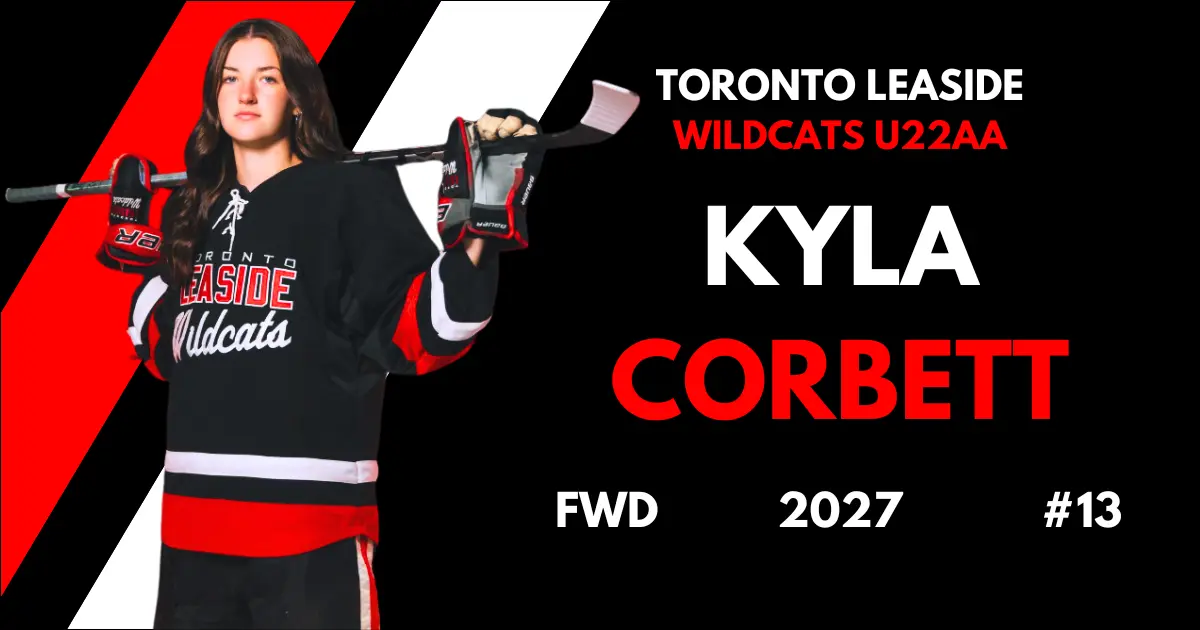
Kyla Corbett
Player Overview
Height
5’8″
Position
Forward
Shot
Left
Team
Toronto Leaside Wildcats U22AA
School
Mayfield Secondary School
Grad Class
2027
Programs of Interest
- Kinesiology
- Nursing
- Sports Medicine
Academic Record
Scouting Report
Defensive Zone
Key Strengths
- Check Connectivity: Kyla Corbett keeps her assignment in front of her throughout the shift, not just at the point of contact. As the puck moves, her feet adjust in sequence — small pivots, weight transfers, subtle angles — so her check never gets clean access to the inside without earning it through her.
- Weak-Side Mirror: Away from the puck, she tracks movement with her shoulders and hips rather than her eyes alone. Carriers looking to feed the weak-side seam find her already there — body angled, stick cutting the lane, feet set to absorb a cut rather than scrambling to cover one.
- Slot Anchoring: When the puck goes below the dots, she doesn't follow it mindlessly. She identifies the next threat, plants in the slot, and gives her defenseman a layered structure to work behind. The interior stays protected because she's already there, not because she reacted in time.
- Support Timing: Reading when to lean into a battle versus when to slide off the contact point and become a stabilizing presence is a genuine skill, and she does it naturally. She senses which battles her defenseman needs help finishing and which ones she should leave alone to stay connected to the next danger.
- Leverage Control: Her body angles are deliberate. She doesn't just close space — she closes it at a slant, using her hip and shoulder to steer opponents toward the wall rather than allowing them to cut back through the middle. Those subtle redirections take away options before they're attempted.
Areas to Refine
- Depth Management: There are moments when she drops a half-step too far tracking the puck low, which creates a gap between her and the slot that a quick outlet can exploit. Staying slightly shallower in those sequences keeps her connected to both the puck and the threat behind her.
- Weak-Side Release Timing: She mirrors well, but occasionally holds her weak-side position a beat too long when the puck is moving back up the wall. That delay pulls her out of the next assignment just as coverage is being redistributed.
- Gap Against Speed: Against forwards who attack quickly off the catch, her gap can open wider than intended. She reads the play correctly but closes at a pace that gives fast carriers a window to accelerate through before pressure fully lands.
Key Strengths
- Instinct-Driven Jumps: She no longer waits for confirmation before stepping. Loose touches, hesitant carriers, a puck that rattles off the boards — she's already moving before the opportunity fully presents itself, arriving with purpose rather than permission.
- Net-Front Physicality: The same strength that wins her wall battles translates directly into her net-front pressure. She uses her body to occupy space, stays square through contact, and forces carriers working the front of the net to deal with her before they deal with the puck.
- Short-Area Disruption: Her pressure isn't built on speed — it's built on compactness. She closes short distances explosively, gets into the carrier's hands fast, and forces rushed decisions before plays can find rhythm or structure.
- Wall Engagement: Along the boards, she doesn't wait for the puck to be pinned before committing. She reads the angle of the retrieve, times her approach to arrive as the carrier turns, and uses her strength to flatten possession rather than chase it.
- Possession Knockoff: When she engages, the effect is cumulative. Even when she doesn't come away with the puck on first contact, she disrupts the handle enough that the next touch is compromised — rushed, off the tape, or forced into a corner her teammates can capitalize on.
Areas to Refine
- Containment Default: There are still sequences where she reads the pressure opportunity correctly but defaults to containment rather than committing. That half-decision gives carriers just enough time to settle and move the puck before contact arrives.
- Approach Angle on Wide Carriers: When the puck is moving wide along the wall, her closing angle can drift too square. That lets carriers hold the puck to the outside and find a reverse rather than being steered into a dead end.
- Pressure Sequencing with Linemates: Her individual pressure is sound, but there are moments where she jumps without her linemates in position behind her. The pressure lands, but the coverage structure behind it isn't fully loaded, which can give opponents a clean outlet if she doesn't win it outright.
Key Strengths
- Lane Recognition: She reads shooting cues — shoulder load, blade angle, weight shift — and steps into the lane before the release is committed. That anticipation means she's closing space rather than reacting to a shot already in the air.
- Competitive Willingness: She doesn't flinch. Traffic in front, bodies around her, a shooter she knows is going to release — she holds her ground. That willingness to absorb is visible in how she positions herself in the final two seconds before a shot loads.
- Stick-First Coverage: Her stick deploys early in the sequence, taking away the ice-level lane before her body fully commits. That layered approach — stick cutting the low path, body handling the rest — limits tips and deflections even when she can't fully seal the shot.
- Recovery After Contact: When she blocks and the puck bounces loose, she doesn't stay down. Feet reset quickly, eyes find the puck, and she re-engages the play instead of clearing the crease. That follow-through prevents second shots from forming in uncontested space.
- Tracking Through Screens: She stays connected to the shooter through traffic in front. Rather than losing the release point behind a screen, she positions wide enough to keep the shooter in her sightline while still threatening the lane.
Areas to Refine
- Drop Mechanics: The instinct to block is there, but the execution of the drop itself needs work. She arrives upright too often, which narrows the lane instead of sealing it — pucks find gaps at her feet or slip through at the knees rather than dying on contact.
- Commit Timing: There are moments where her read is correct but her drop comes a fraction late. The shooter gets the release off clean because she committed just after the puck left the blade rather than just before.
- Lane Prioritization: When multiple shooting threats are present, she doesn't always select the most dangerous lane first. She commits to the first option shown rather than the highest-percentage shot, which can leave a cleaner look alive behind her decision.
Key Strengths
- Early Route Setting: She doesn't wait for chaos to find her spot. As the puck transitions to retrieval, she's already moving into the breakout lane — feet underneath her, body angled toward open ice — so her defenseman has a real option by the time possession is secured.
- Outlet Cleanliness: When she presents for the pass, she presents properly. Stick down, hips open, body moving through the lane rather than stopping to receive. That gives the puck carrier a target that's already in motion and doesn't require a perfect pass to connect.
- Carry Capacity: When the system calls for it, she has the skating strength and puck confidence to carry the puck out herself. She doesn't need to be told twice — reads the open lane, takes the puck with purpose, and gets her team across the line under control.
- Pressure Absorption on Retrieval: When she's the one retrieving, she gets her body between the puck and the forecheck immediately. She doesn't spin blindly — she absorbs the hit through her shoulder and keeps the puck on her stick rather than letting pressure knock possession loose.
- Connection After Exit: Once the puck leaves the zone, she doesn't disengage. She stays underneath the play through the neutral zone, keeps herself available as a secondary option, and helps the exit sequence connect into transition rather than stalling at the line.
Areas to Refine
- Release Timing: She occasionally holds the puck a beat longer than the breakout pattern requires, which allows the forecheck to reload and close lanes that were briefly open. The read is right — the release just needs to trust it sooner.
- Middle Exit Recognition: When the middle lane is briefly available during a breakout, she defaults to the wall. That habit keeps exits predictable and bypasses cleaner, faster routes up the ice that the structure occasionally presents.
- Recovery Depth After Turnover: If the exit attempt turns over, her recovery depth isn't always where it needs to be. She gets caught between the retrieval and the defensive reset, which can leave her group short one body in a critical moment.
Neutral Zone
Key Strengths
- Carry Authority: Kyla doesn't ask defenders permission to go north. She picks a lane, lowers her shoulder, and makes them deal with her weight behind the puck. Defenders who try to angle her off the play find out quickly that she's not going to redirect — she's going to make them pay for the gap they left.
- Puck Movement Reads: There's no ego in how she moves the puck through the middle third. When the pass is the right play, she makes it without hesitation — one look, clean release, play continues. She's not trying to beat anyone. She's trying to get the puck north, and she finds the fastest way to do it every time.
- Risk Calibration: Turnovers between the blue lines don't happen on her watch very often. She knows what she has and what she doesn't, and she plays accordingly. Forced seams, low-percentage carries, risky lateral passes — none of that finds its way into her game in the neutral zone because she's already ruled it out before the puck arrives.
- Strength Through Pressure: Stick checks, body bumps, defenders trying to slow her stride — she absorbs all of it and keeps moving. Her legs don't stop working when contact arrives. That's what separates her from forwards who look strong until someone actually hits them.
- Vision While Moving: Her head is never down between the blue lines. She's processing support positions, gaps in the defensive structure, and her next option while her feet are still driving. The read and the skate happen at the same time, which is why her decisions come out clean instead of rushed.
Areas to Refine
- Read and Go: She occasionally scans one option too many before committing, and the neutral zone doesn't give you that luxury. By the time the second look is done, the lane has tightened and she's playing catch-up. The first clean read needs to be enough.
- Speed Variation: She moves through the neutral zone at one tempo, and defenders pick it up fast. A sudden burst through an opening, a deliberate stutter before accelerating — anything that breaks the rhythm she's giving them would create separation that straight-line speed alone isn't generating.
- Wide Lane Usage: The middle of the ice is her default, and when the defence has collapsed inward it's the worst place to be. The wide lane is open in those moments and she's not using it. Getting outside would let her gain the zone cleanly instead of driving into a wall of sticks.
Key Strengths
- Puck Awareness on the Drop: The moment possession turns back, she's already sorting where the regroup needs her. She doesn't guess and drift — she reads the puck carrier's body, finds the right depth, and gets there before the outlet pass needs to happen. Her defenseman always has a real option.
- Motion Through Reception: She doesn't stop moving to catch the puck. Her route is timed so the pass meets her mid-stride, which means the forecheck is chasing a moving target instead of loading up on a player who's planted waiting to receive. That small detail changes how much pressure arrives on the catch.
- Support Presentation: Stick blade down, hips turned toward the puck, body already angled to receive and continue north — she makes herself an easy target to hit. Puck carriers under pressure need clean pictures, and she gives them one every time.
- Regroup Persistence: When the first connection doesn't happen, she doesn't drift out of the play. She curls, resets her route, and shows up again. Regroups that should die get a second life because she refuses to accept the first breakdown as final.
- Advance off the Catch: The regroup isn't a pause for her — it's a launch point. One touch to settle, eyes already up, and the puck is moving forward before the forecheck can reset. She treats possession in the regroup as the beginning of the attack, not the end of the retreat.
Areas to Refine
- Early Drift Up Ice: She releases north before the regroup has settled, and the timing costs her team an option at the worst moment. The puck carrier needs her connected just a beat longer. Dropping slightly lower and holding her position until possession is secure keeps her in the play instead of ahead of it.
- Speed Into the Regroup: She slows down as she drops into the outlet lane, and the forecheck reads it immediately. A decelerating target is an easy target. Keeping her feet moving through the drop makes the pass easier to complete and harder to jump.
- Verbal Engagement: She does the positional work but doesn't back it up with her voice. Calling for the puck — letting her teammate know she's there and ready — takes the guesswork out of a split-second decision under pressure. Her movement is good enough. Her voice needs to match it.
Key Strengths
- Regroup Reading: She doesn't watch the puck in opposing regroups — she watches the people moving it. The setter's shoulders, the swing man's speed, the timing of the first outlet touch. By the time the pass leaves the blade, she already knows where it's going and her feet are already moving to meet it.
- Lane Interception Timing: The jump happens at exactly the right moment — late enough that the puck carrier has committed, early enough that the lane hasn't closed. That timing is what turns her neutral-zone reads into live turnovers instead of near-misses that the opponent recovers from.
- Physical Presence Factor: She doesn't have to win every puck battle in the neutral zone to affect the game. Opponents who know she's there make worse decisions — quicker releases, tighter touches, earlier commitments. Her presence alone narrows the options available to teams trying to move through the middle against her.
- First-Checker Commitment: When neutral-zone pressure belongs to her, she brings everything. No half-close, no containment when a real check is available. She gets into the carrier's space with her full weight behind the decision, and the puck carrier has to answer for it.
- Turnover to Attack: She doesn't admire the turnover after she creates it. The puck changes hands and she's already moving toward the entry — which means she's a threat in the attacking sequence she just started, not a spectator watching her linemates go without her.
Areas to Refine
- Outlet Jump Timing: Her pressure angle runs too straight at the carrier, which leaves the escape lane to the outside alive. An inside-out route removes that option entirely and funnels the play toward her support rather than letting the carrier drift wide and reset.
- Pressure Support Awareness: There are moments where she commits to pressure without a clear picture of who's behind her. When she doesn't come away with the puck, the space she just vacated becomes available. A quick check of her support structure before the jump keeps the group connected through her pressure.
- Swing Pass Timing: Fast regroups catch her a half-beat late. The puck moves before her jump is fully committed, and the window closes. Reading the trigger earlier — the setter loading weight, the carrier's first stride — would get her into the lane before the release rather than just after it.
Key Strengths
- Net-Drive as F2: Give her the inside lane and she's going straight to the net. No hesitation, no detour. Defenders have to choose between staying with her or protecting the slot, and either answer creates a problem for the goalie. She makes that decision uncomfortable every time she's in the role.
- Possession Extension as F3: When she arrives as the third forward, the play gets a longer life. She catches pucks behind the initial wave, absorbs pressure without surrendering possession, and buys her linemates the time they need to establish themselves in the zone. Late entries don't die with her involved.
- Zone Entry Speed: The blue line doesn't slow her down. Her stride stays loaded through contact at the line, and defenders who try to body her off the entry find themselves giving ground instead of taking it. She gets her team into the zone with the puck because she physically refuses to be stopped at the boundary.
- Entry Read: The defensive alignment is already sorted before she hits the line. She knows whether she's taking the middle, curling wide, or holding at the top — and that decision was made with enough time that the entry flows rather than stalls while she figures it out under pressure.
- Net-Drive Impact: When she gets to the front of the net at speed, the goalie's job gets harder and the defenders' jobs get messier. Sightlines disappear, positioning breaks down, and the loose pucks that come from that chaos find open ice because she pulled the coverage to her on the way in.
Areas to Refine
- Calling for Pucks: She earns open ice in the attacking zone more often than she gets the puck there. Linemates aren't finding her because she's not telling them where she is. Calling for the puck when she has position — especially as F3 or in the slot — keeps her involved instead of invisible.
- F2 vs. F3 Decision Speed: There's a moment in some entries where her role in the sequence hasn't been declared, and the attack stutters while it waits for her to commit. Settling that read — drive or support — a beat earlier removes the hesitation and keeps the entry sharp from the line in.
- Entry Patience: When the rush isn't fully loaded, she sometimes forces the issue at the blue line rather than pulling up and holding the defence in place. A controlled delay at the top buys her linemates time to get into position and turns a rushed entry into a controlled one.
Offensive Zone
Key Strengths
- Perimeter Control: She doesn't just survive pressure along the boards — she uses it. When defenders close, she leans into her frame, gets her body between the puck and the check, and turns the contact into dead space around the puck. The battle doesn't become a turnover because she's already absorbed the hit before it can knock possession loose.
- Territory Recognition: When defenders give her room, she takes it immediately. She reads the gap, moves into the space, and starts building the next action before the defence can recover and close. She doesn't wait for permission to claim ice — she just claims it.
- Patience Down Low: Working the puck behind the net, she keeps her head up and her hands quiet. Pressure arrives from multiple angles down there and she handles it without rushing — scanning, adjusting her body angle, and moving the puck when the right option shows itself rather than the first one.
- Contact into Opportunity: She has learned to turn defensive pressure into offensive advantage. A defender leaning hard into her hip creates space on the other side, and she reads it. That ability to flip the script on physical pressure is what separates a wall battler from a possession player, and she's crossed that line.
- Puck Protection Under Pressure: When support is slow arriving and pressure is stacking up around her, she doesn't force the puck away. She stays low, tightens her grip on possession, and holds until a real option opens. Turnovers in tight areas don't come from panic — and she doesn't panic.
Areas to Refine
- Escape Mobility: She preserves possession well but doesn't always find a way out of it. Rolling off contact, spinning into open ice, staying in motion after absorbing pressure — those escapes would turn static holds into live possessions that push the attack forward instead of stalling it.
- Head Up Under Pressure: When defenders are on her quickly, her scanning tightens. She locks into protecting the puck rather than reading what's developing around her, which delays the next action and gives the defence time to load more pressure before she moves it.
- Net-Line Aggression: She holds possession well below the dots but doesn't consistently challenge defenders by driving the puck closer to the net. Pushing that boundary — even half a stride — pulls coverage tighter and creates more dangerous options for the players arriving behind her.
Key Strengths
- Net-Front Disruption: She makes life difficult at the blue paint without the puck anywhere near her. Sticks get tied up, defenders get dragged out of position, and the goalie's sightlines disappear. None of it requires a pass to find her — she creates chaos at the net just by being there and refusing to be moved.
- Crease-to-Pocket Movement: She doesn't stay in one place long enough to be accounted for. One moment she's in the crease creating contact, the next she's slipped into a scoring pocket five feet away. That movement forces defenders to choose between tracking her and protecting the slot, and there's no clean answer to either option.
- Backdoor Awareness: She reads when her presence at net-front has pulled enough attention to open the back side of the ice. When that lane appears, she gets there quietly — no sprint, no telegraphing — and arrives in position for a quick-strike chance before the defence has time to rotate.
- Net-Front Discipline: She ties up sticks and occupies bodies with purpose, not just aggression. The contact she initiates in front of the net is calculated — enough to disrupt without taking herself out of a scoring position. She stays upright, stays engaged, and stays dangerous.
- Soft Ice Recognition: When the play bogs down along the wall and defenders are stacked in physical areas, she finds the soft ice in the middle of the zone. That movement gives her linemates an outlet, resets the attack, and puts her in position to receive a quick-strike pass in space rather than fighting for the puck in traffic.
Areas to Refine
- High Lane Creation: When the puck moves to her side of the rink, she stays close to the action rather than climbing higher to create distance from the traffic. Getting above the dots in those moments gives her more time and space to get a shot off — and her shot from that range is a real threat that the defence isn't currently being asked to respect.
- Timing of Crease Exits: She commits to net-front work fully, but doesn't always read the moment to leave it. Staying in the crease a beat too long after the puck has moved away from the net pulls her out of the next scoring position and leaves soft ice unclaimed.
- Weak-Side Anticipation: On shots from the point, she positions well on the strong side but doesn't consistently get to the weak-side rebound position. Pucks that deflect across the crease find open ice because she's still working the side the shot came from.
Key Strengths
- Tight Corridor Passing: Below the dots and along the walls, she moves the puck in spaces where most forwards are just trying to survive. A quick slip pass through a defender's skates, a touch into a seam that opens for half a second — she finds those plays because she's comfortable in tight areas and doesn't need wide open ice to execute.
- Wait and Release: She doesn't move the puck the moment she feels contact. She holds, lets the pressure commit fully, and releases once the lane has opened on the other side of the check. That patience turns defensive pressure into offensive geometry — the harder they come, the more space appears for her linemates.
- Drives Through Contact: When passing lanes are closed and the play needs forward momentum, she puts her head down and drives through a defender's reach rather than waiting for a cleaner option. That willingness to make something happen physically keeps cycles alive when the puck would otherwise die.
- Cycle Feed Timing: She reads where her linemate is going to be, not where they are. Her passes arrive as players are arriving into position, which means the next action can happen immediately rather than requiring an extra touch to get organised. That timing keeps the cycle moving rather than stalling between connections.
- Compression Creation: When she drives defenders into tight spaces below the dots, the ice opens up above her. She reads that and moves the puck into it — a quick touch to the high player, a feed to the slot — converting the physical work she's done below into a threat above. That chain of actions is where her playmaking pays off most.
Areas to Refine
- East-West Range: Her playmaking lives in tight, direct corridors and doesn't extend much across the offensive zone. Developing confidence in wider passes — cross-ice feeds, weak-side connections — would make her harder to contain because defenders couldn't simply load to one side of her.
- Deception Before Release: Her passes are accurate and well-timed, but her intentions are readable. Eyes and shoulders telegraph the target before the puck moves, which gives defenders just enough notice to adjust. Adding a look away before the real pass would close that window.
- Possession Restart: When the cycle pauses and the puck sits still, she waits for it to move rather than driving the next action herself. Taking ownership of those stalled moments — demanding the puck, making a move, forcing the defence to react — would keep possessions from losing momentum between touches.
Key Strengths
- Scramble Finishing: Her goals don't come from clean looks — they come from staying alive in the mess. Rebounds off pads, loose pucks in the crease, deflections through traffic — she's there for all of it because she never leaves the front of the net when the sequence gets ugly. That presence turns broken plays into finished ones.
- Quick Release in Range: When the puck lands in her scoring area, it doesn't stay there long. She gets it off her blade fast — minimal load, compact motion — before the window can close around her. In heavy areas of the ice where defenders are closing from multiple directions, that release speed is the difference between a shot and a blocked attempt.
- Drives to the Net: She doesn't wait for chances to find her — she goes and gets them. Driving inside, drawing defenders, taking contact on the way to the net — those actions produce the opportunities she converts. The goal often starts three seconds before the shot, and she's the one who initiated the sequence.
- Persistence Around the Crease: After the first shot, she stays engaged. She tracks where pucks are going to bounce, holds her position through contact, and gives herself a second and third chance at pucks that most forwards have already given up on. That persistence turns single scoring opportunities into extended threats.
- Depth Finishing: She provides the kind of scoring that doesn't show up in highlight packages but shows up in tight game results. Physical games, heavy shifts, moments where skill alone can't break through — she finds ways to finish in exactly those situations, which gives her team a threat that doesn't disappear when the game gets hard.
Areas to Refine
- Scoring Pocket Assertiveness: There are moments where she's in or near a prime scoring position and doesn't demand the puck. She lets the play develop around her instead of making herself the next option. Calling for the puck and being ready to release in those pockets would put her shooting range to better use.
- Shot Selection from Distance: When she does shoot from outside her natural range, the attempt rarely troubles the goalie. Recognising earlier which looks are worth taking and which ones are better turned into a pass would keep possession alive rather than trading it for a low-percentage attempt.
- Anticipation on Point Shots: She times her net-front position well for loose pucks, but her read on point shots arriving through traffic can be late. Getting set a half-beat earlier — before the shot releases rather than after — would put her in the right spot for deflections and rebounds instead of arriving just after the puck has gone by.
Technical Skills
Key Strengths
- Closing Angles: She doesn't close straight — she closes with her body angled to cut off the lane, arriving in a position that removes the carrier's options rather than just reducing them.
- Contact Stride: Through the neutral zone, her stride doesn't break down when defenders make contact. She absorbs the bump, keeps her legs driving, and comes out the other side still in control of the puck. That ability to carry through pressure rather than around it is why separating her from possession is harder than it looks.
- Small Area Skating: On the penalty kill and in tight defensive sequences, she doesn't need a running start to be effective. Her edges give her bite in small spaces — quick pivots, sharp cuts, lateral steps that close lanes without requiring her to fully open her stride. Those moments don't show up in a speed reading, but they show up in the outcome of shifts.
- Net-Front Stability: Once she's established position in front of the net, her skating keeps her there. She shifts laterally to stay between the defender and the puck, uses her edges to absorb pushes without losing her footing, and stays difficult to move even when contact arrives from awkward angles. Her base stays low and her feet never stop working.
- Power Base: The foundation of her stride is built on genuine lower-body strength, and it shows in how she handles pucks under pressure. Defenders who try to angle her off the puck find that she doesn't redirect easily — she plants, drives back into the play, and makes them pay for the gap they thought they had.
Areas to Refine
- Top-End Separation: When she needs to create distance from a defender in open ice, her top-end speed doesn't always deliver the burst she's looking for. She gets there, but not always with enough margin to make the play before pressure arrives on her heels.
- Stride Extension: Her stride length sits shorter than her frame suggests it should. More extension through the push phase would generate more ground per stride without requiring additional effort — a mechanical adjustment that would show up immediately in how much space she covers between blue lines.
- Escape Quickness: When pressure traps her along the wall or in a corner, her first step out of contact is functional but not sharp. Getting that first stride quicker — not the skating itself, just the initial push — would give her more separation before defenders can reload.
Key Strengths
- Clean First Touch: When pucks arrive in difficult situations — bad bounces, passes through traffic, catches made under a forecheck — they settle. Her hands absorb the delivery, get the puck under control quickly, and move into the next action without the extra touch that gives defenders time to close.
- Hands in Stride: She doesn't need to stop moving to control the puck. Through the neutral zone and off regroups, she catches passes in stride and keeps her feet driving without needing to reset. That continuity keeps transitions moving and prevents the forecheck from collapsing on a stationary target.
- Wall and Corner Work: Down low, her hands do specific, unglamorous work. Stick lifts, puck pulls from skates, pins along the boards — she earns possession in tight areas through technique rather than reach. Those details repeat shift after shift and keep possession alive in spots where most forwards just chip and chase.
- Body-First Protection: Her hands stay close and her body leads. When contact arrives, she uses her frame to shield possession rather than relying on her stick alone, which keeps the puck on the safe side and forces defenders to go through her to get it. Separation doesn't happen without earning it.
- Net-Front Hands: Around the crease, her hands speed up. Loose pucks don't sit long. She finds them, pulls them into a shooting position, and gets the shot away before defenders can reset their feet. That quickness in tight spaces is where her stickhandling converts directly into goals.
Areas to Refine
- Open Ice Creativity: Her hands are built for contact and traffic, and they show it. In open ice, when time and space exist to make a more complex play, her handle stays conservative. Expanding what she does with the puck when defenders aren't immediately on her would make her harder to read and defend.
- One-on-One Evasion: When a defender cuts her off in space and the play turns into a direct one-on-one, her handle doesn't generate much deception. She tends to protect the puck and wait for support rather than using her hands to create a lane out of the confrontation.
- Weak-Side Touch: When the puck arrives on her off side in tight situations, the first touch isn't always as clean. She manages it, but the extra adjustment required slows down what comes next and gives pressure an extra half-second to arrive before she's ready to move it.
Key Strengths
- Early Decision Making: The option is chosen before the pass happens. Her head comes up, the read gets made, and by the time the puck arrives her mind is already on the release. That sequence keeps pressure from catching her mid-decision and ensures passes come out on time rather than a beat late.
- Passing in Stride: Most of her passes come with her skating still active. She doesn't plant to deliver — she passes out of motion, which shortens the window defenders have to step into lanes and keeps the sequence moving rather than pausing to allow coverage to reset around her.
- Outlet Reliability: Under pressure, she doesn't force seams that aren't there. When the first look is covered, she finds the safe option — a puck to open ice, a short wall pass, a touch that protects possession and resets the play. That reliability keeps her line out of trouble and gives her team something to build off rather than chasing a turnover.
- Below the Goal Line Feeds: From behind the net, her passes find linemates arriving in motion. Quick dishes to the side of the net, feeds into the slot, short plays that pull coverage just enough to crack the structure — she reads when those options appear and delivers them before the window closes.
- Possession-First Intent: She passes to keep things moving, not to make something happen. That distinction matters. Her passes don't force the play into danger — they extend possession, reset spacing, and let the attack build on her terms rather than forcing her linemates into difficult situations to receive.
Areas to Refine
- Seam Passing Range: Her passing success lives in short to mid-range connections. Longer cross-ice passes and seam feeds through the neutral zone appear infrequently, and when they do arrive the accuracy drops. Building that range would give her a tool she currently doesn't reach for even when it's the best option available.
- Pass Disguise: Her eyes go to the target early and stay there through the release. Defenders with good reads pick up on that pattern and slide into lanes before the puck arrives. A look away before the real pass would keep coverage honest and open up options that currently close before she gets there.
- Give-and-Go Execution: She sets up give-and-go plays along the wall and below the dots, but doesn't always complete the second half. After moving the puck, she doesn't consistently drive into the return lane — the give happens, the go doesn't, and the sequence stalls where it should accelerate.
Key Strengths
- Slap Shot Weight: When she gets her slap shot away, goalies have to handle it — not absorb it. It comes off heavy and clean, with enough pace that it forces a real save rather than a routine stop. She doesn't go to it often, but when she does the ice in front of her changes. Defenders respect it, and goalies know it's coming with something behind it.
- Wrist Shot Accuracy: Her wrist shot hits spots. Short side, far corner, low blocker — the placement is intentional and it shows in how often her attempts find the areas goalies protect most. The power is there too, but it's the accuracy that makes it a real scoring tool rather than just a shot that reaches the net.
- Release off Movement: When she shoots off motion — a give-and-go, a puck arriving on her strong side in stride — the release comes up fast. There's no pause to load, no windup that tips off the timing. The shot is away before defenders have fully committed, which is exactly when it needs to happen.
- Snap Shot Comfort: In tight areas and off quick puck movements, her snap shot gives her a release option that doesn't require setup. It's not a power play weapon — it's a shift play, a net-front touch, a quick chance before defenders can recover. That short, compact release creates goals in the areas where she does her best work.
- One-Timer Capability: Full windup, puck arriving on her strong side — she can let it go. The power and release speed combine naturally in that motion, and it's a weapon that fits her game without requiring her to change what she does. Defenders who cheat to stop the pass leave her with a clean one-time look she can punish.
Areas to Refine
- Release Timing: She holds the puck a beat too long in certain situations, and the space she had when the shot was available disappears before she pulls the trigger. The ability is there — the decision to use it just needs to come sooner, before sticks arrive and lanes close.
- Off-Side Delivery: When the puck arrives on her off side, the release slows down. The adjustment takes a moment, and that moment is enough for defenders to close the gap. Cleaning up that catch-and-release sequence on her weak side would add a shooting option she currently can't access at full speed.
- Shot Selection Under Fatigue: Late in shifts, her shot selection loosens. Attempts come from angles and distances that don't match what she's capable of earlier in the same shift. Tightening that standard — same looks, same range, same situations — regardless of where she is in the shift would keep her shooting percentage honest.
Situational Play
Key Strengths
- Knows Her Job: Before the puck drops, she's already sorted her assignment. Breakout support, defensive-zone coverage, net drive on entry — she doesn't need the play to develop before she knows where she belongs in it. That clarity puts her in the right place before anyone has to find her.
- Finishes Her Check: She doesn't leave assignments half-done. When a check is hers to make, she completes it — full contact, full follow-through — rather than drifting toward the next play before the current one is resolved. That habit prevents the loose ends that turn into second chances against her group.
- Simple Play Execution: When the system calls for a simple play, she makes it without trying to improve it. A wall support becomes a wall support, not an attempted carry. A rim becomes a rim, not a forced seam. That restraint keeps her group connected and prevents breakdowns that start with one player trying to do too much.
- Reloads Between Plays: After each action — a pass, a check, a retrieval — she resets her feet and finds her next assignment without waiting to be directed. Shifts don't have dead moments with her on the ice because she's always moving toward the next responsibility rather than standing still between them.
- Adapt Shift-to-Shift: When the coach changes a breakout pattern or adjusts a defensive-zone assignment mid-game, she picks it up and executes it cleanly. She doesn't need repetition to implement a change — she applies it the next time the situation presents itself and doesn't revert to old habits under pressure.
Areas to Refine
- Broken Play Ownership: When the system breaks down and the play goes off-script, she retreats into structure rather than deciding the moment. There are sequences where taking ownership of the disorder — making a play, forcing a turnover, driving the puck north — would serve the group better than waiting for shape to return.
- Early Shape Setting: She fills her assignment correctly, but doesn't always set the shape of the play before it develops. Arriving at her spot a beat earlier — before coverage locks in, before pressure loads — would let her influence how the sequence unfolds rather than simply executing within it.
- Verbal Organization: She communicates through her positioning but rarely with her voice. Calling out coverage, confirming assignments, directing linemates into position — that layer of verbal organization would accelerate how quickly the system locks in and reduce the guesswork that slows sequences down.
Key Strengths
- First to the Paint: She takes net-front position before defenders are set and holds it through everything they send her way. Cross-checks, pushes, repeated contact from behind — none of it moves her. The goalie behind her is working without a clean sightline for as long as she's there, which is as long as the puck stays in the zone.
- Dirty Area Finishing: Clean looks don't find her often in front of the net, and she doesn't wait for them. Deflections off her shin, tips through traffic, scramble finishes on pucks that bounce off pads and skates — she converts in situations most forwards have already written off as unfinished chances.
- Rebound Tracking: When a shot goes to the net, her eyes go with it. She reads the angle off the goalie, anticipates where the puck is heading, and gets her stick there before the defence can clear it or the goalie can smother it. First touch on rebounds belongs to her more often than not.
- Draws Coverage: She keeps defenders occupied without the puck anywhere near her. Two bodies committed to moving her off the front of the net means two fewer defenders available to block shots or collapse passing lanes. The open ice her unit finds on the perimeter exists because she's making life difficult thirty feet away.
- Takes the Hit: The contact she absorbs in front of the net would move most forwards out of position. She stays upright through it, keeps her feet under her, and remains a threat even after repeated physical attention. Defenders who make moving her their priority find out it costs them more than it costs her.
Areas to Refine
- Perimeter Shooting: When the puck finds her on the half wall with a shooting lane available, she moves it instead of loading the shot. Defenders know it and stay compact because she hasn't made them respect her from distance. One hard look from the perimeter changes that calculation and opens the net-front space she fights for every shift.
- Ready to Shoot: When a pass finds her in front with time and space, the blade isn't always set. The opportunity is there but the shot takes an extra beat to organize, which is all defenders need to close the lane and goalies need to reset their positioning. Blade down before the pass arrives — that's the fix.
- Early Unit Involvement: She's a force once the power play is established, but her involvement in the early touches of a possession is limited. Getting connected to the first and second pass — showing as an option before she drives the net — would make her harder to ignore from the opening seconds of the man advantage.
Key Strengths
- Inside Ice Control: The middle of the ice belongs to her on the penalty kill. She plants between puck and net, cuts seams with her stick, and absorbs contact without surrendering position. Opponents who try to work through the middle against her find a wall that doesn't move and eventually stop looking for that route.
- Hard Clears: When the puck is hers to move, it leaves the zone with conviction. No soft chips along the wall, no hopeful rims that give the power play unit an easy retrieval. She puts pace and purpose behind every clear, giving her team enough time to regroup and reset before the next wave comes.
- Ties It Up: When a clean clear isn't available and pressure is stacking up around her, she doesn't force a bad play. She gets her body on the puck carrier, ties up sticks and arms, and holds until the whistle. That decision — absorb rather than gamble — prevents the desperate clears that turn into two-on-ones going the other way.
- Closing Route: She doesn't close straight at puck carriers. Her approach runs inside-out, cutting the escape lane toward the middle before contact arrives. That angle funnels play toward the boards and toward her support, removing the option that most penalty killers leave alive by closing too square.
- Wears Them Down: Power play units that go up against her for a full game feel it by the third period. The accumulated contact, the denied touches, the disrupted timing — it doesn't show up in the box score but it shows up in how the opposition's power play starts second-guessing its own patience against her.
Areas to Refine
- Gap Before Commitment: She reads pressure opportunities correctly but occasionally jumps before the gap has fully closed. That extra half-stride of distance gives the puck carrier time to move the puck before contact arrives, and the space she vacates becomes available to the first outlet her partner hasn't covered.
- Finish the Block: When shots load in front of her, she narrows the lane with her stick and body but doesn't always fully commit to the drop. The shooter gets the puck away through a gap at her feet or knees that a complete block would have eliminated. The read is right — the finish needs to match it.
- Weak-Side Recovery: After a clear or a tie-up, her recovery to weak-side coverage can lag. She resets to her primary position first, which leaves the back door available for an extra beat longer than her partner expects. Getting to the weak side faster after possession resolves would keep the structure intact through the transition.
Key Strengths
- Force When It's Time: She reads the moments when the game needs a physical answer and delivers without deliberating. Late periods, close scores, shifts where the other team has built momentum — she doesn't wait for permission to change the tone. The decision happens fast and the response is full.
- Territory Protection: When a specific piece of ice needs to be owned, she owns it and makes the cost of taking it higher than most opponents want to pay. Net-front on the power play, the corner on a defensive-zone draw, the slot in the final two minutes — she identifies what matters in the moment and refuses to surrender it.
- Late Game Reliability: The final minutes of close games don't tighten her up — they sharpen her. Decisions get simpler, physicality stays consistent, and she executes what the moment requires without adding anything it doesn't need. Coaches put her on the ice in those situations because they know exactly what they're getting.
- Reads the Swing: When momentum shifts in her team's favour — a big stop, a momentum hit, a sequence that changes the emotional current of the game — she reads it immediately and stays locked into the shift rather than coasting on it. Her team gets the full benefit of the swing because she doesn't let it dissipate.
- Play Ending: She knows when a sequence needs to stop rather than continue and she stops it. A hard finish on a puck carrier, a battle at the net that results in a whistle, a clear that gets the puck out of danger — she makes those plays decisively when the game calls for them and doesn't look for a more elegant option that isn't there.
Areas to Refine
- First Battle Sets the Tone: Her dominant game builds through a shift rather than arriving at the opening whistle. The first contested puck, the first net-front battle, the first close — those are the moments that set the terms for everything that follows. Getting to that register from the first touch would give her team the full weight of her game immediately rather than waiting for it to find its level.
- Knows When to Change Pace: Her game operates in one register — physical, direct, forceful — and she stays there even when the moment is asking for something different. A soft pass that catches a defender flat-footed, a change of pace that creates a step — those plays exist inside her game but don't come out often enough to keep opponents honest.
- Trust Yourself: In tight games where the margin is thin, she manages the situation rather than imposing herself on it. The physical tools to tip those games are already in her hands — the next step is reaching for them instead of protecting what's there. One decision to dominate rather than manage can change the outcome of a game she's been in control of all night.
Mental Game
Key Strengths
- Sees It Early: She reads trouble before it fully forms. A coverage gap opening behind a pinching defender, a forecheck about to collapse into her zone, a puck carrier about to turn it over along the wall — she identifies those situations while they're still developing and moves before anyone around her has processed what's coming.
- Game State Awareness: The scoreboard and clock shape every decision she makes. Tight game late, she simplifies and protects. Time and space available with the game open, she pushes. Those adjustments happen without instruction and without delay, which means her decisions stay aligned with what the game actually needs from her at that moment.
- Reads the Match-Up: She tracks who's across from her and adjusts accordingly. A defender who's been on the ice for two minutes gets pressured differently than a fresh pair. A weak-side forward who doesn't commit to backchecks gets identified and used. Those reads happen shift to shift and show up directly in her route choices and where she puts the puck.
- Knows When to Attack: A loose puck with defenders caught recovering gets pushed immediately. A contested retrieval in her own end with pressure arriving from two directions gets managed and simplified. She reads which phase the play is in and matches her decision to it — which is why her game rarely produces the forced plays that come from misreading the moment.
- Off-Puck Positioning: Without the puck on her stick, she stays connected to where it's going rather than where it is. She adjusts her position based on the next phase of the play, arrives in the right spot without sprinting to catch up, and stays relevant in sequences where most forwards drift out of the picture entirely.
Areas to Refine
- Read and React: Her reads arrive on time but her response occasionally doesn't match them. The decision is right — it just needs to come out faster. At higher levels the window between a correct read and a closed opportunity shrinks, and that half-second gap between recognizing and acting is where good hockey sense stops translating into good plays.
- Use What You See: She identifies what defenders are going to do before they do it, but doesn't consistently weaponize that information. A look away, a hesitation, a false weight shift — using what she's already read to move a defender before committing would turn correct reads into exploited advantages rather than simply avoided mistakes.
- Talk Through the Play: Her awareness stays internal. She processes what's developing, adjusts her own positioning, and makes the right play — but the linemates around her don't benefit from what she's seeing. Vocalizing reads early would extend her hockey sense into the group rather than keeping it contained to her own game.
Key Strengths
- Shift-to-Shift Standard: Her compete level doesn't move. First shift of the game, last shift of the third period — the standard is identical. Coaches know exactly what they're deploying every time she goes over the boards, which makes her one of the easiest decisions on the bench regardless of game state or score.
- Hard Assignment Acceptance: Difficult matchups don't change how she approaches her game. Facing the opposition's top line, taking a defensive-zone draw late in a close game, covering the best forward on the other team — she accepts those responsibilities without adjusting her standard downward to account for the difficulty. The work just looks different depending on the assignment.
- Through the Contact: Physical sequences don't end her involvement in a play. A hit along the wall and she's back in the battle before the puck settles. A contested net-front situation and she stays engaged through repeated contact rather than drifting to easier ice. That persistence through physicality makes her difficult to move off her game regardless of what opponents bring.
- Compete Travels With Her: She doesn't save her physical game for one end of the rink. The same urgency she brings to defensive battles shows up in front of the net offensively, in corner fights below the dots, and along the walls in the attacking zone. Opponents have to deal with her compete in both directions, every shift.
- Hard to Wear Down: Shift after shift of denied touches, contested ice, and physical engagement accumulates. By the third period opponents are operating with less room and less time than they had in the first. That kind of compete doesn't make highlight packages — it changes outcomes in games where margins are thin and physical attrition decides who walks away with the result.
Areas to Refine
- Opening Shift Assertion: Her compete finds its full level as the game develops rather than arriving from the opening puck drop. The first contested battle — the first close, the first corner fight — is where that standard needs to show up immediately. Setting the physical terms early forces opponents to answer a question they weren't prepared for at puck drop.
- Separation in Battles: She stays in physical battles longer than most forwards at this level but doesn't always come away with the puck when they end. Winning the fight and winning the possession aren't always the same thing. Closing that gap would turn competed battles into recovered pucks rather than prolonged physical exchanges that end in a chip and a chase.
- Backcheck Finish: Her backchecks are committed and direct but don't always complete all the way through the defensive zone. She covers the route and removes the immediate threat, then peels off before the play is fully resolved. Finishing all the way through — staying connected until possession is secured — eliminates the second opportunities that form after incomplete defensive sequences.
Key Strengths
- Nothing Changes After Mistakes: When something goes wrong, the outside doesn't show it. Head stays up, shoulders stay square, and her next shift starts from exactly the same place as every other one. Teammates aren't managing her reaction on top of their own game, which keeps the group's attention forward rather than sideways.
- No Retaliation: Hard hits, physical confrontations, opponents who play on the edge of the rulebook — none of it pulls her into a response that costs her team. She processes the contact and moves forward. That discipline has kept her out of situations that would put her team a player short when the result is on the line.
- Loves to Compete: She plays with visible enjoyment — it shows in how she skates into battles and how she stays engaged through difficult shifts — but that enjoyment never loosens her execution. The fun doesn't come at the expense of her decisions. She respects the game enough to keep both present simultaneously, which is a balance most players at this level are still working to find.
- Unfazed by the Moment: Hostile buildings, tight scores, shifts where everything is going wrong at once — none of it changes the quality or pace of her decisions. External pressure doesn't accelerate her game or push her toward choices she wouldn't make in a neutral situation. She functions at her standard when everything around her is trying to knock it off course.
- Channel the Moment: Big stops, momentum hits, sequences that swing the emotional current of the game — she reads those moments and lets controlled intensity rise with them rather than holding everything at the same level. That ability to shift into a higher register when the game is asking for it gives her bench something to follow when the shift matters most.
Areas to Refine
- After-the-Whistle Presence: She disengages cleanly after every whistle, which protects her team from penalties, but she doesn't use those moments to establish herself physically in contested areas or communicate with linemates. A position held, a word exchanged, a presence asserted — small actions after the play that extend her impact beyond live action.
- Visible Intensity: Her emotional control is genuine and consistent, but from the outside it can read as disengaged during stretches where the group needs visible leadership. Not emotion — just edge. Letting that controlled intensity show in her body language during difficult moments would give her bench something to feed off rather than a steady presence that stays quiet when the game gets loud.
- Bench Presence Between Shifts: On the bench between shifts, her demeanour stays level — which is a strength — but it doesn't extend into active engagement with what's happening on the ice. Tracking the play, identifying what's coming, staying locked in visibly — that between-shift presence would keep her preparation sharp and signal to her coaches that she's ready the moment her number is called.
Key Strengths
- Mistakes Stay Contained: Errors end when they happen. A missed assignment, a turnover, a chance that doesn't convert — none of it travels into the next sequence. The mistake belongs to the play it happened in and nothing else. Her next touch and her next decision start from a clean slate regardless of what just occurred.
- No Pressing After Errors: When something goes wrong, she doesn't reach for a big play to compensate. Her next decision stays inside the game structure — the right read, the right route, the right play — rather than a forced attempt to balance the ledger. That discipline prevents the compounding mistakes that turn one error into a long stretch of defensive time.
- Opponents Get Nothing: There's no visible frustration, no change in how she carries herself, no pressing that tells opponents they've knocked her off course. They expect to find an opening after a mistake and find instead the same forward they were dealing with before it happened. That denial of psychological information removes the leverage that errors often hand to the opposition.
- No Redemption Instinct: Her next action after a mistake is whatever the game is asking for — not whatever she needs emotionally to feel even. She doesn't hunt for a defining play to cancel out what went wrong. That absence of redemption-seeking is what keeps single mistakes from turning into sequences of forced plays driven by emotion rather than reads.
- Shift Separation: Each deployment starts completely clean. A long defensive sequence, a physical shift that went against her, a period where nothing connected — none of that shows up in how the next shift begins. The ability to close one shift fully before the next one opens is what keeps her game from eroding over the course of a full forty minutes.
Areas to Refine
- Build on Good Shifts: She resets negatives cleanly and returns to her baseline every time. What she doesn't do as consistently is press forward off strong shifts. A good sequence, a battle won, a shift where everything connected — those carry momentum that can be pushed rather than simply maintained. Treating positive runs with the same intention she brings to recovering from mistakes would let her game compound in the right direction.
- Reset and Attack: The reset brings her back to her standard, which is reliable and consistent. What it doesn't always produce is a forward who comes back from a mistake in an assertive state rather than a neutral one. The next step after a reset can be more than returning to baseline — it can be a statement that the mistake is behind her and she's taking the game back.
- Lead the Reset: She moves through her own reset quickly and cleanly but doesn't consistently bring her linemates through the same process. After a breakdown, a word, a gesture, a moment of direction — extending her reset ability into the group around her would stabilize the line rather than just herself, which is where her mental game starts to become a leadership asset rather than a personal one.
Frequently Asked Questions
- Kyla plans to pursue a career in health care as a paramedic or nurse. She also intends to stay involved in the game by coaching when her playing days are done.
- Outside of hockey, Kyla plays rugby and flag football, works out regularly, and spends time with her family and friends.
- Kyla trains within her team environment under James Roxborough. She also follows a strength and conditioning program designed specifically for her development.
- Coaches should know Kyla volunteers at an animal shelter, participates in school activities like the Mavericks Athletic Association, and helps coach her brother’s U9 hockey team.