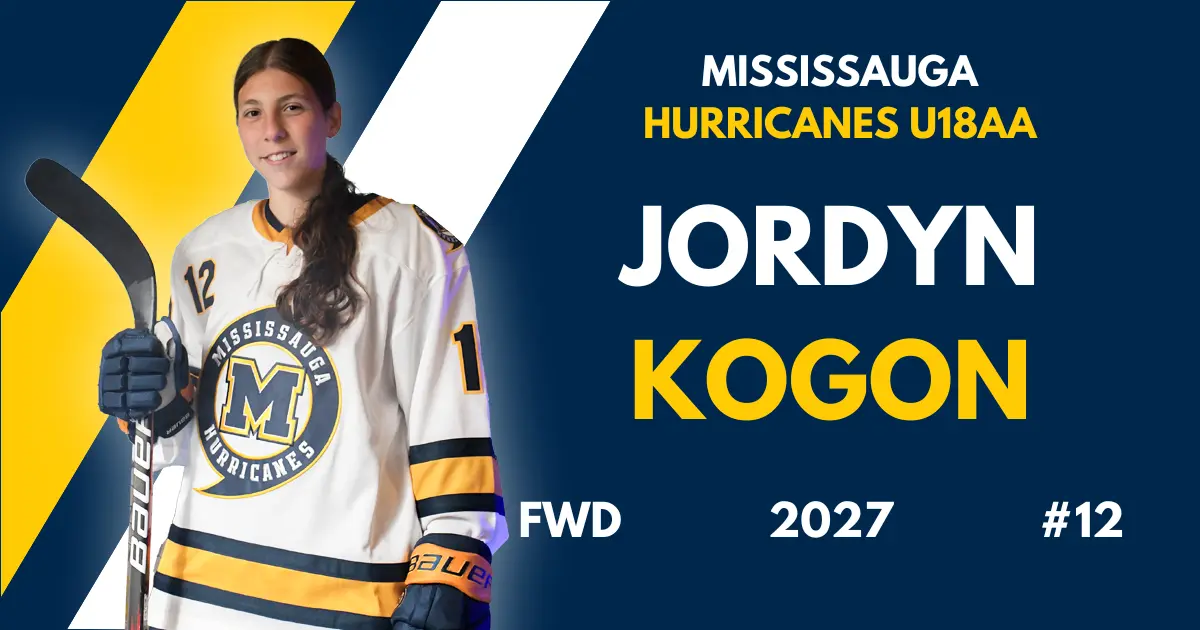
Jordyn Kogon
Player Overview
Height
5’5″
Position
Forward
Shot
Left
Team
Mississauga Hurricanes U18AA
School
Thomas A. Blakelock High School
Grad Class
2027
Programs of Interest
- Environmental Engineering
- Environmental Science
Academic Record
Scouting Report
Defensive Zone
Key Strengths
- Lane Coverage: Jordyn Kogon finds her lane naturally — she doesn't need the play to develop before she moves into position, which puts her ahead of most forwards at this level. That instinct gives her team a reliable presence in the defensive structure from the moment the puck enters the zone.
- Reading the Play: Her reads in the defensive zone are genuine. She processes what's developing in front of her before she commits, which means her decisions come from information rather than reaction. That habit shows up consistently and gives her defensive game a foundation to build from.
- Assignment Discipline: Jordyn understands her defensive responsibilities and executes them with consistency. She knows where she needs to be relative to her assignment and gets there without being told, which makes her a dependable piece of any defensive structure her coach puts her in.
- Inside Positioning: She works to establish inside positioning on her assignment, making it difficult for opponents to use interior routes to create danger. That presence in tight areas reflects a player who understands where the threats come from and positions herself to take them away.
- Shift Consistency: Jordyn brings the same defensive habits shift to shift. Her compete level doesn't drop in the defensive zone, and her positioning reliability doesn't fluctuate with the score or the situation. That consistency makes her a player coaches trust in their own end.
Areas to Refine
- Weak-Side Adjustments: When the puck engages Jordyn physically, her focus can shift entirely to the battle in front of her at the expense of her weak-side awareness. Developing the habit of checking her assignment off the puck — even mid-engagement — would close the gaps that open up when her attention narrows.
- Late-Period Habits: Jordyn's positioning structure holds well through the early portions of a game, but as fatigue builds the discipline can loosen. Sharpening her ability to maintain the same positional habits in the third period as she does in the first would make her a more complete and reliable defensive forward.
- Gap Consistency: There are sequences where the gap between Jordyn and her assignment widens without her adjusting. Tightening that gap recognition — particularly when the play shifts quickly — would eliminate the windows that timing-based attackers look to exploit.
Key Strengths
- Compete Level: Jordyn Kogon's compete level in the puck pursuit game is one of the most identifiable parts of her game. She goes after the puck with genuine physicality and her engagement level is never in question from shift to shift.
- Pursuit Timing: She times her pressure well in most situations — closing when the carrier is vulnerable rather than committing early and giving them time to adjust. That timing gives her pressure game an efficiency that raw aggression alone doesn't produce.
- Gap Recognition: Jordyn reads the gap between herself and the carrier and uses it to shape her approach. She understands when she has enough ground to close and when she needs to hold her structure, which keeps her pressure purposeful rather than wasteful.
- Body Engagement: When she arrives on a check, Jordyn is physical. She doesn't shy away from contact and uses her body to take away space from the carrier rather than simply reaching with her stick. That physicality is a genuine asset in her pressure game.
- Puck Battles: Once she's engaged, Jordyn competes hard to win the puck. She stays in the battle through contact and doesn't give up on the play once the check is made — a habit that separates compete players from players who simply look competitive.
Areas to Refine
- Maintaining Pressure: Jordyn's pressure game is most effective when she sustains it through the full sequence of a shift. There are moments where the intensity dips between engagements, giving carriers a brief window to reset. Building the habit of maintaining pressure from the first puck battle to the last would make her a more disruptive presence throughout the entire shift.
- Chase Discipline: Jordyn's physical compete can pull her too deep into the pursuit, leaving her out of position when the puck moves. Learning to recognize when to disengage and recover — rather than continuing a chase that has passed its window — would keep her structurally sound and make her pressure more sustainable.
- Recovery After Contact: After a physical engagement, Jordyn can take an extra beat to reset into her structure. Sharpening her recovery pace following contact — getting her feet moving and her head up immediately after the check — would close the gap between her pressure game and her positional responsibility.
Key Strengths
- High-Zone Reads: Jordyn Kogon processes shot threats from high in the zone before they develop into releases. She identifies when a defender is loading a shot early, which gives her the read she needs to begin her route before the puck leaves the stick.
- Blocking Commitment: When she decides to block, she commits fully. There is no hesitation in her approach and no pulling out at the last moment — she gets her body into the lane and stays there, which is a trait that can't be coached into a player who doesn't already have it.
- Body Positioning: Her body positioning in the block is functional and consistent. She arrives in the lane with enough structure to be an obstacle rather than a body going through the motions, and that positioning gives her a genuine chance to deflect or absorb the shot.
- Defensive Instincts: Jordyn's shot blocking comes from instinct rather than calculation. When the moment presents itself, her body responds before her mind has finished processing — that reactive quality is what makes her blocking an asset rather than an occasional event.
- Team-First Effort: Putting her body in front of a shot is a choice Jordyn makes willingly and repeatedly. That willingness reflects a player whose compete level extends beyond individual battles into genuine team-first behaviour in the defensive zone.
Areas to Refine
- Blocking Technique: Jordyn's desire to block shots is not the issue — her technique is. Developing a more disciplined blocking form, particularly getting lower and squaring her body to the shooter, would give her more surface area in the lane and convert more of her attempts into actual blocks.
- Timing the Block: The half beat she loses between reading the shot and initiating her movement is costing her. Working on her first-step quickness out of her stance — particularly from a static position — would get her into the lane before the release rather than arriving just after it.
- Post-Block Recovery: Once she's gone to the ice to block, Jordyn needs to get back into the play faster. Sharpening her recovery from the block position — getting her feet under her and her head up immediately — would make her a factor in the transition rather than a player the play moves past.
Key Strengths
- Puck Retrieval: Jordyn Kogon is a reliable support player on zone exits. She reads where the puck is going to be retrieved and positions herself to be a usable option for the carrier before the play develops, which gives her team a clean outlet when they need one.
- First-Touch Decisions: When the puck comes to her on an exit, Jordyn makes a quick decision. She doesn't hold the puck or invite pressure — she identifies her option and moves it, which keeps the exit sequence moving at pace rather than stalling in the defensive zone.
- Outlet Reads: She reads the available outlets off the puck retrieval with enough accuracy to be a functional piece of her team's breakout. Her support game in the exit is built on those reads, and when they're on, the exit sequence flows naturally through her.
- Break-Out Awareness: Jordyn understands her role in the breakout structure. She knows where she fits in the sequence, executes her responsibility without hesitation, and gives the carrier a target they can trust when the exit is developing cleanly.
- Support Positioning: As a support player by tendency, Jordyn's value in the zone exit comes from being where she needs to be before she's needed. That positional habit gives her team options on the breakout and makes the exit more reliable when pressure is applied in the defensive zone.
Areas to Refine
- Exit Pace: Jordyn's support game on exits is positionally sound, but the pace at which she gets to her spot can cost her team a clean option. Getting to her outlet position faster — before the carrier is under pressure rather than as the pressure arrives — would make her a more reliable piece of the exit sequence.
- Second-Option Vision: When the primary outlet on a breakout is taken away, Jordyn needs to sharpen her ability to present herself as the second option immediately. Developing the habit of scanning for the open lane when the first read closes would keep her involved in the exit rather than becoming a spectator when the play breaks down.
- Transition Support: Once the puck exits the zone, Jordyn needs to identify her lane into the transition earlier and commit to it with purpose. Building that habit of reading her best route up ice — and staying with it through contact and traffic — would make her a more consistent and valuable piece of her team's attack coming out of the defensive zone.
Neutral Zone
Key Strengths
- Reads the Play: Jordyn Kogon doesn't wait for the puck to find her — she positions herself in motion, tracking the play's development so she's available as an outlet before the need is urgent. The read comes first; the feet follow.
- Far Side Distribution: Her outlet passing in transition is consistent and purposeful, with a clear tendency to work the far side option rather than the safe, short release. She finds the player who advances the play, not just the player who's open.
- Lane Commitment: After releasing the puck, she doesn't coast — she follows the pass and fills the vacated lane, keeping herself in the picture as a secondary option for the puck carrier moving up ice.
- Purposeful Movement: There's no wasted motion in her transition game. Her skating tempo adjusts in real time to what's developing around her — she reads before she moves, which keeps her positionally sound rather than just busy.
- Back Pressure Read: When a breakdown occurs in transition, her recognition and pivot back into a defensive posture are reliable. The read is there and the skating gets her back — though there's ceiling in how quickly she can close at the highest competitive level.
Areas to Refine
- Puck Carrier Role: She transitions well when the puck is moving through her, but she rarely initiates as the carrier on the attack. Getting comfortable driving transition herself — not just enabling it — would add another dimension to her game.
- Space Management: When she does carry through the neutral zone and runs out of room, the reset isn't always there. Recognizing the wall before it arrives and reloading under pressure is the next step for her as a puck mover.
- Vocal Presence: Her communication on the ice needs to carry further. The reads are good — her voice should match them. Making calls loud enough to be heard through the play, not after it, makes everyone around her faster.
Key Strengths
- Positional Availability: Off the puck, Jordyn keeps herself playable on either side — when a regroup is initiated, she's within range and her timing to occupy the right spot is consistent. Teams don't have to wait for her.
- Lane Maintenance: She creates a passing lane and holds it by staying in motion, mirroring the flow of the play while staying aware of who is tracking her. The lane doesn't just open — it stays open.
- Rotation Read: When the regroup calls for it, she switches off with her linemates without hesitation. The role recognition is there — she doesn't force her spot when the play asks for a different one.
- Dual Function: She can carry the puck through the regroup or connect as a one-touch option depending on what's needed. That versatility makes her a reliable piece in different regroup structures.
- One-Touch Execution: When she uses the one-touch pass in the regroup, it's clean and well-timed — she releases early enough that the play keeps its pace. It's a weapon when she trusts it.
Areas to Refine
- High Positioning Discipline: When she plays up high in the regroup, she occasionally leaves herself exposed to the opponent tracking her. If she's going to hold that space, she needs to use it more deliberately — move inside the offensive blue and come back out, stay out of reach, keep the defender occupied while engineering her own lane rather than just waiting in it.
- Depth on the Swing: There's more speed available to her if she comes down lower — swinging behind her defenseman and flying back up ice generates a different kind of threat than the shallow regroup she defaults to. That extra depth changes the timing for everyone.
- Carry Initiative: Same note as Transition Play — she's dependable as a connector, but driving the regroup herself as a puck carrier is an area she can grow into. The reads are there; the aggression with the puck needs to follow.
Key Strengths
- Compete Identity: Jordyn Kogon's compete level in the neutral zone is a defining part of her game — she arrives at the puck with intention and her pressure is consistent, not situational.
- Disciplined Pursuit: She doesn't chase. Her pressure is selective and positionally sound — she stays in her structure rather than overextending and pulling herself out of the play.
- Weak-Side Timing: On the weak side, she reads the play's direction and times her check as the puck moves toward her — she's not reacting late, she's already arrived.
- Support Positioning: When she's not the first checker, she mirrors the pressure and holds herself as a support option — making the first checker more dangerous by taking away the easy out.
- Wall Physicality: Along the boards, she brings a physical element that opponents feel. She competes for body position and uses her frame to make those battles uncomfortable.
Areas to Refine
- Route Variation: Her approach to the puck carrier can be too direct — a linear route tips her hand and gives the carrier time to adjust. Adding angle and deception to her pursuit makes her harder to read and harder to avoid.
- Battle Conversion: She makes contact, but the next step is finishing the job — turning those collisions into possession. The compete is there; the execution at the end of the battle needs to convert more consistently.
- Stick Lift Development: On the backcheck, developing a reliable stick lift gives her another tool to disrupt without relying solely on body contact. It's a skill that pays off especially when she's recovering from behind.
Key Strengths
- Support Read: She understands her role relative to the carrier — whether that's driving the net hard or hanging as the trailer, she makes the right call and executes it without hesitation.
- Blue Line Timing: Her timing through the neutral zone is reliable — she rarely goes offside, which tells you she's reading the play rather than just skating.
- Possession Mindset: When she carries the puck to the line, she's looking to keep the play alive — not dump and hope. She stays composed under pressure and makes decisions that keep her team in control.
- Contact Tolerance: She doesn't shy away from traffic at the line. She'll take a hit to make the play, and that willingness to drive through contact opens options that more hesitant players don't create.
- Playmaker Signals: Everything in her entry game points toward a player who wants to create, not just deliver. The reads, the composure, the support timing — it all fits the profile of a playmaker developing her tools.
Areas to Refine
- F2 Depth: As the second forward on the entry, she needs to get behind the defenseman more consistently — using the wall for a chip retrieval and establishing possession from there rather than holding in a space where she's easy to track.
- Middle Lane Usage: Once she's earned the blue line as a carrier, she tends to stay wide. Using the middle lane gives her more options and forces the defense to respect a different threat angle.
- Carry Attempts: The tools are there — she just needs to use them more. Getting north with the puck more often as a carrier, rather than defaulting to a support role, is the next step in her development as an entry threat.
Offensive Zone
Key Strengths
- Motion-Based Game: Her possession game in the offensive zone runs on movement — she keeps the puck alive through skating rather than slowing down and waiting for the play to come to her. It's an active, high-tempo style.
- Decision Quality: She doesn't force the issue. When contested, she finds the cleanest option available and executes it — the puck stays on her team's stick more often than not because she doesn't gamble.
- Perimeter Protection: Along the boards and the perimeter, she's difficult to dispossess. She uses her body to shield effectively and doesn't give up the puck without making the opponent earn it.
- Uses the D: She makes good use of her defensemen to reset and extend possession — recognizing when to go back and reload rather than forcing a play that isn't there.
- Fights for It: She's hard to take the puck from when a battle develops — opponents have to work for every inch, and more often than not she comes out with it.
Areas to Refine
- Deceptive Patience: She tends to keep moving rather than stopping to draw the checker in and manipulate the play. Learning to slow down deliberately — let the pressure come, then exploit it — would add a layer of deception her game currently lacks.
- Net-Drive Aggression: Right now her possession game is oriented toward keeping the play alive. The next step is using that possession as a setup to attack — taking it to the net with intent rather than circulating until an option appears.
- Play-Facing Positioning: When she's moving away from pressure with the puck, she can end up with her back to the play and looking to pass just to maintain possession. She needs to position herself around the zone so the play stays in front of her — keeping her options visible and her decisions proactive rather than reactive.
Key Strengths
- Zone Identity: Off the puck in the offensive zone is a genuine strength — she's active, aware, and difficult to account for because she's never standing still.
- Scrum Awareness: During battles and scrums along the wall, she plays off the pile rather than getting locked in — staying on the perimeter to pick up loose pucks and keep the play moving.
- Lane Creation: She doesn't float. When her team has possession, she's moving to open a passing lane for the carrier — making herself available rather than waiting to be found.
- Cycle Rotation: She reads the cycle well and rotates into the right spots — her timing keeps the puck moving and prevents the opposition from locking down the structure.
- Defensive Reset: When possession turns over, she doesn't chase — she resets to her position within the structure and looks to trap the opposing team in the zone before they can get out clean.
Areas to Refine
- Vocal Presence: Same note as earlier in the report — she needs to call for the puck. Her positioning earns her looks that aren't coming because the carrier doesn't know she's there.
- Scoring Position: She creates well for others but needs to get herself into shooting and scoring positions more deliberately. The support game is strong; now it needs to include herself as an option.
- Situational Aggression: On the power play and 6-on-5, she can back off too high and play it safe. There are moments where staying aggressive and going to the pile — rather than playing off it — is the right read. She needs to recognize those situations and act on them.
Key Strengths
- Ice Vision: When she has time and space, she sees the full picture — her reads are ahead of the play and she uses that vision to find options others miss.
- Escape and Execute: Under pressure, she doesn't just survive — she finds a way out and makes a play on the other side of it. The decision-making holds up when the ice shrinks.
- Cross-Ice Range: Her cross-ice passing awareness is a real weapon. She finds the weak-side option and delivers it, which stretches the defense and creates chances that straight-line play doesn't.
- Move and Support: After she releases the puck, she doesn't watch — she moves into a support position immediately, keeping herself in the play and giving the new carrier an option right away.
- Finds the Shooter: Her reads to the shooter are consistent — she identifies who has a lane and gets them the puck on their tape in time to release without resetting.
Areas to Refine
- Play Creation: She facilitates well but needs to start driving plays designed to produce a goal — not just keeping possession or finding the open man, but engineering the sequence with a finish in mind.
- Behind the Net: Setting up behind the net gives her a different look at the defense and opens the front of the crease. It's a tool she hasn't developed yet, and it would add a dimension to her playmaking that fits her skill set.
- Focal Point Mentality: She's at her best when the puck is on her stick — but she doesn't demand it enough. Taking ownership of the play, making herself the option the carrier is looking for, is the mindset shift that unlocks the next level of her game.
Key Strengths
- Effort Goals: When Jordyn Kogon finds the scoresheet, it's because she worked for it. Her goals are earned through compete and positioning — not chance.
- Shot Selection: She's more dangerous coming down on the goalie and releasing than she is trying to beat them with a deke. She knows her shot and uses it.
- Net Presence: She's not afraid to crash the crease and dig for the puck in the paint. She goes to the hard areas and competes for what's there.
- Rebound Hands: Playing net-front, she has the hands to convert quickly on rebound attempts — she doesn't need time to set up, she's ready when the puck arrives.
- Consistent Contributor: She brings secondary scoring to her team — a reliable presence on the scoresheet who contributes consistently without needing to be the focal point of the offence.
Areas to Refine
- Scorer's Mindset: The support game and playmaking instincts are already there — the next step is turning that same attention toward her own scoring opportunities. Developing the goal-scorer mentality on the attack raises her stock as a complete offensive player.
- Weak-Side Reads: When she's on the weak side, her first read should be the scoring area — get there, establish position, and be ready. Right now she's not consistently prioritizing that spot when the play develops away from her.
- Shoot First: She has moments where the shot is there — clean, clear, nothing between her and the goalie — and she looks for the extra pass anyway. The pass instinct is a strength elsewhere; at the net, she needs to trust the shot.
Technical Skills
Key Strengths
- Stride and Stance: She skates from a low, stable base with a consistent stride — her knee bend and push through each extension give her skating a reliable foundation that holds up through a full shift.
- Acceleration: Her initial push is sharp and deliberate — she gets to full stride quickly whether she's reading a loose puck, closing on a carrier, or releasing off a line change. The burst is there with and without the puck on her stick.
- Ice Usage: She reads the open ice and gets to it — she doesn't stay pinned to one side of the play but uses the full width of the rink to find soft spots, create separation, and keep herself available.
- North-South Threat: Her straight-line skating is her most dangerous gear. She generates real north-south speed and uses it to beat defenders to the puck on the forecheck, close on carriers from behind, and drive through the neutral zone with her compete level leading the way.
- Contact Balance: When opponents make contact along the wall or through traffic, she doesn't have to reset her feet — she stays on the puck and continues the play without breaking stride.
Areas to Refine
- Separation Speed: When a defender is closing from behind, she doesn't consistently have the top-end gear to open up clean ice. She relies on positioning and puck protection to manage pressure rather than skating away from it — building that extra burst would give her an exit option she doesn't currently own.
- Off-Puck Agility: Without the puck, her change-of-direction game needs work. Her pivots and cuts off the puck are wide rather than sharp, which gives checkers time to recover and re-establish position on her when she's trying to get open.
- East-West Carry: When she's carrying, her movement is predominantly linear. Adding side-to-side deception with the puck — crossovers, cuts back against the grain — would force defenders to respect more than one direction and create space she isn't currently generating.
Key Strengths
- Control Game: Jordyn Kogon's stickhandling identity is built around control and protection rather than deception — she's a puck controller first, and that game is legitimate and effective at her level.
- Catch and Control: She receives passes cleanly in stride — the puck doesn't bobble or pull her off her line, she absorbs it and keeps moving without breaking tempo.
- Possession Strength: She's difficult to strip the puck from — her grip strength and hand positioning through contact keep it on her stick when opponents reach and poke.
- Three-Lane Comfort: She handles the puck with confidence across all three lanes of the ice — she doesn't have a comfort zone she retreats to, she carries wherever the play takes her.
- Body Positioning: When she protects the puck, her body is between the checker and the puck consistently — her positioning is deliberate and well-executed, not accidental.
Areas to Refine
- One-Hand Push: When she's protecting along the wall and needs to gain speed up ice, she needs to learn to use her free hand to extend and keep the checker's body further away while her top hand controls and pushes the puck forward — it creates separation without sacrificing possession.
- Deception Development: She hasn't fully discovered who she is as a stickhandler yet. Starting with simple deception moves in practice — a shoulder dip, a toe drag, a hesitation — and building from there will tell her which tools fit her game naturally.
- Carry Tempo: When she's moving the puck up ice, she can overhandle and bleed speed in the process. The puck should be moving her forward, not slowing her down — less is more when the lane is open.
Key Strengths
- Passing Identity: Consistency is the foundation of her passing game — her power, accuracy, and delivery are reliable across all three zones. Coaches can count on the pass being there.
- Transition Timing: Her passes in transition are well-timed and well-weighted — the puck gets to its target when the receiver can use it, not a half-second late. It's one of the clearest next-level indicators in her game.
- Small-Area Execution: In tight spaces, she uses the one-touch pass effectively — she doesn't need room to wind up, she releases quickly and keeps the play moving through congestion.
- Far-Side Stretch: The stretch pass to the far side is a genuine trademark. She executes it consistently and with conviction — it generates clean zone exits and creates entries that wouldn't exist without that look.
- Offensive Zone Distribution: In the offensive zone, her passing game fits the attack — she finds the right option at the right moment and delivers it in a way that extends the play rather than interrupting it.
Areas to Refine
- Slip Pass Usage: She tends to look for options through traffic rather than trying the shorter slip pass through a seam. In the offensive zone especially, the slip pass would open up plays she's currently bypassing in search of a bigger option.
- Backhand Commitment: There's nothing wrong with her backhand — she just doesn't reach for it when the situation calls for it. From off-wing positioning in particular, the backhand is the cleaner, quicker delivery, but she defaults to repositioning for the forehand instead.
- Delay Passing: Her passing foundation is strong enough to start adding layers. The delayed pass — holding the puck an extra beat to let the opposition commit, then hitting the seam that opens up — would give her a new look that her current game doesn't show yet.
Key Strengths
- Shot Selection: Her shooting game is built around the wrist shot with the snap shot as a secondary weapon — two reliable tools she understands and deploys in the right situations.
- Shooting in Stride: She shoots on the move with confidence, approaching the goalie and releasing without breaking down into a set position — she does it from her natural wing and her off wing without hesitation.
- Quick Release: When she has space, the shot is off before the goalie can fully set — she doesn't telegraph it or wind up, the release is compact and immediate.
- Unpredictable Release Point: Shooting in stride naturally shifts her release point on the goalie — it's harder to track and time than a stationary shot, and she uses that movement deliberately.
- Shot Accuracy: She keeps the puck on net consistently — very few shots sail high or wide. When she scores, it tends to be high glove or high blocker, which tells you the accuracy is intentional, not lucky.
Areas to Refine
- Early Release Under Pressure: When a checker is closing, she waits too long — she holds the shot until contact rather than reading the pressure a beat earlier and getting the puck off before the window closes. The shot needs to leave before the checker's stick gets there, not after.
- One-Timer Development: Her one-timer timing needs work. The progression to build it properly starts with stick on the ice and making clean contact on sweeping one-timers first — getting comfortable with the connection point before adding a half-windup, then graduating to a full release once the timing is consistent.
- Shot Power: Developing shot power is about the full chain — weight transfer through the hips, loading the stick shaft on the backswing, hand positioning through the pull-push motion, and a full follow-through that finishes high. Right now the accuracy is there but the velocity behind the shot needs to grow to make it a threat against higher-level goaltenders.
Situational Play
Key Strengths
- System Fit: She stays inside the team's plan — her assignments don't drift when the play gets messy, and coaches don't have to account for where she might be. She's where the system puts her.
- Breakdown Recovery: Her first move after a breakdown isn't to chase — it's to read. She figures out what the situation needs, gets to her spot, and re-engages without the scramble that pulls other players out of position.
- Defensive Zone Pressure: A puck-pressure system brings out the best in her. The intensity, the physicality, the willingness to make the opposition uncomfortable in their own end — that style fits her game like it was built for her.
- Neutral Zone Systems: She's a natural fit when the team is built around regrouping and in-motion transitions. Her timing and availability in the neutral zone mean the system doesn't have to wait for her — she's already in it.
- Offensive Adaptability: Puck movement or dump-and-chase — she adjusts her role to match what the team is running without losing effectiveness in either. She reads the style and finds her place in it.
Areas to Refine
- Changing Speeds: High-tempo, physical play is her comfort zone — and that's a strength. But a system that asks her to slow down, hold her position, and let the play come to her will expose a gap in her game until she develops it. The ability to change speeds — to go from full compete to deliberate and patient within the same shift — is what makes a high-motor player genuinely difficult to defend, because the opposition can no longer predict which gear is coming.
- Instinctive Play: In open, read-and-react situations, she has the hockey sense to make plays — but she's more comfortable when the team is moving with her than when she has to trust her own read without the structure around her. Learning to act on those instincts without waiting for confirmation is uncomfortable work, and it should be. That discomfort is exactly where the next layer of her game lives.
- System Driver: There's a difference between running a system and driving it. Right now she executes her role — but the next step is owning the system from inside it. That means demanding the puck at the right moment, making the call that puts teammates in motion, and holding the structure together when it starts to slip. Players who drive a system are harder to replace than players who fit one.
Key Strengths
- Wall and Low Game: Along the wall and down low, her physicality and puck protection suit the power play well — the skill set she brings to those areas makes her difficult to handle when the kill unit sends its hardest pressure.
- Motion System Fit: A power play built around movement suits her naturally. She's not a static setup player — she operates better when the unit is in motion and the puck is working through multiple hands.
- Passing and Playmaking: She brings a legitimate distribution game to the power play. She finds options, moves the puck quickly, and keeps the unit in the offensive zone rather than burning time on resets.
- F1 on the Dump-In: As the first forward on a dump-in, she's effective — she pressures the defenseman hard enough to force a bad decision, a rim, or a puck thrown up the wall under duress rather than a controlled exit.
- Zone Coverage: She rotates and covers across both levels of the zone — she doesn't get locked into one spot, she fills where the unit needs her whether that's supporting low or getting up to the high slot.
Areas to Refine
- Tempo Control: Her compete level is an asset, but on the power play it can work against the unit. When the right play is to slow it down and make the kill unit move their feet, her instinct to push the tempo can speed the play up past the point where the advantage is being used properly. Learning when to take the air out of it is a skill in itself.
- Shooting Options: She looks to distribute first almost every time. There are moments on the power play where she has a shooting lane and passes through it — getting comfortable identifying those looks and pulling the trigger would make her harder to defend and open up more of the passing lanes she already uses well.
- Vocal Leadership: Same thread that runs through the rest of this report — she needs to be louder. On the power play, communication is what keeps the unit connected when the kill is collapsing and options are closing fast. Her reads are good enough that her voice should be directing traffic, not staying quiet.
Key Strengths
- PK Identity: The penalty kill is where her game translates most directly — the compete level, the physicality, the willingness to go to hard areas. A puck-pressure kill system is built for players like her.
- Forecheck Pressure: She doesn't sit back and wait on the kill. She pressures the puck carrier and forces decisions under duress — a rim, a turnover, a rushed breakout that puts the power play unit back on its heels.
- Shot Blocking: Her willingness to put her body in front of shots on the penalty kill is a genuine asset. She doesn't flinch in the lane and her commitment to the block is consistent — the same trait that shows up in her defensive zone game translates directly to the kill.
- Compete in the Corners: Along the wall and in the corners on the kill, she competes for possession rather than just containing. Her physical game makes her difficult to pin down and gives the kill unit a chance to generate short-handed opportunities off her battles.
- Positional Discipline: She doesn't overcommit on the kill. Her pressure is aggressive but her structure holds — she understands when to engage and when to hold her lane, which keeps the kill unit from getting stretched out of position.
Areas to Refine
- Stick on Pucks: Her compete and body engagement on the kill are ahead of her stick work. Developing her stick lift and poke check on the kill would give her a second tool to disrupt the power play without having to close the full gap — particularly useful when the unit is moving the puck quickly and she can't get all the way to the carrier.
- Reading the Seam: On the kill, when the power play is cycling and looking to thread a pass through the middle, she needs to sharpen her read on where that seam is opening. Getting her stick into those lanes before the pass is made — rather than reacting to it — would generate more turnovers from her pressure game.
- Short-Side Awareness: When the power play moves the puck to the far side quickly, she can lose her positioning relative to the short-side threat. Tightening that awareness — knowing where the dangerous man is when she's not directly in the play — would close the gaps the best power play units look to exploit.
Key Strengths
- Situational Reading: She reads what the game is asking of her in real time — whether to pressure, support, carry, or hold. That situational awareness is what makes her effective across different systems and different game states without needing to be directed.
- Score and Situation Awareness: Her compete level and positional discipline don't fluctuate with the score or the game situation. She brings the same approach whether the team is up, down, or tied — that consistency tells you she's not playing to the scoreboard, she's playing to the game.
- Special Teams Recognition: She understands the demands of special teams situations and adjusts her game accordingly — more aggressive on the PK, more structured on the power play. The role changes and she changes with it without losing her identity.
- Pressure Moment Awareness: In high-pressure moments — short-handed, defending a lead, late in a period — her reads sharpen rather than soften. She recognizes when the game matters most and responds to it.
- Multi-Role Recognition: She identifies what role the play needs from her quickly — F1 on the forecheck, trailer on the entry, support on the regroup — and gets into it without hesitation. That awareness of her role within the larger picture is a consistent thread across every zone.
Areas to Refine
- Offensive Situation Awareness: She reads defensive and neutral zone situations more sharply than offensive ones. Recognizing scoring opportunities earlier — the weak-side opening, the seam through the middle, the moment to shoot rather than pass — is the awareness gap that most directly limits her offensive production.
- Self-Awareness as a Threat: She's acutely aware of what her teammates need but less aware of when she herself is the right play. Building the situational awareness to recognize when the game is asking her to be a scorer, not a support player, would make her harder to defend and more complete as a forward.
- Tempo Awareness: There are moments where the game is asking for patience and she pushes the tempo anyway. Developing a sharper read on when to slow the play down — when the situation calls for control over compete — would give her a more complete situational game.
Mental Game
Key Strengths
- Read Before React: Jordyn Kogon's hockey sense is the engine underneath everything else in her game. She processes what's developing in front of her before she commits — her decisions come from information, not instinct alone, and that habit shows up consistently across all three zones.
- Positional Intelligence: She knows where to be before the play tells her. The lane coverage, the outlet timing, the support positioning — none of it is accidental. She reads the game a step ahead and her feet follow the read, not the other way around.
- Multi-Zone Awareness: Her hockey sense doesn't live in one zone. The same quality that makes her a reliable outlet in transition is what makes her a disruptive presence on the forecheck and a composed decision-maker when the puck is on her stick in the offensive zone.
- Timing: The one-touch passes, the blue line reads, the weak-side checks — they all land at the right moment because her internal clock is calibrated. She understands when to move and when to hold, and that timing is what separates her hockey sense from raw instinct.
- Play Recognition: She identifies what a situation needs from her quickly — a support role, a pressure role, a carry role — and gets into it without hesitation. That recognition is what makes her a functional piece across different systems and structures.
Areas to Refine
- Freedom of Reads: Her hockey sense is strong enough to operate in open, unstructured situations — but she hasn't fully learned to trust it there yet. When the team isn't moving with her, she can wait for confirmation rather than acting on what she already sees. Backing her own reads in those moments is the next step.
- Offensive Read Depth: Her reads in the defensive and neutral zones are more developed than her offensive zone reads. Getting behind the net, identifying the seam earlier, reading the scoring area from the weak side — those are the reads that still need time and repetition to sharpen.
- Self as Option: She reads her teammates well but doesn't consistently read herself into the play as a scoring threat. The hockey sense that finds the open man needs to start identifying when she is the open man.
Key Strengths
- Game Identity: Compete isn't a mode she switches into — it's how she plays. The physicality, the puck pursuit, the willingness to go to hard areas — it runs through every shift regardless of the score or the situation.
- Consistent Engagement: Her compete level doesn't fluctuate. It's there in the first minute and it's there in the third period — coaches don't have to manage it or motivate it. It shows up on its own.
- Physical Presence: She uses her body as a tool, not a last resort. Along the wall, in the corners, at the net — she competes with her frame and makes opponents earn every inch of ice they get.
- Team Compete: Her compete level extends beyond individual battles. She blocks shots, she finishes checks, she goes to the paint — the habits that define a team-first competitor rather than a player who simply looks engaged.
- Pressure Compete: Under pressure — late in a period, short-handed, defending a lead — her compete doesn't drop. If anything, those are the moments where it becomes most visible.
Areas to Refine
- Compete Efficiency: The engine runs hot, and sometimes that works against her. Sustaining compete through a full shift means knowing when to disengage — continuing a battle past its window costs energy and position that the next play needs.
- Compete Into Possession: She competes hard to get to the puck, but the conversion rate — turning that physical pressure into actual possession — needs to grow. The work is there; the finish needs to follow more consistently.
- Channeling the Motor: In systems that ask for patience and structure over aggression, her compete can push the tempo past where the play needs it. Learning to channel that motor — to compete within a slower pace rather than against it — would make her effective in a wider range of situations.
Key Strengths
- Composure Under Pressure: When the play breaks down or the puck isn't going her way, she doesn't chase or force. She resets, reads, and re-engages — her composure in difficult moments is one of the more reliable things in her game.
- Decision Stability: Her decision-making doesn't deteriorate under pressure. She makes the same quality of read when the game is tight as she does when it isn't — that stability is what coaches are looking for in players they trust in important moments.
- No Wasted Emotion: She doesn't carry a bad shift into the next one. The reset is clean — she comes back to the bench, gets her head right, and goes back out with the same approach she started with.
- Confidence in Her Role: She plays with a clear sense of what she brings to the game. Her support role, her compete game, her defensive responsibility — she executes those with conviction rather than hesitation, which tells you she's settled in who she is as a player.
- Reliable in Structure: When the game gets physical or the structure breaks down around her, she doesn't get pulled into the chaos. She finds her position and holds it — an emotionally controlled player in a moment that pulls less composed players out of their game.
Areas to Refine
- Late-Game Discipline: As fatigue accumulates, the emotional control that holds her structure early in a game can soften. Maintaining the same positional discipline and decision quality in the third period as she brings in the first is the standard she's working toward.
- Confidence With Puck: Her confidence in her support role is clear — but that same conviction hasn't fully transferred to moments where she needs to be the focal point. Trusting herself as a puck carrier and a scorer with the same certainty she brings to her support game is the next layer.
- Vocal Expression: Her emotional control reads as quiet — and in most situations that's a strength. But there are moments where the team needs her to be expressive, loud, and direct. Learning to channel that composure into vocal leadership would give her emotional presence on the ice, not just positional presence.
Key Strengths
- Breakdown Composure: When a play breaks down, her first move is to read — not react. She identifies what the situation needs, finds her spot, and re-engages without the scramble that pulls other players out of position.
- Clean Transitions: She moves between roles cleanly — from attacker to defender, from carrier to support — without carrying the previous play into the next one. The mental reset happens quickly and the next shift starts fresh.
- Structure After Contact: After a physical battle, she returns to her positional responsibilities without needing time to settle. The engagement ends and the structure comes back — that habit keeps her reliable through the physical parts of the game.
- Shift Consistency: Her reset ability is what makes her shift-to-shift consistency possible. The compete level, the positioning, the reads — they stay stable because she doesn't carry mistakes or frustration from one sequence into the next.
- Pressure Stability: In high-pressure moments — a turnover, a bad line change, a goal against — she resets to her role and gets back to work. There's no visible drop in her engagement or her positioning after a difficult sequence.
Areas to Refine
- Post-Contact Reset Speed: After a physical engagement, she can take an extra beat before her feet are moving again. Sharpening that recovery — getting her head up and her skates going immediately after the check — would keep her in the play rather than a half-step behind it.
- Reset Into Aggression: Her reset after a breakdown tends to be positional and supportive — she finds her structure and holds it. The next step is resetting into an aggressive read, not just a safe one. Recovering her position and then immediately looking to make something happen rather than waiting for the play to develop around her.
- Offensive Mindset Reset: After a sequence where she's been in a defensive or support role for an extended stretch, she can stay in that mode longer than the play requires. Resetting her offensive mindset — recognizing when the game is asking her to be a threat rather than a support — would make her more dynamic through a full game.
Frequently Asked Questions
- Jordyn Kogon is pursuing a career in environmental engineering. She plans to earn her degree at a Canadian university in a program she is passionate about.
- Outside of hockey, Jordyn Kogon competes in football, track and field, and cross country. She also enjoys biking and spending time outdoors with family and friends.
- Jordyn works with head coach Chelsey Greenwood, strength and conditioning coach Nathan Archer, and power skating coach Nancy Whiteford.
- Jordyn leads by example. She is the kind of player teammates lean on — someone who shows up consistently and holds herself to a high standard in hockey, school, and everything in between. She describes herself as quietly competitive and accountable, and those around her back that up. Academically, she is a strong student who manages her time well and takes her grades seriously.