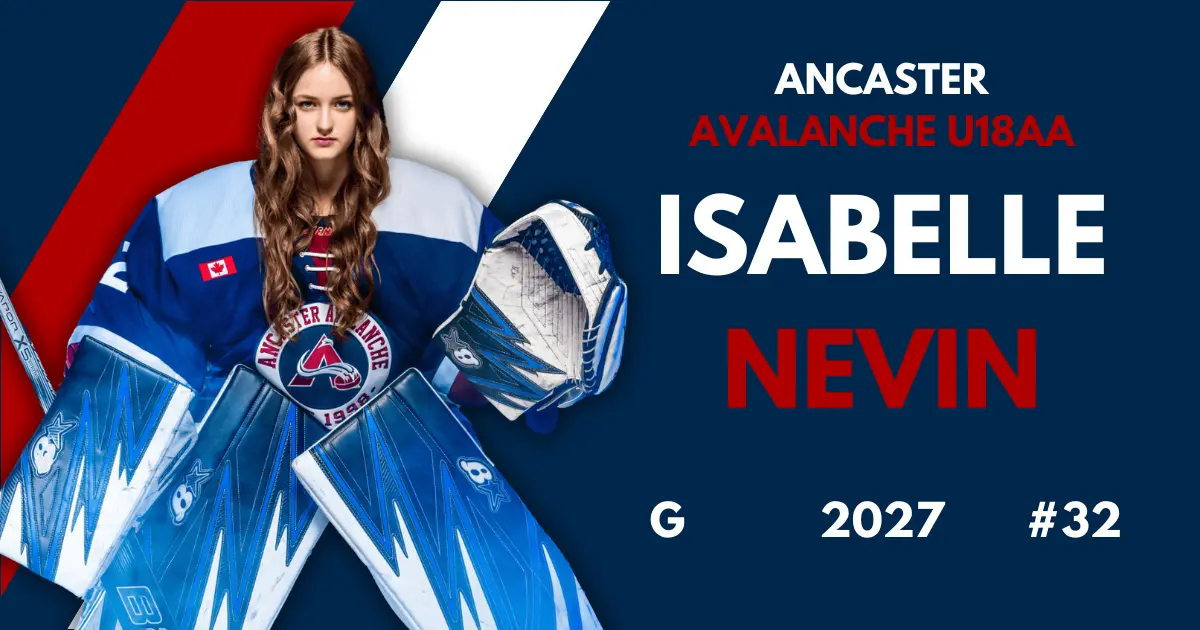
Isabelle Nevin
Goalie Overview
Height
5’7″
Position
Goalie
Glove
Left
Team
Ancaster Avalanche U18AA
School
Thomas A. Blakelock High School
Grad Class
2027
Programs of Interest
- Graphic Design
- Interior Design
- Communication & Digital Media
Academic Record
Scouting Report
Positional Foundation
Key Strengths
- Built for Coverage: Isabelle Nevin sets up square and crouched, and her height does the rest. The stance doesn't need to manufacture coverage — it arrives with it. From the moment she's set, she fills the net in a way that asks shooters to earn their look rather than find one by default.
- Hand Placement: Her hands sit middle-low and stay connected to her frame when she's set and tracking. The glove and blocker don't chase the play — they hold their position and let her body do the primary work. When the stance is working, the hands are exactly where they belong.
- Shoulder Integrity: Her shoulders don't drop. That discipline keeps her upper body tall through the stance and prevents the postural collapse that signals to shooters where the net opens above her. The top of the net stays protected because the top of her body stays honest.
- Pad Geometry: Her leg pads form a clean triangulation without flattening out. They stay vertical enough to allow her to hold height while keeping the ice-level coverage connected. The result is a stance that covers both planes simultaneously without sacrificing one for the other.
- Square Presence: She stays square to the play and the shooter. As the puck moves, she moves with it. There's no drifting off-angle or losing the thread of where the threat is coming from. Her orientation is a constant — the puck always has her full front.
Areas to Refine
- Stance Compression: As play closes in, her stance shrinks rather than holds. The crouch tightens, the coverage picture narrows, and top corners that were sealed become available. The read to compress isn't wrong — the degree of it is. Holding her foundation a beat longer as pressure arrives will keep those lanes closed at the moments they matter most.
- Hand Discipline: There are moments where her hands drift from the stance and pull her into a reach her body didn't need to make. It isn't a constant — her default position is sound — but it surfaces often enough to be worth owning. Keeping that awareness sharp through training video will help her catch the pattern and close it before it becomes a habit the next level can find.
- Self-Study Habit: The next step here lives off the ice. Watching herself through training video and game film — identifying the specific moments where the stance holds and where it breaks — will surface the common threads faster than any external correction. She already has the foundation. Learning to see it herself is what turns awareness into adjustment.
Key Strengths
- Forward Presence: Izzy starts her sequences at the top of her crease. She doesn't wait for the play to come to her — she meets it. That forward positioning takes space away from shooters before they've made a decision, and it gives her depth system a proactive foundation rather than a reactive one.
- Lateral Tracking: As the play moves east to west, her depth stays in line with it. She doesn't get pulled out of position by lateral movement — she mirrors it, staying connected to the threat as it shifts without losing her angle or drifting off her working depth.
- Linear Consistency: Her in-and-out depth adjustments are clean and reliable. As the play moves up and down the ice, her positioning responds accordingly, keeping her net coverage optimized through the full sequence rather than arriving late or overcorrecting.
- Low Play Positioning: When the puck works below the circles or behind the net, her depth responds correctly. She reads the change in threat geometry and positions herself accordingly — staying connected to where the danger is going rather than where it currently is.
- Rarely Buried: She doesn't retreat into her net. The tendency to sit too deep — a common habit for goalies adjusting to AA pace — isn't part of her game. Her depth stays functional and forward-leaning across the majority of what she faces.
Areas to Refine
- Perimeter Patience: When the opposition is building an attack from the perimeter or above the circles, she can give ground earlier than the play requires. Staying higher in her crease through those sequences — holding her depth until the threat actually earns a response — will keep shooters honest and preserve the coverage advantage her forward positioning creates.
- Point-Blank Challenge: There are moments where a shooter arrives in close and her depth doesn't meet the moment. Challenging out further on point-blank situations — closing the angle aggressively rather than absorbing the pressure from a passive depth — will put the problem on the shooter instead of on her.
- Shrink Timing: When adjusting back into her net, she can compress a beat early. The retreat starts before the play has fully asked for it, which surrenders depth that didn't need to be given up yet. Tightening that timing — holding her position until the moment actually calls for the adjustment — will close the small windows that early retreats open.
Key Strengths
- Square Foundation: When the play is in front of her, Izzy's angle coverage is centered and honest. She sets up square to the threat and holds it — nothing is bleeding open through the middle lane, and shooters don't find seams by default. The foundational picture is sound.
- Glove Side Depth: When she's challenging out, her glove side angle coverage is a strength. The depth and the angle work together — she's not just presenting a body, she's closing the lane. Shooters probing that side when she's forward in her crease find less net than they expect.
- Blocker Side Low: Coming off the wall and on low plays, her blocker side is reliable. She uses her post as a starting point, building her movement and angle coverage from a confirmed reference rather than approximating where she needs to be. That habit gives her blocker side an anchor that her coverage benefits from.
- Fluid Adjustment: Her skating to adjust angle isn't choppy or mechanical. She moves cleanly between positions, staying connected to the play as it shifts without breaking her base or losing the thread of her coverage. The movement looks natural, which tells you the technique behind it is already internalized.
- Seam Control: Foundationally, she isn't giving away seams. The angle coverage holds across the majority of what she faces — not because she's lucky with positioning, but because the base she works from is technically sound and consistently applied.
Areas to Refine
- Rush Challenge: On rush plays, she can be content to hold her depth rather than cutting the angle down aggressively. Taking more ice on those sequences — stepping out to compress what the shooter sees — will turn a sound angle into a challenging one and force more difficult decisions before the release.
- Blocker Post Check: On point shots and plays developing above the circles on her blocker side, the post check habit that anchors her low play coverage needs to carry upward. Finding the angle from the post and adjusting depth outward to challenge will close the blocker side high the same way it closes it low.
- Single Unit Sealing: When she moves to change and seal an angle, her stance can open up in transition — the body separates instead of traveling as one unit, and brief seams appear in the process of getting there. Keeping everything connected through those adjustments — letting the body close the angle together rather than in pieces — will eliminate the windows that show up between where she was and where she's trying to be.
Key Strengths
- Perimeter Seal: On low plays along the perimeter, Izzy stays tall and seals. She doesn't concede the post early or drop before the play earns it — she holds her height, closes the short side through posture, and makes the shooter work for a look that isn't there yet.
- Behind the Net: When the puck goes below the goal line, she drops and lets her leg coverage take over. Post to post, her pad presence becomes an asset she actively leverages rather than a fallback position — the coverage is deliberate, not reactive, and it closes the space that wrap attempts are designed to find.
- Symmetrical Setup: Standing in the middle of her net, her spacing is honest on both sides. Pad to post reads the same left and right — nothing is bleeding open through uneven positioning. That symmetry means shooters don't find a preferred side by default.
- Blocker Side Seal: When she drops on the blocker side, the paddle stays down and the post locks inside. Puck carriers looking to wrap around find the short side already closed before they've committed to the attempt. The seal is waiting for them, not chasing them.
- Glove and Pad Connection: On the glove side, her pad and glove work as one unit. As the leg goes low, the glove positions itself above to keep the post sealed as the attacker moves across. It's a subtle detail, but it reflects a goalie who has thought through the full geometry of what she's covering rather than simply reacting to where the puck is.
Areas to Refine
- Post-to-Post Consistency: The improvement here is real and visible. What comes next isn't more learning — it's repetition until the movement stops requiring thought. Ten sequences into a period, under fatigue, when focus narrows, that's when the habit needs to hold on its own.
- Speed of Connection: The glove and pad work together well when the play gives her time to feel it. When an attacker moves quickly across, that window compresses and the connection can arrive late. At pace, the relationship needs to be ahead of the movement, not catching up to it.
- Reversal Readiness: Behind the net she handles deliberate plays cleanly. Quick reversals are where the gap still shows — the far post seal can arrive in pieces rather than assembled. When she gets there whole every time on those plays, that situation stops being one the opposition can target.
Movement Patterns
Key Strengths
- Technical Foundation: Izzy's crease movement is compact and controlled by design. She doesn't waste motion or manufacture movement the play hasn't asked for — every push, every shift, every adjustment is purposeful. The discipline in how she moves through her crease tells you the technical work has been done.
- Moving as One: Her movement is growing into a more unified expression. Where the body used to expand or separate through transitions, it's beginning to travel together — feet, torso, and hands finding the same direction at the same time. That development is visible and it's still building.
- Position Preserved: She rarely overextends or gets pulled out of position by her own movement. The crease stays hers. Whatever adjustment she makes, she makes it without surrendering the ground she started from — which keeps her available for whatever comes next in the sequence.
- Relaxed Movement: Since the season's end her movement has loosened without losing its structure. There's a comfort in how she moves through her crease now that wasn't as present earlier — less tension, more flow. That relaxed quality is what the technical foundation was always building toward.
- Low Play Mirroring: When a carrier moves post to post on low plays, her lateral timing is well matched. She mirrors the movement cleanly, staying connected to the threat as it travels rather than arriving late or overcorrecting. In the sequences that test that timing most directly, she holds up.
Areas to Refine
- Next Level Speed: Her movement is technically sound at AA pace. As competition rises, the same movements will need to happen faster without losing the compactness and control that make them effective. The technique doesn't change — the demand on it does.
- Recovery Mobility: Getting back to a working position after a save or scramble is where her crease mobility still has room to grow. The first movement is clean — it's the return that can cost her a beat. Tightening that recovery so she's back and ready before the next threat arrives will complete the sequence rather than leaving it exposed.
- Anticipatory Movement: Her crease mobility responds well once the play has shown itself. The next evolution is loading the movement earlier — reading what's coming and letting the body begin its adjustment before the threat fully declares. At higher levels the play moves too fast to wait for confirmation. The read has to drive the movement, not follow it.
Key Strengths
- Skating Foundation: The growth in Izzy's skating is one of the clearest year-over-year changes in her game. Steven flagged it directly, and it shows — her edges put her where her reads tell her to be rather than fighting to get there. What used to be a developmental gap is now a platform the rest of her game is built on.
- Compact Pushes: Her edge work matches how she plays. Pushes are short and controlled, moving her the distance the play asks for without overshooting it. She covers ground without spraying power she can't manage, which keeps her square and available when she arrives.
- Lateral Strength: Side to side is where her edges are strongest. She tracks carriers across the zone and mirrors low plays post to post without losing her base. The lateral push is clean enough that she stays connected to the play through the movement rather than catching up to it after.
- Clean Stops: When she stops, she stops. There's no slide past the point she meant to hit, no drift that opens her up before she's set. That control on the stop is what lets her change direction without a wasted beat in between.
- Edges That Hold Position: Her edges keep her in her crease rather than carrying her out of it. She rarely overextends or gets pulled past where she needs to be — the skating serves her positioning instead of compromising it, which is exactly what you want from a goalie whose foundation is built on staying square.
Areas to Refine
- Loaded Through Compression: When her stance shrinks under pressure, the edges underneath it can lose their load with it. A compressed stance with unloaded edges leaves her flat-footed at the moment she most needs to push. Keeping the edges engaged even as the stance compresses will let her drive out of those collapsed positions rather than being stuck in them.
- Second-Effort Edges: Her first push is clean because it's deliberate. The follow-up pushes — the second and third edges in a scramble or an extended sequence — are where the polish still has to catch up. Those are the movements that have to fire without thought, and right now they arrive a touch behind the first one. Sharpening the edges that come after the read is what closes the gap.
- Recovery Edge: Tied to the early-shrink pattern already in her game, the push back into position can arrive soft. The retreat starts before it should and the edge that carries her there doesn't have full authority behind it. Driving that recovery push with the same conviction as her initial movement will keep her set and ready before the next threat finds her rather than arriving mid-recovery.
Key Strengths
- Composed Arrival: When a rebound or scramble pulls Izzy off her post, she arrives at the recovery without panic. There's no flailing or desperation in how she gets back — the movement looks like a continuation of the sequence rather than an emergency response to it. That composure under a broken play is a real asset, because the moments that pull her off her post are exactly the moments goalies tend to lose themselves.
- Anchored by the Post Check: Her recovery benefits from the same post-check habit that anchors the rest of her game. She knows where her post is before she needs it, so when the play forces her back she's recovering to a known reference rather than searching for one. The anchor is already set when the scramble starts.
- Seals on Arrival: When she gets back to her post, the seal is there. She doesn't arrive and then leave a window open while she reorganizes — the pad and post connect as she lands. For a goalie whose triggers are rebounds and scrambles, arriving sealed rather than arriving and then sealing is what keeps those second chances from becoming goals.
- Tracking Through Recovery: Her ability to stay connected to the puck while she's recovering has grown noticeably. Where the eyes might once have lost the play during the movement, she's increasingly tracking it the whole way across — which means she's arriving at the post already knowing where the threat is rather than finding it after she's set. It's a developing strength, and the trajectory is the right one.
- Recovers Without Overcommitting: She doesn't throw her body at the recovery and end up worse off than where she started. The return is controlled — she gets back to a working position rather than oversliding past it, which keeps her available for the next shot instead of recovering into a new problem.
Areas to Refine
- Assembling Under Speed: Her composed arrival holds when the scramble develops at a readable pace. When the rebound kicks out fast and the second shot comes immediately, the recovery can arrive in pieces — body there, seal a fraction behind. The composure is already in place; the next step is arriving fully assembled even when the second chance comes faster than the first.
- Reading the Next Threat First: Her tracking through recovery is improving, and the next layer is reading the most dangerous threat rather than the most obvious one. On a scramble with bodies around the net, recovering toward the back-door option before it gets the puck — not just toward where the puck currently is — is what turns a good recovery into a preemptive one. The eyes are getting there; the anticipation is the next build.
- Recovery as Automatic: Her best recoveries happen when she has a split second to gather herself before the next shot. The goal is to take that split second out of the equation — so the same clean, sealed recovery shows up even when the play gives her no time at all. Right now it's a skill she executes well. The next step is making it pure instinct, so it holds up just as strongly on the last scramble of the game as the first.
Key Strengths
- Balanced Stance: Izzy's balance starts in her stance and holds there. Upright and set, her weight is centered and her base is sound — she's not fighting to stay square or correcting a lean before the play even develops. That settled foundation is what lets everything she does next start from a stable place rather than a recovery.
- Into the Butterfly: When she drops, her balance comes down with her. The move into the butterfly doesn't throw her off-center or leave her tilting to one side — she lands stacked and square, ready to push or seal from a balanced position rather than scrambling to find one. The drop is controlled, not a fall.
- Post to Post: Moving across her crease, her balance travels with her. She doesn't list or lurch from one post to the other — the base stays underneath her through the movement, which is why she arrives square instead of arriving and then squaring up. That stability in lateral travel is a big part of why her post-to-post game holds together.
- Depth Changes: As she adjusts her depth in and out, her balance stays level. Coming forward to challenge or settling back into her net, she doesn't pitch forward or rock back onto her heels — the weight stays where it needs to be, keeping her ready to react the moment she arrives at her new depth.
- Balance While Tracking: Even as she tracks and mirrors the play, her balance never gets pulled into the movement. Her eyes and body can follow the puck across the zone while her base stays sound underneath, which means the act of staying connected to the play doesn't cost her the stability she needs to respond to it. The balance and the tracking work together rather than competing.
Areas to Refine
- Use It More: Her balance is already a strength — the next step is using it to take more. A goalie this balanced can afford to challenge harder, hold depth longer, and play more aggressively, because the stable base means she can recover from those riskier positions. The refinement isn't fixing her balance; it's trusting it enough to let it unlock a more assertive game.
- First-Step Quickness: Balance gives her control, and the next layer is pairing that control with quicker first-step explosiveness out of her set position. She's stable — the growth is converting that stability into faster initial movement when the play demands it, so being balanced never tips into being planted. The foundation is there to push off; it's about pushing off it sooner.
- Balance Under Chaos: Her balance holds against everything U18AA produces. As she climbs, the game will deliberately try to pull her off it — screens that force a shift at the moment of release, plays designed to catch her mid-movement. Her base is strong enough to meet that; the refinement is keeping it just as sound when the chaos is built specifically to disrupt it rather than occurring naturally.
Save Execution
Key Strengths
- Strong Tracking: Izzy's tracking is one of the most improved parts of her game, and it shows on film. She follows the puck cleanly from the shooter's blade all the way into her body, staying locked on through the release rather than losing it at the critical moment. That consistency through the shot is what keeps her saves clean and controlled.
- Eyes Lead: She finds the puck first and her body follows. The read comes before the movement — she's not throwing a pad or a glove at a spot and hoping, she's seeing the shot and reacting to it. That order keeps her square to the puck and her saves on the right line.
- Reads the Release: She picks up the shot off the shooter's hands and stays with it. Instead of committing early and getting caught, she lets the puck come and reads it the whole way, which means she's reacting to the actual shot rather than the one she expected. Shooters don't get her to bite before they've released.
- Consistent Tracking: Her tracking holds up across situations — clean shots from the point, looks off the rush, pucks moving through her crease. It's not a skill that only works when the play is simple. She stays connected to the puck whether the shot comes clean or the play gets busy in front of her.
- Composed in Traffic: When the puck gets screened or tipped and she loses sight of it for a moment, she stays calm and finds it again. There's no panic, no abandoning the play — she works to pick the puck back up and keeps battling to see it. That composure when the sightline breaks is a real asset.
Areas to Refine
- Seeing It Sooner: Her tracking is strong, and the next step is picking the shot up even earlier — reading the release off the shooter's setup before the puck's on her. Getting that read a beat sooner gives her more time to set and react, which matters as shots come harder and faster at the next level.
- Through Traffic: She tracks well through traffic now, and the heaviest screens are where the next level will push hardest. Fighting through bodies for her sightline — getting her head around the screen to find the puck early — is what keeps her tracking sharp as the traffic in front of her gets thicker and more physical.
- Locking It In: Her tracking has come a long way, and the work now is keeping it there. Repeating those clean habits until they hold deep into games — when she's tired, when the pace is high, when the shots keep coming — is what turns a strong stretch into a permanent part of her game.
Key Strengths
- Redirects to Safety: Izzy's most consistent rebound trait is where she puts the puck. When she can't freeze it, she steers it to the corners and away from the middle of the ice — pucks end up in spots her defense can recover rather than sitting in the slot for a second chance. That consistency on her redirects is the foundation of her rebound game.
- Reads the Shot: She mixes her response to fit the shot. Some pucks she kills dead, others she steers away — she's not locked into one answer, she reads what the situation gives her and picks the rebound that makes the most sense. That flexibility keeps her from forcing a smother when a redirect is the safer play, and the reverse.
- Standing and Down: Her rebound control isn't tied to one position. Standing up she handles pucks and directs them with purpose, and down in the butterfly she does the same. A goalie who only controls rebounds from one position gets exposed when the play forces her out of it — Izzy holds up in both.
- Kills the Play: When the situation calls for ending the play — a scramble in tight, a puck that needs to simply stop — she can smother it dead and get the whistle. She doesn't leave pucks loose when the moment demands a freeze, which takes the second chance off the board entirely.
- Defense-Aware: Her rebound placement gives her defense a recoverable puck rather than a contested one. The direction she sends pucks isn't random — it's away from danger and toward her own support, which shortens the scramble and helps her team get out of the zone instead of defending another wave.
Areas to Refine
- In-Tight Glove: The glove side in tight is where her rebounds get away from her most. On close-range shots to her glove, the puck doesn't always die or redirect cleanly — it can pop loose into a dangerous area. Tightening that glove hand in close, so it absorbs or controls rather than spilling, is the most direct way to take second chances off her doorstep.
- High Shots: On shots to her upper body and chest, the control is there sometimes and not others. When it's on, the puck dies in her chest and drops harmless; when it's off, it can kick out front. Making that chest absorption consistent — the same clean result every time the shot comes high — closes a gap that gets tested more as shots get harder.
- Hands and Body: When a rebound does get away, it's sometimes the shot beating her clean and sometimes her hands and body not arriving together on the save. Connecting the two — hands moving with the body rather than independently — will clean up the rebounds that come from the save itself being slightly out of sync rather than from the shot being too good.
Key Strengths
- Size as Coverage: Izzy's frame does real work here. She fills the net and takes away angles at the same time — shooters looking at her don't find the open space they'd see against a smaller goalie. The size isn't just something she has; she uses it, presenting a wall that makes the net look smaller from the shooter's end before they've even picked a spot.
- Big Standing Up: She covers the most net on her feet, and she plays to that. Her tall, square stance closes off the high looks and the angles while she's standing, which means she doesn't have to drop to feel like she's covering the net. That's an asset — a goalie who's this big standing up can hold her feet longer and make shooters beat her from up top.
- Strong Down Low: The bottom of the net is hard to find against her. Low shots, pucks along the ice, attempts to sneak it under her — those run into her pads and her base. Shooters who try to beat her low are going at her strength, which pushes them toward the higher, lower-percentage looks.
- Covered Post to Post: When she moves post to post at the top of her crease, her coverage travels with her. She stays square to the carrier as the puck moves across, and the net stays covered through the movement rather than opening up while she shifts. That's coverage in motion, not just from a set position.
- Tracks and Covers: As she tracks the puck carrier across the zone, her net coverage holds. She's not so focused on following the play that she lets the net open behind her read — the coverage and the tracking stay connected, so she's covering the right part of the net as the threat moves rather than chasing it.
Areas to Refine
- Sitting Back: The net opens up high on her most when she's sitting back in her crease. Deep in the paint, her height covers less of the angle and the top of the net comes into play — the same frame that takes away the high looks when she's up covers less when she's back. Getting out and challenging more keeps that high net closed, turning a gap into the strength it already is when she's forward.
- Big in the Butterfly: She covers the most net standing — the next step is carrying more of that coverage into the butterfly. When she drops, a tall goalie can give up the height she had on her feet. Staying as big as possible going down — chest up, hands up, holding her frame — keeps the net from opening at the top the moment she leaves her feet.
- Up High: Since she's strongest low and most beatable high, the refinement is closing the gap up top. Keeping her hands ready and her posture tall so the high shots get the same denial her low coverage gives, especially as shooters at the next level pick corners better, is what makes her coverage complete top to bottom.
Key Strengths
- Flush to the Ice: When Izzy drops, her pads seal flush to the ice. There's no daylight underneath for pucks to slip through — the pad meets the ice and stays there, closing the bottom of the net the moment she goes down. This is a clear strength, and it's gotten noticeably tighter over the past year.
- Five-Hole Closed: Down in the butterfly, her five-hole is sealed. Her pads come together and her stick covers the gap, taking away the lane between her legs that skilled shooters look for first. Pucks aimed at the five-hole find it closed rather than open.
- Post Seal Holds: When she seals to the post, the short side is genuinely closed. Pad to post, paddle down, her seal does what her positioning sets up — there's no sliver between her pad and the post for a puck to sneak through. The seal matches the position, which is what makes her post play reliable rather than just well-placed.
- Hands Stay Up: When she's sealed low, her hands stay up and ready. Going down doesn't pull her glove and blocker down with it — she holds them in position to cover the area above her pads, so dropping to seal the bottom doesn't open the top. That's a detail that separates a complete seal from one that only covers the ice.
- Seals When Set: When she arrives into a set position and seals, the result is clean and reliable. Given a moment to get there and lock in, her seal is sound top to bottom — flush below, hands above, post closed. She's at her best when she can arrive, set, and seal as one connected sequence.
Areas to Refine
- Long-Range Blocker Side: The odd puck that does get through low comes blocker side from distance. It's not a frequent thing and it's improved a lot, but on the rare occasion the seal leaks, that's where it shows. Tightening that specific spot — the blocker-side pad sealing flush on long shots — closes the last small window in an otherwise strong low seal.
- Sealing on the Move: Her seal is cleanest when she's set, and sealing while she's still moving is where it has room to grow. Sealing mid-slide or on a recovery doesn't lock in quite as tight as sealing from a set position — though it's getting better. Closing that gap, so the seal holds just as well moving as it does when set, is the next step.
- Seal Speed: As the game gets faster at the next level, the seal has to arrive in less time. The mechanics are sound — the demand ahead is executing them quicker, so the seal is flush and complete even when the play gives her a fraction of the time she gets now. The technique is there; the speed is what the next level will ask for.
Game Situations
Key Strengths
- Lets It Come: Izzy is patient on the rush. She lets the play come to her instead of lunging at it, staying with the puck and reading the rush as it develops rather than committing before she has to. That patience keeps her in control of the sequence — the rush has to beat her, she doesn't beat herself by guessing.
- Reads Shot or Pass: When the rush gives her a shoot-or-pass look, she stays disciplined. She doesn't sell out to the shot and get caught on the pass, or cheat the pass and get beat by the shot — she holds her read until the play declares, then responds. That patience on the two-way threat is a real strength.
- Stays Square: Through the rush, she keeps her body square to the puck. As the play moves and the angle changes, she stays facing the threat rather than getting turned or caught flat. The square base means whatever the rush produces, she's lined up to meet it.
- Handles the Odd-Man: On odd-man rushes — 2-on-1s, 3-on-2s — she's shown well. She reads the play, respects the pass without abandoning the shot, and more often than not comes out of those situations with the save. Like any goalie she's been beat on them, but the read holds up more than it doesn't.
- Across on the Cross-Ice: When the rush moves the puck east-west before the shot, her timing getting across has come a long way. She stays square through the lateral movement and arrives on the far side ready, which keeps the cross-ice one-timer from being the automatic look it is against goalies who are late to slide.
Areas to Refine
- Challenge the Carrier: Izzy reads the rush well but plays it conservatively — she's not retreating, but she's not aggressively taking the carrier on either. Stepping out to challenge harder on the rush takes time and space away from the shooter before they're ready, and it turns a sound, patient read into one that puts real pressure on the carrier. She has the tracking and the square base to be more assertive here.
- The Double-Move 2-on-1: The play that beats her most is the deceptive 2-on-1 — the pass to the backdoor that draws her across, then a return pass back to the original carrier or a new backdoor option. It's a high-end read that gets a lot of goalies, but recognizing the second movement before committing fully to the first pass is the next layer. Holding a touch longer on those deceptive looks keeps her from being pulled all the way across on the first move.
- Reading the Setup: As she climbs, rushes will be built to deceive rather than just executed. Picking up the signs that a play is a setup — the delay, the extra patience from the carrier, the backdoor option creeping in early — before it fully shows is what keeps her ahead of the most creative rushes at the next level. The read is good; the next step is reading the intent behind the rush, not just the rush itself.
Key Strengths
- Patient Point-Blank: When a shooter arrives in the slot right on top of her, Izzy stays patient. She doesn't move first and give the shooter a window to read — she holds and makes them commit, then reacts. That composure at point-blank range, where panic beats most goalies, is one of the steadiest parts of her game.
- Size in Tight: Her frame works for her in the slot. In close, she fills the net and makes the shooter beat her through a small window rather than picking a corner of open space. The size that helps her on net coverage carries right into the slot — there isn't much net to find when she's set in tight.
- Strong Straight-On: On a straight slot shot — puck comes, she reads it, she stops it — she's reliable. When the shooter takes what's in front of them rather than trying to move her, she handles it cleanly. Her read and her base are sound on the direct look.
- Blocker Side Solid: When a shooter moves the puck and tries to beat her across, her blocker side holds up. Even when the play forces her to react to movement, the blocker is there and dependable — shooters going to that side in tight run into a solid answer.
- Composed in Scrambles: When the slot turns into a scramble — loose puck, bodies, quick chances — she stays composed. She doesn't get swallowed by the chaos; she finds the puck and competes through it. The calm she shows at point-blank carries into the messy slot sequences too.
Areas to Refine
- Own the Challenge: Izzy mixes challenging the slot shooter with sitting back, and the next step is owning the challenge more often. Taking on the shooter — stepping out and making them beat a goalie who's coming at them rather than waiting — puts the pressure back on them. She has the size and the patience to challenge harder; using them to take the slot on is what turns a good slot read into a dominant one.
- Dropping Too Soon: When she drops early and hasn't challenged out far enough, that's where the slot beats her — post-to-pad opens, and the puck can get up high over her. The fix ties to the challenge: getting out and staying up longer keeps those lanes closed, so she's not giving the shooter the top of the net by going down before the play earns it.
- Glove in Tight: On movement plays in close, her glove can be off-line — she'll make the save, but the catch isn't always clean or where it should be. Tightening the glove on those in-tight looks, so it catches on line rather than reacting late, cleans up the one spot where a quick move in the slot can get the better of her hands.
Key Strengths
- Active Head and Body: When a screen sets up, Izzy stays active to find the puck. She keeps her head moving and her body adjusting to find a sightline rather than freezing and hoping the puck comes through clean. That activity — working for her vision instead of waiting for it — is what keeps her connected to the play when bodies get in front.
- Tall at Range: On long-range screened shots, she stays tall. She holds her height to see over the traffic rather than dropping and losing the puck behind it, which keeps her sightline alive on the shots she has time to track. Staying up at range is the right read and she makes it consistently.
- Sees Through Traffic: She can pick the puck up through bodies and partial sightlines. A screen doesn't automatically beat her — she finds seams between players and tracks the puck through them, staying with the shot even when she can only catch pieces of it. Her improved tracking shows up here in her ability to play through traffic she couldn't a year ago.
- Composed on Tips: When a puck changes direction in front of her off a tip or deflection, she stays composed. The results are mixed, as they are for any goalie on tips, but she doesn't come apart — she reacts to the new direction and competes for the puck rather than getting frozen by the redirect.
- Competes Net-Front: When there's a body parked in her crease, she works to deal with it. She'll move, work around it, and battle to find her ice rather than letting the screen plant itself and take her vision. That willingness to compete net-front keeps the front of her net from becoming free real estate for the opposition.
Areas to Refine
- Shrinking on Short-Range Screens: She stays tall at range but shrinks when the screen is close. Dropping early on a short-range screen gives up the height she needs to see over and around the traffic. Holding her stance longer on those closer screens keeps her tall enough to find the puck rather than going down into the bodies and losing it.
- Heavy Traffic, Clean Shot: The screen that beats her most is heavy traffic where the shooter still gets a clean look — the puck comes through post-to-pad or up high before she's picked it up. It's a tough spot every goalie deals with, and the next step is fighting even harder for the early sightline so she sees the release through the bodies rather than after it.
- Finding It Sooner: As traffic gets thicker at the next level, the work is picking the puck up earlier through the screen. The sooner she finds it through the bodies, the more time she has to set and seal — which turns a screened shot she reacts to into one she's ready for. She sees through traffic well now; doing it a beat sooner is the next layer.
Key Strengths
- Wraparounds Locked: Izzy handles wraparound attempts cleanly. Her post is sealed and waiting, and a quick wrap doesn't catch her — she's there before the puck is, and the attempt runs into a closed door. This is a settled part of her game; teams don't beat her going around the net.
- Strong on Jams: When a puck gets jammed at the post or stuffed in tight, she holds strong. Her physical ability is a real asset here — she anchors at the post and doesn't get pushed off her ice, so net-front stuffs that rely on moving her don't find the room they need. She wins those battles more than she loses them.
- Meets the Walk-Out: When a carrier comes out from behind the net into the slot, she reads the timing and meets them. That below-the-line-to-in-front transition, where a lot of goalies get caught between the post and the shooter, is one she handles — she's square and ready when the carrier emerges rather than chasing the play.
- Sound at the Post: Her post play on low plays is reliable. She tracks the puck below the goal line, stays connected to where it's going, and holds her post position with patience rather than lunging at the first look. The post is a place of strength for her down low.
- Tracking Down Low: Her tracking on low plays is improving — when the puck works below the goal line, she's staying with it better than she used to. She reads the play behind and beside her net and keeps her eyes connected to the puck as it moves, which keeps her a step ahead of where the threat is going.
Areas to Refine
- Stay on Her Feet: She's at her best down low when she stays on her feet rather than dropping — when the situation allows it, staying up puts her in a better spot to read and react. The refinement is recognizing those moments and trusting her feet, dropping only when the play truly demands it rather than going down early and giving up the better position standing would have given her.
- Low-to-Slot Pass: The low play that beats her most is the pass out to the slot. When the puck comes from below the goal line out front, she can sit a bit back in her crease, and openings show up in her stance as she adjusts. Challenging out to meet that slot threat — rather than receiving it from a deep, passive depth — closes the gaps that appear when she's caught back on the pass-out.
- Squaring the Pass-Out: On that same low-to-slot play, getting from her post back to square on the new slot threat is where the work is. The faster and cleaner she transitions from the post seal to a set, square position in front, the less time the slot shooter has to exploit the window that opens while she's adjusting. Her post is good; connecting it quickly to the slot read is the next step.
Puck Management
Key Strengths
- Clean First Touch: When Izzy stops a puck, her first touch is clean. It doesn't bobble or squirt away and force a scramble to settle it — she gets it stopped and under control the first time, which keeps the play calm and gives her team a settled puck to work with rather than a loose one to chase.
- Strong on Freezes: Covering the puck for a whistle is a strength. When she wants a stoppage, she gets the puck covered cleanly and draws the whistle — pucks don't sit loose under her for a second swipe. That ability to kill a play dead when her team needs a breath is reliable and valuable.
- Stops It for the Setup: She stops pucks behind the net to set up her defense. She's not leaving every puck for her D to chase down — when a dump or rim comes in, she'll stop it and put it in a spot where her team can start the breakout. That's the foundation of a goalie learning to be a third defender.
- Composed Under Pressure: When a forechecker is bearing down, she reads the timing. If she knows she can win the puck clean and make the play, she'll go; if not, she doesn't force it. She's not overly aggressive, but she's not panicking either — she picks her moments rather than getting rushed into a mistake.
- Signals of More: She's showing the early signs of handling the puck, not just stopping it. The instinct to do more than freeze-and-cover is there, and it's the right foundation to build a real puck-handling game on top of as she gets more comfortable.
Areas to Refine
- Handle It More: The biggest growth area is handling the puck more, not just stopping it. She's a clean stopper but not yet a true puck handler — getting more confident moving the puck, making plays with it, and using her stops to start transition is what the next level will ask for. The touch is clean; the next step is doing more with it once she has it.
- Reading the Rim: Her success reading hard rims off the boards is mixed. Hard-rimmed pucks with unpredictable bounces can give her trouble getting to the right spot to stop them. Developing the read for how a rim behaves off the end boards — and getting her body to the spot before the puck arrives — will make her rim stops as clean as her straight ones.
- Owning More Pucks: As she gets more comfortable, stepping out to stop and play more pucks — rather than picking her spots conservatively — will take pressure off her defense and cut off opposition forechecks before they start. She wins the pucks she commits to; the next step is committing to more of them as her handling grows.
Key Strengths
- Reads Before She Goes: Before Izzy commits to a retrieval, she reads the situation. She's processing whether pressure is coming, whether it's a line change, whether the forecheck is set — she's not leaving her net blind. That read-first habit keeps her retrievals connected to what the play actually needs rather than going just because the puck is there.
- Right Call Most of the Time: When she decides to go, it's usually the right decision. She picks good moments to retrieve and good moments to stay home — she's not abandoning her net on bad reads or getting caught making retrievals she shouldn't attempt. The judgment behind the decision is sound.
- Composed Under Forecheck: Retrieving with a forechecker bearing down doesn't rattle her. She stays composed and makes her play rather than panicking and rushing it into a bad spot. That calm under pressure is a real asset on retrievals, where a rushed decision turns into a turnover in dangerous ice.
- Sets Up Her D: When she retrieves, she gets the puck to a spot where her defenseman can initiate the play back up ice. She's thinking about the breakout, not just the stop — her retrieval becomes the first piece of her team's transition rather than the end of the defensive sequence. That awareness of what comes next is the right instinct.
- Knows When to Win It: She goes when she can clearly win the puck, which means the retrievals she commits to, she completes. She's not losing races she shouldn't be in or getting beat to pucks she called herself onto — when she decides it's hers, it's hers.
Areas to Refine
- Leave the Net More: The growth here is leaving the net more often by deciding earlier. Right now she goes when she can clearly win it — the next step is treating every dump-in as a puck to play unless the read tells her otherwise. Committing earlier and more often takes pressure off her defense and stops forecheckers from catching them flat-footed. The judgment is good; the next step is trusting it sooner and using it more.
- Decide Earlier: A lot of retrieval success comes from the decision happening before the puck arrives, not as it does. Sharpening how early she reads the dump and commits — so she's already moving to the puck rather than deciding once it's there — will let her get to more pucks first and give her more time to make the next play once she has them.
- Initiate, Not Just Hand Off: Right now she retrieves to set her defenseman up to start the play. As her comfort grows, becoming more willing to initiate the breakout herself — carrying it a few strides, making the first pass — turns her from a goalie who supports the retrieval into one who starts the transition. That's a higher-level skill and the natural next step as her handling develops.
Key Strengths
- Smart and Safe: When Izzy has the puck, her decisions are smart and safe. She makes the right play to the right spot and doesn't put her team in trouble — there are no high-risk choices that turn into turnovers in dangerous ice. She understands where she is in her development and plays within it, which is exactly right for a goalie building this part of her game.
- Keeps It Simple: She doesn't try to force plays that aren't there. She makes the simple, available play rather than reaching for something flashy that creates risk — the puck goes where it needs to go to keep her team connected. That simplicity isn't a limitation; it's good judgment about what the moment calls for.
- On-Time Decisions: Her decisions arrive on time. She's not holding the puck until pressure forces a panicked choice — she reads the play and moves the puck when it needs to move. The timing keeps the breakout flowing rather than stalling at her stick.
- Predictable for Her D: Her defensemen know what to expect from her. Her decisions are consistent enough that her team can read off them — when a defenseman turns back for the puck, they know where it's going to be. That predictability is a real asset; it lets her D play with confidence instead of guessing.
- Plays Within Herself: She makes decisions inside her current ability rather than overextending. She's willing to handle the responsibility, but she doesn't push past what she can execute cleanly — which keeps her decisions reliable and her team out of trouble while the rest of her puck game develops.
Areas to Refine
- The Passing Game: The overall passing game is the growth area. The decisions are sound — the next step is the execution catching up to them, so the right read turns into a crisp, well-placed pass every time. Building range, pace, and accuracy on her outlets is what will let her sound decision-making translate into genuine breakout offense rather than just safe puck movement.
- Decide Even Earlier: Her decisions are on time, and the next layer is making them even earlier — locking in the read before the puck arrives so the play is already decided when it gets to her stick. The earlier the decision, the faster the puck moves up ice and the less time a forecheck has to take her best option away.
- More Than the First Option: As her comfort grows, seeing past the first available play — the second and third options on the breakout — will let her shape the transition rather than just complete it. Right now the simple play is the right play; as the passing game develops, having more options in her pocket turns a safe outlet into a play that actually starts her team's attack.
Key Strengths
- Active Communicator: Izzy communicates with her team. She's not a silent goalie who leaves her defense to figure it out — she's engaged in the play, giving information and staying connected to the five players in front of her. The instinct to communicate is there, which is the foundation everything else builds on.
- Calm and Useful: When she talks, her voice is calm and useful. It carries information, not panic — her communication steadies her team rather than adding tension to the moment. That composure in how she communicates is exactly what a defense wants to hear behind them when the pressure is on.
- Guides the Retrievals: When her defensemen go back for pucks, she gives them information. They're not retrieving blind — she's telling them what she sees, whether there's pressure, whether they have time. That guidance fills in the blind spots her D can't see from their position and keeps breakouts from turning into trouble.
- Flags the Threats: She calls out threats around her net — backdoor players, screens, bodies in the slot. She's an extra set of eyes for her defense, giving them information about dangers developing in spots they can't always see. That awareness, communicated in time, helps her team close threats before they become chances.
- Communicates Through Her Play: Even where her voice is still developing, she communicates through how she plays. Her consistent puck placement and reliable habits tell her team what to expect — defensemen read off her tendencies and move accordingly. That kind of communication only comes from a goalie whose game is predictable enough to trust.
Areas to Refine
- Find More Volume: She communicates well, but she's not as loud as she could be. The information is good — the next step is delivering it with more volume and presence so it reaches her team clearly in the moments that matter most. A louder voice doesn't just relay information; it commands the front of the net and lets everyone know she's in charge of it.
- Step Into Leadership: Her communication supports her team — the growth is taking ownership of it. Moving from guiding the play to directing it, from contributing information to leading the group with it, is the next layer. That leadership doesn't require being the loudest personality; it requires choosing to take command of her crease and the players in front of her.
- Build the Shared Language: As she steps into a bigger vocal role, developing quick, clear cues with her defense — calls everyone understands and reacts to instantly — will make her communication a genuine tactical weapon. The faster her teammates can process what she's telling them, the more every word she says is worth.
Mental Game
Key Strengths
- Steady Across Game States: Izzy plays steady regardless of the situation. Up a goal, down a goal, power play, penalty kill — the goalie you get on the opening faceoff is largely the same one you get when the game tightens. That consistency of approach across game states gives her team a stable presence to play in front of, no matter what the scoreboard says.
- Rises With the Stakes: There are early signals that she elevates her game as the stakes climb. Rather than shrinking when the moment gets bigger, she shows signs of meeting it — the kind of trait that separates goalies who survive big games from goalies who want them. It's developing, but the indicators are there and they're encouraging.
- Reads the Game Flow: She senses what the game needs. She reads momentum and pressure building, and she knows when her team needs a freeze for a breather versus when to keep the play moving — and she does it calmly. That game-feel, the awareness that operates above the puck, is a real part of her mental game.
- Tracks the Play: She knows where the play is and stays connected to it. Her awareness of where the puck is and what's developing around her net keeps her oriented to the threat rather than getting lost in the chaos. That foundation of tracking the play is what her anticipation is being built on top of.
- Calm in the Read: Her situational awareness comes with composure. She processes what's happening around her without the read tipping into panic — she stays calm enough to actually see the game clearly, which is what makes her awareness useful rather than just reactive. The calm and the read work together.
Areas to Refine
- Anticipating the Threat: She tracks where the play is, and the next step is reading where the threat is going to come from. She's getting better at anticipating the danger before it arrives rather than reacting to it once it does — it's not fully dialled in yet, but the trajectory is right. Seeing the threat develop a beat early is what turns sound awareness into the kind that stays ahead of the play.
- Reading the Setup: As she climbs, plays will be built to deceive — designed to look like one thing while becoming another. Developing the awareness to read the setup, not just the play in front of her, is the next layer. Picking up when a sequence is being manufactured rather than developing naturally will keep her ahead of the most creative offense at the next level.
- Big-Game Reps: The growth that only experience can give her is time in high-leverage games. She doesn't show any obvious gaps, but the deep playoff runs, the elimination games, the moments where everything tightens — those reps will reveal and sharpen what she brings when the stakes are highest. The signals are good; banking the experience is what turns signals into certainty.
Key Strengths
- Gives Nothing Away: Izzy doesn't show negativity. Whatever happens — a goal, a bad bounce, a tough sequence — her body language doesn't hand the opposition anything to feed off. There's no slumping, no visible frustration, nothing for the other team to read as a crack. That emotional neutrality takes a weapon out of their hands entirely.
- Lets It Go: A goal against doesn't stay with her. She releases it and moves on rather than carrying the weight of the last play into the next one. That ability to let go keeps a single goal from turning into a rough stretch, which is one of the most important emotional skills a goalie can have.
- Settles Her Team: Her composure travels to the players in front of her. You can see her team plays with confidence when she's in net — her steadiness tells them the situation is handled, which lets them play their game instead of gripping their sticks. That's emotional control becoming a team asset, not just a personal one.
- Holds Steady in Adversity: When things aren't going her way, she holds steady. Bad bounces, tough calls, a soft goal — she doesn't let any of it show or pull her off her game. The opposition doesn't get the satisfaction of seeing they're getting to her, because they aren't getting to her. That steadiness under frustration is genuine.
- Even Keel: Her emotional baseline stays level across a game. She doesn't ride the highs too high or let the lows pull her down — she stays in the same steady place whether she's just made a huge save or just been beaten. That consistency of emotional state is what makes her reliable over a full sixty minutes.
Areas to Refine
- Find the Fire: Her steadiness is a strength — the next step is learning to bring fire, intensity, and aggression when the moment calls for it. There are times a goalie can swing momentum or lift her bench with a visible competitive edge, and accessing that gear without losing her composure is the growth ahead. She has the calm; adding the spark gives her a second tool.
- Rev It and Dial It Back: Learning to rev her game up and bring it back down is something she'll need to develop and embrace. The ability to raise her intensity in a key moment and then settle back to her baseline — without either shift affecting her play — is a high-value skill. Right now her throttle lives in one steady gear; building the range to move it up and down on purpose is the next layer.
- Embrace the Edge: Adding a competitive edge to her game isn't about changing who she is — it's about giving herself permission to show it when it would help. Her team would feed off seeing her compete with visible fire in the big moments. The composure stays; the refinement is letting the other side of her come out when the game asks for it, then putting it away when the job's done.
Key Strengths
- Natural Reset: Izzy gets herself back to neutral in a natural way. Her reset isn't a forced, mechanical routine she has to grind through — it flows, settling her for the next play without drawing attention to itself. That ease is a sign of a goalie whose mental game is genuinely steady rather than held together by ritual.
- Clean Off Both: She resets cleanly off a goal and off a big save alike. A goal against doesn't drag her down and a highlight save doesn't leave her floating — either way she's back to her baseline and ready for what's next. Resetting equally well from both outcomes is what keeps her game level across a full sixty minutes.
- Ready by Puck Drop: When the game gives her a pause — a whistle, a faceoff — her reset is complete by the time the puck drops. She uses the stoppage to get fully back to zero, so she's not still processing the last sequence when the next one starts. The whistle does its job because she lets it.
- Settled Between Plays: In the gaps between plays she settles herself — a mix of post checks, taking space when she needs it, getting set before a D-zone faceoff. She uses those moments to reset and prepare rather than standing idle, which keeps her ahead of the next sequence instead of reacting to it cold.
- Holds Under Pressure: For the most part her reset stays clean even when the chances come fast. She's able to get back to neutral on the fly when the game doesn't give her a pause, which keeps her present for second and third chances rather than still recovering from the first.
Areas to Refine
- Make It Automatic: Everything here is about making the reset automatic for the next level. It's already clean — the work now is locking it in so it holds without fail when the pace is higher, the chances come faster, and the recovery time shrinks. The reset she has needs to become something her game does on its own, no matter what the game throws at her.
- Reset Through the Slip: When momentum is building against her, there are small, rare signs of the reset slipping. Tightening it in exactly those moments — when the pressure is sustained and the resets have to come one after another — is what keeps a building wave from turning into a goal. The reset is strong; protecting it through the toughest stretches is the next step.
- Reset Through Communication: A step ahead is resetting through her voice — using communication after a breakdown or a big save to reset herself and her team at the same time. A quick call to her D after a scramble settles everyone and puts the last play away for the whole unit, not just for her. As her vocal game grows, that becomes a powerful way to reset the group, and studying how the best goalies do it will sharpen her own.
Key Strengths
- Rises to the Competition: The better the team in front of her, the better Izzy plays. Stronger opponents and higher-quality chances bring out a sharper version of her game rather than exposing her — she meets the level she's playing against. That's one of the most telling traits a goalie can have, because it means the biggest games are the ones likely to bring out her best.
- Compete in Games That Matter: When the game matters, she brings a high compete level. She doesn't coast or shrink in the moments that count — she competes for every puck and every save like the result matters to her. That willingness to battle when the stakes rise is the foundation a big-game goalie is built on.
- Confident and Calm: As the stakes climb, she shows more confidence and calmer, cleaner saves. Rather than tightening up when the pressure builds, she settles into it — the game slows down for her instead of speeding up. That composure under elevated stakes is exactly what serious evaluators look for and a genuine sign of where her ceiling sits.
- The Foundation Holds: Everything established through this report — the positioning, the improved tracking, the steady mental game — holds up when the game gets bigger. Her baseline doesn't crack under pressure; it carries. A foundation that stays intact when the stakes rise is worth more than one that only occasionally peaks, and hers holds.
- Mentally Ready: Her mental foundation is ready for big moments. The steadiness, the reset, the composure, the compete — the pieces that big games demand are already in place. She's not a goalie who has to build the mindset for these moments; she has it. What's left is putting it on the stage.
Areas to Refine
- Get Battle-Tested: Her mental foundation is ready — now it's about battle-testing it. The deep playoff runs, the showcase games, the high-leverage moments she hasn't fully lived yet are what will turn promising signals into a proven big-game book. The foundation is built; the next step is putting it through the fire and letting those games show exactly what she's made of.
- Showcase the Big Moments: Performing in big-game moments is what coaches at the next level need to see. They want to know what a goalie brings when everything tightens, and those are the games where Izzy can separate herself. Seeking out and rising to those moments — making sure her best games come on the biggest stages — is how she shows recruiters who she really is.
- Prepare Body and Mind: Getting ready for those opportunities should be a priority — preparing her body and mind to meet big games rather than just play in them. Building the routine and the mental preparation that elite goalies bring to high-stakes environments, and studying how the best handle that pressure, will make sure she's ready to deliver when the chance to be seen arrives.
Game Film & Highlights
| Date | Opponent | Game Type | Watch |
|---|---|---|---|
| Spring 2026 | Rhea & Savannah Hicks | Training | ▶ Watch Film |
| Fall 2025 | Various | Highlights | ▶ Watch Film |
×
Frequently Asked Questions
- Isabelle Nevin plans to build a career in the creative arts — with interests in Graphic Design, Communications Technology, Digital Media, and Interior Design. She expects hockey to remain part of her life in some form, whether as a player or a coach.
- Outside of hockey, Isabelle Nevin is an avid reader and member of her school's Book Club. She hikes regularly with her family and two dogs, trains at the gym, and competes in softball — playing shortstop for the U17 Halton Hawks and on her high school varsity team. She also volunteers as a softball coach through the Jays Care Program.
- Isabelle Nevin works with two dedicated goalie coaches — Steven Derkach of Derkach Goaltending and Bill Hoover of Fusion Goaltending. She works with Dan Davies, goalie coach for the Ancaster Avalanche U18AA, under head coach Geraldine Heaney, and her strength and conditioning is handled by Bri Krula of Conker Fitness.
- Away from hockey, Isabelle Nevin recently placed third in the Horror/Suspense category at the HDSB Eddies Film Festival.
- Yes, Isabelle Nevin is open to taking a gap year for the 2027-28 season and starting university in the Fall of 2028.