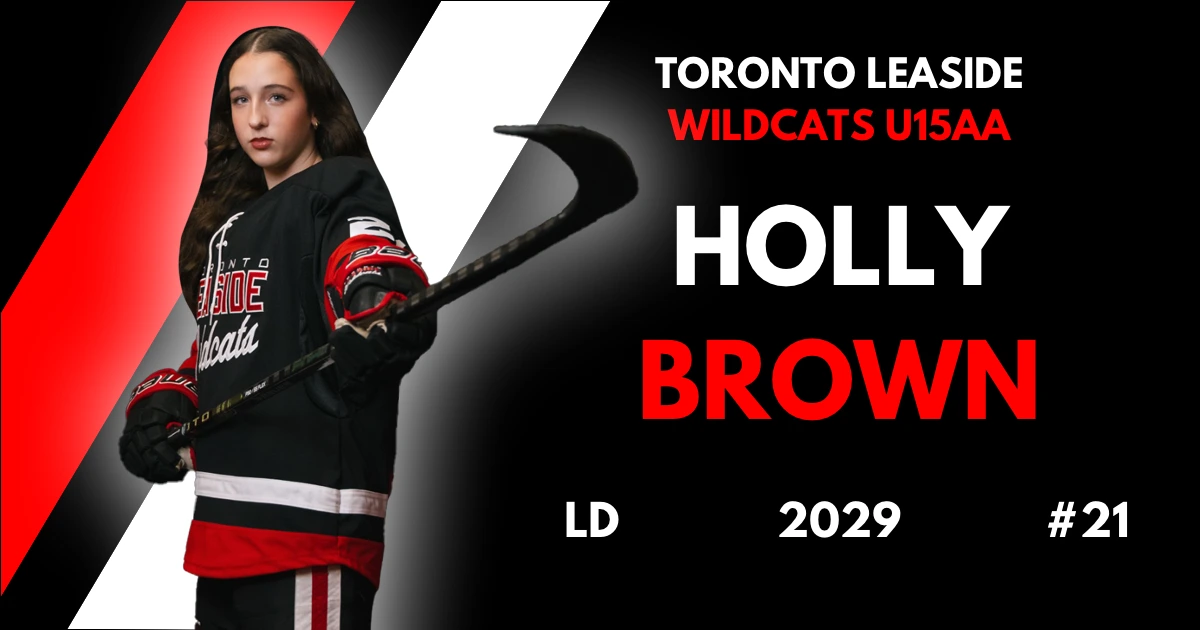
Holly Brown
Player Overview
Height
5’5″
Position
Defenseman
Shot
Left
Team
Toronto Leaside Wildcats U18A
School
Father John Redmond
Grad Class
2029
Programs of Interest
- Math
- Music
- Phys.Ed
Academic Record
Scouting Report
Defensive Zone
Key Strengths
- Weak-Side Coverage: Holly Brown finds her spot on the weak side without being told. She doesn't drift into it or guess her way there — she reads where the play is going and gets there first, holding the lane and taking away the second option before the puck carrier can use it.
- Net-Front Presence: She understands the real estate in front of her goalie and gets there with her body between the attacker and the crease. She's not chasing from behind and cleaning up — she's there before the threat arrives.
- Strong-Side Read: When play collapses to her side she reads the threat level without overcommitting. She stays in a position that keeps her useful to the group instead of jumping at the puck and leaving a gap behind her.
- Partner Support: She recognizes when her partner is engaged and adjusts to what the play needs — dropping into outlet position when her partner has it handled, stepping up as cover when she doesn't. That read happens without a conversation.
- Outlet Availability: When her partner has the puck, Holly is already in the right spot as a clean option. She doesn't need to be called for — she's there before the need becomes urgent.
Areas to Refine
- Arrival Speed: Holly gets to the right spot, but not always on time. A half-beat late is enough for a shooter to get a clean look or a cycle player to find space she should already own — the read is right and the destination is right, but the pace getting there isn't matching either of them yet.
- Releasing the Aggressive Side: She has an edge to her game that doesn't always come out. When she suppresses it her positioning becomes passive — she's occupying space instead of controlling it, and there's a meaningful difference between those two things on film.
- Converting Reads to Action: Her reads are ahead of her execution. She gets to the right spot with the right idea and then doesn't finish the thought — arriving with intent instead of just presence is the next step her positioning game needs to take.
Key Strengths
- Committed Reps: When Holly decides to go, she goes all the way. She finishes her check, sees it through contact, and doesn't pull up short — those reps show exactly what her pressure game looks like when she lets it out, and the ceiling is visible on those shifts.
- Lane Removal: On her better shifts she takes the option away before the puck carrier can use it. She's closing the lane with her body and eliminating the easy play before the decision gets made, not after.
- Body Positioning: When she engages with intent she gets inside — her body is between the puck and the option, not reaching from the outside hoping to get a piece of it. That's the difference between pressure that disrupts and pressure that inconveniences.
- Puck Race Commitment: In foot races she closes the gap and arrives with enough purpose to disrupt, not just contest. On those reps she's competing to win possession — the body language and the result are both different from the shifts where she holds back.
- Check Completion: She has shown the ability to finish a check and stick with it through contact. When that habit is present she's not easy to play through — the puck carrier has to account for her all the way through the play, not just at first contact.
Areas to Refine
- Commitment Consistency: The gap between her best pressure reps and her hesitant ones is wide enough to show up clearly on film. She has the skill to execute at a high level — the inconsistency isn't in the ability, it's in the decision to fully commit, and that's a harder problem to solve than a technical one.
- Closing Intensity: Even when she goes, the intensity can be dialed back from where it needs to be. Pressure that arrives at 80% gives the puck carrier just enough room to work through it — and at the next level, that room is all they need.
- Habit Over Instinct: Right now her puck pressure runs on instinct — good reps show up, inconsistent ones follow, and there's no reliable pattern to which one is coming. Building it into a repeatable habit every shift is where her pressure game needs to go, and that only comes from deciding it's non-negotiable before the shift starts.
Key Strengths
- Lane Positioning: Holly gets her body into the shooting lane. She's not guessing at where the shot is coming from — her read on the release point puts her in the right spot to be a factor before the puck leaves the stick.
- Stick Disruption: When she doesn't fully commit to a block, her stick stays active in the lane. She angles it to take away the clean release or deflect the puck off its path — it's not passive positioning, she's still working to affect the shot even when she stays upright.
- Read Before the Release: She identifies the shooter early enough to step in front of the attempt rather than reacting after the fact. The hockey sense to be in the right place at the right time is already there — what's being built now is the technique to match it.
- Willingness to Engage: She doesn't avoid the lane. Even without a fully developed drop technique, she's putting herself in front of pucks and accepting contact — that willingness is the foundation everything else gets built on, and it's already present.
- Goalie Sightlines: Her positioning doesn't screen her own goalie. She gets in the lane without taking away the look behind her — a detail that a lot of developing defenders miss, and one that shows she's thinking about more than just the shot in front of her.
Areas to Refine
- Drop Technique: Holly stays upright when blocking and it's limiting what she can take away. Learning to drop and seal the full lane is the skill that separates a positional shot blocker from one who takes away shooting lanes completely — and it needs to get reps in practice before it becomes something she trusts in a game.
- Confidence in the Technique: The hesitation in committing to a drop comes down to trust in a skill she hasn't fully developed yet. Getting comfortable with it in training will carry over into games — the reads and the positioning are already there to support the technique once it arrives.
- Finishing the Block: Right now the block disrupts the shot but doesn't control what happens after it. The next step is learning to angle her body or her stick to direct the puck away from danger — turning a deflection into a controlled clear instead of a loose puck sitting in the slot for a second attempt.
Key Strengths
- Clean First Pass: Without pressure Holly finds the outlet and delivers. She identifies the clearest option — usually her strong side — and executes with a success rate that's high enough to count on every shift. It's not flashy but it's reliable, and reliability on zone exits matters more than creativity.
- Puck Carrier Confidence: She's willing to skate with the puck and initiate the exit herself rather than forcing an immediate pass the moment she touches it. When she does it she claims the territory the play gives her and keeps the breakout moving forward instead of stalling it.
- Net as a Shield: When a forechecker is on her back she uses the net to create separation — she puts the structure between herself and the pressure, buys the moment she needs, and takes the easiest clean outlet available from there. It's a functional habit that shows up in the right situations.
- Composure in Traffic: When pressure arrives she doesn't panic and she doesn't force the play. Her decisions under a forecheck are clean — she keeps the puck, finds the option, and doesn't manufacture turnovers out of situations that don't require them.
- Strong-Side Execution: Her go-to exit is clean and well-timed on the strong side. Coaches can count on her to move the puck out of the zone without drama when that option is available — and she finds it consistently enough that it's become the most dependable part of her exit game.
Areas to Refine
- Net as a Reset Tool: Holly uses the net to escape pressure and that habit is already there. What isn't there yet is using it to stop, survey what's ahead, and initiate the exit from a position of control rather than reaction — the net isn't just a shield, it's a place to reset the whole play from, and she's not using it that way yet.
- Partner Usage on the Reversal: When the strong side is closed she doesn't consistently look to her partner on the reversal. That read needs to be built in as the automatic next option when the first one isn't there — right now it's an afterthought when it should be the first thing she sees.
- Reversal Outlet Positioning: When Holly is the one receiving the reversal she needs to get to the far corner early and give herself room to work. Her positioning on that side doesn't give her enough space to be a clean option under pressure — and if she's not positioned to receive it cleanly, the reversal her partner is trying to make doesn't have anywhere to go.
Neutral Zone
Key Strengths
- Defensive Tracking: Holly gets to her spot on the defensive side when the puck turns over. She's not reacting to the threat — she's already where it's going. Her assignment doesn't get a free step because she's already taken it away.
- Offensive Timing: When the play goes north she joins it. She reads it early enough that she's in position before the entry develops. She's not arriving after the fact — she's already in the picture when it forms.
- Positional Discipline: When others get pulled out of shape chasing the puck, Holly holds. She knows the difference between a race worth running and one that empties her side of the ice. That decision is already made before the situation forces it.
- No-Chase Habit: She doesn't go after pucks she can't win. Her game stays organized in transition because she's not manufacturing chaos by overcommitting to plays that aren't hers.
- Assignment Reliability: Both directions, both sides of the puck — coaches know where she is. She doesn't go missing in transition and she doesn't create problems by trying to do too much.
Areas to Refine
- Driving the Transition: Holly will complete the pass and stop. She'll reach the right position and wait. The next play is right there and she's not taking it — she's watching it develop around her instead of deciding to be the reason it happens.
- Decision Speed: Her reads are sound but the gap between seeing it and acting on it is costing her. By the time she moves, the window she identified has already started closing.
- Becoming the Play: She's in the picture consistently in transition. What isn't there yet is the moment where she decides to take it herself — to carry, to jump the seam, to force the first decision instead of completing someone else's.
Key Strengths
- Balance Under Pressure: Holly doesn't give the puck up when she draws a check on the regroup. Her balance holds through contact, her edges stay engaged, and she comes out of it still in control of what happens next.
- Cut-Back Habit: When the lane closes she cuts back, puts her body between the puck and the pressure, and finds her partner before the check lands. She's doing it consistently enough that it reads as habit, not accident — and that's a meaningful distinction at this level.
- Partner Awareness: When the strong side isn't there she brings it back. She doesn't force the closed lane — she sees her partner, gets it there, and keeps possession moving in the right direction.
- Edge Engagement: She can change direction under pressure without surrendering the puck. The edgework to handle tight spaces on the regroup is functional, and it shows up when the pressure is real, not just when she has room to work.
- Puck Protection: She holds the puck through contact and uses her body to shield it. She stays composed long enough to find the play, and she doesn't spin it away when the pressure arrives.
Areas to Refine
- Using the Extra Gear: She has more speed in her legs than she's using on the regroup. Pushing through with pace instead of settling into a comfortable tempo changes what's available north of her — defenders who close fast force better decisions and open more ice for their forwards.
- Offensive Jump: When the regroup breaks out she can be quicker to get into it, whether she's got the puck or just handed it off. Right now she's watching the entry develop from behind instead of being part of the reason it works.
- Execution Rate: The instinct on the cut-back and reversal is right and it's showing up. The execution isn't always clean enough to turn a good decision into a clean possession play — and at the next level, the decision alone isn't enough if the delivery doesn't connect.
Key Strengths
- Middle Lane Denial: When Holly stays in motion on the weak side she closes the middle lane before the puck carrier can use it. The play goes wide because she's already there — she's not closing after the fact, she's taking the option away before it opens.
- Wall Pinch Timing: She reads the quick-up to the wall fast enough to get down and contest it. When the timing lands she's in the play before the winger can turn and use the puck, and the opposition has to find a different answer.
- Assignment Mirroring: She's most effective when she stays connected to her check through the neutral zone. That habit keeps her in disruption range without overcommitting, and it keeps her team's structure from bending when the puck moves quickly.
- Battle Continuation: When Holly steps up on a puck carrier she stays on her skates and keeps her body engaged through the check. She's not giving the carrier one obstacle and drifting — she's making herself a presence they have to solve twice.
- Structural Awareness: Her pressure decisions don't leave gaps behind her. She steps up when it's calculated — when she knows she can get there and still have her team covered — not when the puck pulls her into it.
Areas to Refine
- Puck-Watch Drift: When the puck moves to the weak side, Holly's eyes follow it instead of staying on her check. By the time she realizes the assignment has opened up, the gap is already there and the play is through it.
- Strong-Side Trail: When the play enters the offensive zone on her side, she has the opportunity to trail the rush and be a factor on the back end of the entry. She doesn't take it — she applies pressure at the line and stops there instead of following the play in and giving her team a third option at the blue line.
- Pressure Activation: Holly's pressure works when she's already moving when the moment arrives. When she has to initiate from a standstill her timing drops and her closing speed drops with it — the pressure that lands a half-second late gives the puck carrier just enough room to make the next play.
Key Strengths
- Blue Line Structure: Holly holds the line and keeps the group's shape intact on entries. She doesn't jump into bad situations — her read on when not to go is already developed, and the team has a reliable anchor at the line because of it.
- Regroup Connection: When she contributes to an entry it flows directly out of the regroup. There's no interruption, no hesitation at the line — the play keeps its momentum because she doesn't stop it.
- Safe Read First: She doesn't pinch at the wrong moment. That patience is what keeps entries from turning into two-on-ones the other way, and it's a habit that holds even when the play is moving fast around her.
- Body Positioning at the Line: Even without the puck her body closes the exit lane. She makes the line harder to skate back through, and she does it without needing to have the puck in her hands to be a factor.
- Composure Under Pressure: When the entry breaks down and the puck comes back to her she finds the next option without panicking. She resets and moves it — no turnover, no forced play at the worst spot on the ice.
Areas to Refine
- Far-Side Activation: The far-side option comes open and Holly goes back up the wall or back through the middle instead. It's the available play and she's not wrong to see it — but it's also the comfortable one, and comfortable is what's keeping her entry game where it is.
- Originating the Entry: When she touches the entry it's almost always off a regroup she already started. The decision isn't coming from her at the line — she's inheriting the play rather than generating it, and there's a difference between those two things that shows up on film.
- Stationary Tendency: Her feet stop at the line when the play opens up around her. Moving laterally, stepping into space, giving her team a different look — those habits aren't there yet, and the entry options being left on the table because of it are visible every time the read opens up and she doesn't take it.
Offensive Zone
Key Strengths
- High Zone Availability: Holly stays mobile in the offensive zone as the high option and makes herself a consistent link between one play and the next. She's not standing still waiting for the puck to find her — she's moving to stay open and giving her team a reliable reset when the play needs one.
- Flow Reading: She reads the movement of the play well enough to know when to hold her position and when to adjust. That read keeps her connected to what's happening below her instead of drifting out of the play when possession moves around the zone.
- Calling for the Puck: When she's the available option she says so. That vocal habit takes pressure off teammates who are running out of options and gives the play somewhere to go before it breaks down.
- Plan Before Possession: When Holly receives the puck she already has a read on what she's doing with it. She's not catching and thinking — the decision is made before it arrives, which keeps the play moving and prevents unnecessary hesitation at the most exposed spot on the ice.
- Puck Security: She doesn't throw the puck away when the easy option isn't there. She holds it, keeps her team in possession, and finds the next play without manufacturing a turnover out of a situation that didn't require one.
Areas to Refine
- Reading Available Space: When the zone opens up around her, Holly defaults back to the standard option instead of recognizing what the space is giving her. The room to move further into the zone and initiate something is there — she's just not taking it yet.
- Joining the Cycle: When the opportunity to rotate into the cycle presents itself, she watches it from above instead of becoming part of it. That decision keeps her safe and keeps her limited — the play doesn't need another observer, it needs another body in the rotation.
- Taking More Chances: Her possession game lives inside what's standard and reliable. The creative situations are available to her and she's passing on them — not because the reads aren't there, but because she hasn't yet committed to putting herself out there for more than what the moment requires.
Key Strengths
- Strong-Side Commitment: When her team has possession on her side, Holly stays committed to the play all the way through it. She doesn't drift off looking for something else — she holds her position, tracks the play, and remains a live option until the puck moves somewhere that makes her irrelevant.
- Weak-Side Reading: When the play develops on the far side she reads it from the weak side and adjusts her position to match what's coming. She's not flat-footed or late — she's already moving to where the play is going before it gets there.
- Positional Awareness: Like her defensive zone game, Holly knows where to be in the offensive zone when her team has the puck. The instinct for finding the right spot is already developed — it shows up on both sides of the ice and it's consistent enough to count on.
- Pinch Execution: When she pinches she times it cleanly. She's not jumping into bad situations — she reads when the play is there to be won and commits to it without leaving her team exposed behind her.
- Puck Battle Support: When possession gets contested along the wall or below the goal line, she supports it. She gets into the right position to be a factor in the battle without crowding the play or pulling herself out of structure.
Areas to Refine
- Demanding the Puck: Holly is in the right spot but she's not making herself a problem for the opposition when she gets there. Calling for the puck as a genuine threat — not just as a reset option — is what starts to shift how the opposition accounts for her at the line.
- Holding Pressure Longer: When her team is in possession and the play slows down, Holly releases her position too early. Staying set at the line longer — holding the pressure instead of resetting — would give her team more time inside the zone before the opposition can organize a clear.
- Expanding the Threat: Holly knows where to be in the offensive zone and she gets there. The next step is pushing beyond the spots that keep her safe and getting to ice that puts the opposition in a decision — the reads are there to support it, and so is the positioning foundation she's already built.
Key Strengths
- Point A to Point B: Holly's playmaking is most effective when she keeps it direct. She moves the puck from where it is to where it needs to go without overcomplicating it — and that simplicity works because her reads on the right option are usually correct.
- Distribution First: She looks to distribute before she looks to shoot, and her reads on when to move the puck are sound. She's not forcing shots when the pass is the better play — she's making the decision that gives her team the best chance to generate something.
- Lane Recognition: When a shooting lane opens up she'll put it on net to create a scramble. She's not hunting for the perfect shot — she's identifying when the lane is there and using it, which is a more useful habit than waiting for a clean look that may never come.
- Deception Off the Line: She has shown the ability to use deception to move a checker off her at the blue line and take the puck in to make a play. Those reps are early and not yet consistent, but the instinct to create something beyond the first look is starting to surface.
- Puck Protection: When the first option isn't available she doesn't panic into a bad play. She holds the puck, shields it from the pressure closing on her, and keeps her feet moving until the next look opens up — the puck stays on her stick and her team stays in possession because she doesn't give it away cheap.
Areas to Refine
- Intensity With the Puck: Her playmaking is controlled but it doesn't carry urgency. Moving faster, demanding more from her reads, attacking the play instead of managing it — that shift in intensity is what creates chances for her to drive the play instead of distribute it.
- Intensity Without the Puck: The same intensity gap shows up when she doesn't have it. Moving harder off the puck, pressuring her check, putting herself in a position where the play has to account for her — that energy is what generates the situations her playmaking can then finish.
- Consistency of Deception: The reps where she evades a checker and takes it in are the most dangerous version of her playmaking game. Those moments aren't happening enough to be a consistent part of what she brings — building that habit into a reliable weapon would change how the opposition defends her at the line.
Key Strengths
- Step and Release: When the lane opens up she pulls the puck off the line and gets herself into the slot before the defense can close. The shot she releases from there is a different problem for a goalie than anything coming from the point.
- Drive to the Net: She reads when a rush is developing and cuts hard to the net. She's not drifting into the crease area — she's arriving with pace and purpose and giving her team a live body in a dangerous spot.
- Low and On Net: Her wrist shot and snap shot are low and on net. She's not trying to beat the goalie clean — she's creating traffic problems and giving her forwards something to work with in front.
- Offensive Read: Her hockey sense tells her when the play is opening up for an attack before it fully develops. That read gives her a step on the defense — she's already moving when most defensemen are still deciding.
- Willingness to Go: She takes the dangerous option when it presents itself. Those reps aren't polished and they don't always produce — but the decision to go is already there, and that's the part that can't be coached from nothing.
Areas to Refine
- Applying the Read: She reads the game well enough to know when a scoring chance is developing. That same sense doesn't consistently translate into action — she identifies the opportunity and defaults back to the safer play instead of letting the read take her somewhere dangerous.
- Building the Pattern: The slot steps and net drives show up but not enough to be a pattern. One or two reps a game isn't enough to make the opposition adjust — she needs to do it often enough that it becomes something they prepare for.
- Positioning as a Threat: When she doesn't have the puck in the offensive zone she isn't positioning herself as a scoring threat. Getting to dangerous ice without the puck — and being there when it arrives — is the habit that turns her offensive flashes into a consistent part of her game.
Technical Skills
Key Strengths
- Stance and Base: Holly Brown's skating stance is well positioned — she's not upright and she's not overreaching. That foundation gives her balance through contact and keeps her stable when the play demands a quick adjustment.
- Stride Length and Power: Her stride runs between medium and long with a powerful push behind it. She gets more out of each stride than most players her age because the push is generating real force — it's a more efficient engine than a quick, lighter stride would be at this stage of her development.
- First Three Steps: Her initial acceleration is above average. She gets moving quickly enough out of her stance to be a factor in races and transitions — not among the best in the league, but ahead of where most defensemen at this level are starting from.
- Edgework and Balance: Her edges aren't rigid — she moves through them with balance and is showing signs of using weight transfers when she's carrying the puck. That fluidity is starting to show up as a tool rather than just a byproduct of her skating.
- Lateral Movement and Escape: Her lateral movement is becoming a habit she reaches for when evading a check. She can cut back and escape pressure because her vision, her hands, and her feet are working together — it's not one or the other carrying the play, it's all three connecting at the same time.
Areas to Refine
- Top-End Speed: Holly's stride is powerful but it doesn't have another gear. Developing top-end speed would change what she can do in open ice — races she's currently managing would become races she's winning, and the gap between her and faster opponents would close from both directions.
- Explosive Separation: Getting off the line with explosive separation would open a different dimension to her game. Right now the first three steps are above average — pushing them to elite would give her the ability to create distance from pressure and close distance on opponents before they have time to react.
- Mental Commitment to Intensity: The physical tools to skate at a higher level are there. What needs to develop alongside the training and repetition is the mental commitment to raise the intensity of her skating every shift — because the separation between where she is and where she can be isn't just physical.
Key Strengths
- Puck Placement: When space allows it, Holly keeps the puck out in front of her body. That placement gives her options in both directions and keeps the puck in a position where she can use it rather than protecting it behind her.
- Reading the Pressure: When a checker closes, she drops the puck to her forehand or backhand side to create separation between it and the threat. She's not reacting to contact — she's reading the pressure before it arrives and moving the puck to where the checker can't get to it.
- Puck Controller: Holly is a puck controller and protector, not a stickhandler in the traditional sense. She keeps the puck on her stick and moves it on her terms, not the checker's — that identity ties directly into who she is as a skating defenseman and it's a legitimate and effective one.
- Hard to Bump: Body on body, Holly is difficult to bump off the puck. When she's in motion and physically challenged, she absorbs the contact and keeps possession — her ability to hold the puck through physical pressure is one of the more dependable parts of her game.
- Hand and Feet Coordination: Her hands and feet are starting to work together when she's carrying and evading. The coordination between the two is showing up consistently enough that it's becoming part of how she moves through pressure rather than throwing the puck away when pressured.
Areas to Refine
- Building Deception: Holly doesn't need to master deception overnight — but she needs to start taking chances to figure out what works for her. A small fake, a shoulder sell, a hesitation before she moves the puck — those reps in practice and in games are how she starts to build a layer of unpredictability into a handling game that is currently readable.
- Shift and Handle: The weight transfer she's developing in her skating isn't yet connected to her stickhandling. Bringing those two things together — shifting her weight and moving the puck in the same motion — would make her harder to pin down and give her a new tool for creating separation that doesn't rely on pure speed.
- Puck Push: When Holly is controlling the puck into open ice she needs to make better use of the puck push — getting it out ahead of her sooner and with more intent would let her gain speed faster and take more territory before the opposition can close the gap.
Key Strengths
- Power Behind the Pass: Holly's passing game is built on strength — there is nothing frail about how she moves the puck. Every pass has weight behind it, and that foundation gives her the ability to connect on passes that most players her age can't deliver with the same authority.
- Long Range Delivery: She excels on long range passes — quick-ups, cross-ice weak-side feeds, and stretch passes in transition. The distance doesn't affect the weight or the accuracy — she can find a target across the ice or up the wall and put it there with the same confidence she has on a short outlet.
- Outlet Recognition: She reads her outlet options quickly and defaults to the one with the highest probability of connecting tape-to-tape. She's not forcing the first look — she's processing what's available and choosing the pass that gives her team the best chance to maintain possession.
- Hockey Sense in the Pass: Her passing game has genuine hockey sense behind it. She sees the play developing before it fully forms and uses that read to deliver the puck ahead of the pressure rather than into it — the decision and the delivery are connected, not sequential.
- Passing Foundation: The ability to connect on passes in multiple situations isn't something Holly is still building — it's already there. Different game states, different pressure levels, different areas of the ice — the foundation holds up across all of them and it shows up consistently enough that coaches can count on it.
Areas to Refine
- Controlling the Power: The same strength that makes her passing dangerous works against her when it isn't managed. Too much force behind the pass keeps it from sailing flat and crisp along the ice — the delivery loses its precision and the receiver has a harder problem to handle than they should.
- Reversal Angle: She can make the D-to-D reversal pass to her partner below the goal line — the ability is there. What isn't there yet is the recognition of where she needs to be positioned before she sends it. A better angle on the delivery changes the pass from a difficult one into a clean one.
- Specialty Passing: The details that separate a good passing game from a great one aren't yet part of what Holly brings — the chip off the wall, the slip pass, the backhand on her off-wing. Those aren't advanced skills for their own sake — they're the tools that keep the opposition from reading her next move before she makes it.
Key Strengths
- Finding the Lane: Holly reads the play well enough to recognize when a shooting opportunity is developing and gets herself into position before it fully opens up. She takes the space the play gives her and uses it — she's not waiting to be set up, she's setting herself up.
- Catch and Load: She transfers cleanly from receiving the pass into her shooting posture without losing time or balance. The transition from catch to release is smooth — by the time the puck is on her stick she's already in position to shoot.
- Point Shot Power: She can load up genuine power behind her point shot. When she winds up and commits, there is real weight behind it — it's not a shot goalies are comfortable with and it's not one defenders want to get in front of.
- Pucks to the Net: She does the unglamorous work of getting pucks through traffic and on net for rebounds. That habit has generated real assists — not from highlight plays, but from putting the puck in an area where her forwards can finish what she started.
- Accuracy First: Holly won't sacrifice her target for the sake of adding power. She shoots to hit her spot — a controlled shot that lands on net is more useful to her game than a hard one that misses, and she understands that.
Areas to Refine
- Shooting to Score: Holly's default is to get the puck through and on net — and that habit produces results. What needs to develop alongside it is the ability to read when the play is giving her a chance to shoot to score, not just shoot to create. Recognizing that moment and taking it is the next layer her shooting game needs.
- Quick Release: There are moments where Holly loads up when the play is calling for a faster delivery. The sequence needs to become automatic — puck on the stick, read the opening, puck off the stick. Her reads are already at a level where they can drive a quicker release — the habit just needs to catch up to the instinct.
- Slap Shot Development: The slap shot still has real value in a defenseman's game — as an intimidation factor, a way to disrupt a goalie's timing, and a tool for sustaining offensive pressure. Holly doesn't have it in her repertoire yet, and at the level she's building toward, a defenseman who can threaten with a slap shot from the point is a different kind of problem for the opposition to manage.
Situational Play
Key Strengths
- System Buy-In: Holly commits to the structure she's playing in across all three zones — it shows up in her positioning, her decisions, and her habits shift after shift. She's not dipping in and out of the system when it suits her — she's in it all the way through.
- Off-Puck Support: Whether her team has possession or is defending, Holly never leaves a teammate without a support option. That consistency is one of the quieter but more valuable things she brings to a group — the play always has somewhere to go because she makes sure it does.
- Owns the Assignment: Holly plays the role her coaching staff gives her without freelancing or trying to impose her own agenda on the play. Watch her habits and behaviours across a full shift and you'll see a defenseman who is contributing to the system — not deferring from it, not bending it to fit what she wants to do.
- Execution With the Puck: When she has the puck inside the system, she keeps it simple and keeps the team moving forward. A short outlet, a carry when the space opens up — she won't put her team in a high-risk situation to make something happen that the system isn't asking for.
- System Reset: When the play breaks down, Holly's read on the situation takes over. She'll bring the puck back for a regroup, tighten a defensive formation, or get the whistle on a clearing attempt — whatever the moment calls for to get her team out of pressure without adding to it.
Areas to Refine
- Communication: Holly reads the game well enough to be an extra set of eyes for everyone around her — but she's not vocalizing what she sees. Calling out what's developing, directing a teammate off a check, signaling a switch — that information is already in her head and her teammates need to hear it.
- Activating Within the System: Holly fits into her team's system as a reliable piece — the next step is becoming a piece the system runs through. That doesn't mean doing more than the play calls for — it means engaging with more intent at the right moments so that her presence in the system becomes something the opposition has to account for, not just manage.
- Finer Details: The details that make a defenseman valuable across all situations aren't yet a consistent part of Holly's game. At 5v5 she needs to become more involved in the play rather than operating on the edges of it. On the power play, she needs to want the puck — demand it, use it, and make the opposition respect her at the line. On the penalty kill, her puck pressure and shot blocking need to become weapons she reaches for consistently, not situationally.
Key Strengths
- Hockey Sense: The reads and decision-making Holly brings to her game translate directly to power play value. She keeps possession moving by making the simple play at the right moment — and on the power play, that instinct is what keeps the unit out of penalty kill territory.
- Positioning: She knows where to be and when to move. On the power play, that awareness keeps her connected to the play and available as an option without pulling herself out of position at the wrong moment.
- Passing Range: The foundation to go high to low, D-to-D, and cross-ice to the weak side is already in her game. Those are the exact passing lanes a power play unit lives and dies by — and Holly can hit all of them with authority.
- Point Shot: Getting pucks through traffic and on net is her calling card from the point. On the power play, that habit creates rebounds and second chances that keep the pressure inside the zone and the penalty kill on their heels.
- Blue Line Mobility: She stays in motion at the line to keep herself available and connected to the play. That movement makes her harder to pressure and gives her unit a reliable reset option when the puck needs to come back up top.
Areas to Refine
- Engagement: Holly's default is to contribute from the edges of the play. To earn power play minutes and keep them, she needs to bring a compete level that puts her in the middle of key sequences — not as a support piece waiting for the puck to find her, but as a player actively demanding to be part of what's happening.
- Communication: Physical engagement on the power play is one part of it — leading with her voice is another. Calling for pucks, directing her unit, and commanding the play verbally is an outward expression of compete that scouts can see from the stands and coaches can hear from the bench.
- Identity Buy-In: The base to become a focal point on the power play is already there — it shows up in her hockey sense, her passing range, and her ability to quietly generate offense from the point. Becoming the player the power play runs through requires more than quiet competence — it requires wanting the puck, commanding the play when she has it, and positioning herself to shoot to score, not just to contribute.
Key Strengths
- Tracking the Play: Holly reads the power play formation as it develops in front of her. She understands what the opposition is setting up before they execute it — that awareness gives her a step on the play and keeps her from being caught reacting to something she should have already seen coming.
- Tracking Her Assignment: She knows who is around her, gets inside body positioning when the play calls for it, and doesn't let her assignment drift out of her sightline. Her check doesn't get lost in the chaos of a power play — she stays connected to them through the movement and the noise.
- Positioning: She covers her zone of the ice and mirrors the play to take away seams in her area. She's not chasing the puck around the zone — she's holding her ground and closing the options that run through her piece of the ice.
- Puck Battles: Her physicality shows up most on the penalty kill. When possession gets contested, Holly competes to win it — her strength in those battles is one of the more reliable tools she brings to the unit and one of the clearest expressions of her compete level.
- Clearing Shot: She has the power to send pucks cleanly down the ice and is showing early signs of the patience to find the right moment to shoot it through. She's not forcing clears into blocked lanes — she's holding for the opening and using her shot strength to finish the job.
Areas to Refine
- Puck Pressure: To become a true penalty kill specialist, Holly needs to speed up her puck pressure game. That means studying angles and routes, and developing the timing to know when to commit to the check — because at the highest level you don't chase the puck carrier, you stay within reach and force them to make a decision before they're ready to make it.
- Shot Blocking: If Holly wants first unit penalty kill minutes, shot blocking has to become part of her DNA — it's one of the non-negotiables at the highest levels of the game. The read, the positioning, the timing, and the execution of the block all have to come together as one fluid skill. Breaking it down, studying it, and getting reps in training and in games is how that skill gets built into something she can count on when it matters most.
- Identity Buy-In: Like on the power play, becoming a first unit penalty killer starts with a choice — the choice to be that player before the skill is fully there. From that choice comes the work of breaking down what elite penalty killing looks like, building the habits and behaviours it requires, and making that identity part of who she is every time she steps on the ice in a shorthanded situation.
Key Strengths
- Supporting Breakdowns: When her team's structure breaks down, Holly reads it immediately and stays back as the last line of defense. She doesn't get caught up ice when the play falls apart around her — she recognizes the moment and makes herself the safety valve before the situation gets worse.
- Offensive Signalling: She is starting to show awareness of when to join the offensive attack instead of hanging back in the formation. Right now it shows up as trailing the carrier or filling the weak-side lane — small wins at this stage, but the instinct to read when the play is inviting her forward is developing and it's pointing in the right direction.
- Burning Up Seconds: Holly uses her physical strength and body positioning to pin pucks along the wall and slow the play down when the situation calls for it. Her awareness of when to use it is at the standard for her age and level — she's not overusing it or reaching for it at the wrong moment.
- Getting the Whistle: She knows when to get the puck down ice and when to stop the opposition from getting to the net so her goalie can smother it for a stoppage. Those are small details that don't show up on a scoresheet but show up on film — and coaches notice them.
- Line Change Decisions: Holly rarely makes a bad line change. She sees a zone exit through to completion before she leaves the ice, and during an extended shift she waits until the change won't create a risk from her zone. That discipline keeps her team from being caught short at the wrong moment.
Areas to Refine
- Compete Level by Situation: Holly is steady by nature — and there are moments in a game where steady isn't enough. When the game demands intensity and aggression, she needs to match it. The signals that she can get there are already visible — the next step is making that version of herself the response to those moments, not the exception to it.
- Locking Down the Best Player: When Holly's assignment is the opposition's best player, her positioning and attention need to tighten up immediately. Don't give them room to get loose, don't let them drift from her sightline — the details that are good enough against everyone else aren't good enough against the player who can change the game on their own.
- Setting the Tone Early: Holly can ease into a game to read what the opposition is bringing before she fully commits. The highest version of her game doesn't need that information first — it shows up from the drop of the puck and forces the opposition to adjust to her, not the other way around.
Mental Game
Key Strengths
- Reading the Play: Holly Brown is cerebral in how she processes the game. She reads defensive zone threats before they fully develop, identifies outlet options on the breakout before pressure arrives, and tracks power play formations as they set up in front of her. The processing happens early and it shows up consistently across all three zones.
- Decision-Making: More often than not, Holly makes the decision that gives her team the highest probability of executing the play cleanly. The outlet pass that connects, the zone exit that keeps possession moving, the line change that doesn't create a risk — her decisions are sound and her teammates benefit from them shift after shift.
- Playing Within the System: Holly's game reveals itself inside a structured setting. Her positioning across all three zones, her off-puck support when her team has possession and when they don't, her system resets when the play breaks down — all of it surfaces because she understands the structure she's playing in and commits to it completely.
- Keeping It Simple: She will keep the play simple to protect her team from unnecessary risk. A short outlet pass, a carry when the space is given, a clear when the zone needs to be released — she makes the play that keeps her team moving forward without putting them in a difficult situation to manage.
- Attack vs Retreat: Holly is developing the awareness of when to join the offensive attack and when to stay back and support. The read between trailing the rush, filling the weak-side lane, or holding back as the last line of defense is becoming more instinctive — and that development is starting to show up in her game in real and visible ways.
Areas to Refine
- Shoot vs Pass: Holly's default is to distribute — and her passing game is strong enough that it's rarely the wrong call. But there are moments on film where the shot is the right play and she moves the puck anyway. Trusting herself to pull the trigger in those moments, and developing the read to identify them before they close, is the next layer her decision-making needs.
- Work Rate vs Compete Level: Her work rate is never in question — she won't mail in a shift or take a play off. What needs to develop alongside it is the outward expression of intensity when the game demands it. The aggression is in her — it shows up in glimpses — but it needs to become the consistent response to the moment that calls for it, not an occasional one.
- Embrace Creativity: Holly's choices with and without the puck in the offensive zone are linear by habit. The cerebral processing to understand what's developing around her is already there — what isn't there yet is the willingness to step outside what's comfortable and try something the opposition isn't expecting. That starts with taking chances, not mastering them.
Key Strengths
- Consistent Effort: Holly Brown brings a consistent work rate across all three periods. She doesn't have shifts where she's going through the motions — the effort is there from the drop of the puck to the final whistle and it doesn't waver based on the score or the situation.
- Physicality: She will lean into the physical side of her game when the moment calls for it. She's not looking to impose herself unnecessarily — but when the play demands a physical answer, she provides one without hesitation.
- Loves to Battle: Below the goal line, in the corners, along the wall — Holly won't back down from a challenge in any of those situations. She competes to win those battles and she doesn't give up on them when they get difficult.
- Puck Races: When possession is up for grabs, Holly goes after it with full effort. She's not jogging to pucks she might not win — she commits to the race and gives herself the best chance to come out of it with the puck.
- Level Head: Her compete level never costs her team. She doesn't overcommit, overextend, or let her emotions pull her into a bad penalty — she competes hard and stays within the boundaries that keep her team from paying for it.
Areas to Refine
- Own the Intensity: Holly's compete level is steady — and there are moments in a game that require more than steady. Revving the engine and going to the red line when the moment calls for it needs to become a tool she can reach for deliberately, not something that shows up by accident.
- Pick Your Battles: Competing doesn't mean gritting your teeth and skating harder on every play. It means sustaining focus across three periods and knowing which battles are worth winning and which ones can cause a mistake that costs the team. Holly needs to develop that distinction — compete through precision, not just effort.
- Stop Holding Back: The pieces are in place for Holly to accelerate her game to a new level. The only thing standing between where she is and where she can be is the decision to let it happen — no one is holding her back except herself.
Key Strengths
- Won't Get Baited: The opposition can't pull Holly into retaliation. She reads those attempts for what they are and doesn't take the bait — her team keeps their full complement of players on the ice because she won't let an opponent get inside her head.
- Scrum Awareness: When scrums happen after the whistle she'll be present without crossing the line. She knows the difference between showing up for her teammates and costing them a penalty — and she stays on the right side of it.
- Composed After Breakdowns: After a broken play or a goal against, Holly doesn't wear it. She comes back to the bench without the negative on her sleeve, resets, and goes back out ready to play — the mistake doesn't follow her into the next shift.
- Calm by Nature: From the start of a shift to the end of it, Holly is calm, cool, and collected. Nothing she does on the ice is animated or reactive — she plays with an even keel that doesn't give the opposition anything to feed off.
- Trusted in Tight Moments: Coaches can put Holly on the ice in tight moments of a game knowing her emotions won't get in the way of her execution. That trust is earned — and it's one of the quieter but more valuable things she brings to a group.
Areas to Refine
- Let the Emotion Out: Hockey is an emotional game — and emotion can work for you as much as it can work against you. Holly's composure is a strength, but there are moments where an aggressive mindset and her physical ability need to work together out loud. Letting that emotion surface when the game calls for it isn't losing control — it's competing at a higher level.
- Respond With Fire: Coming back to the next shift at baseline after something goes wrong won't cut it at the higher level. When the game turns against her or her team, the response needs to have more fire behind it — not recklessness, but a visible shift in intensity that signals she's not accepting what just happened.
- Body Language: Holly's composure is rarely a problem — but there are moments in a game where her demeanour goes flat and it takes her compete level down with it. Learning to channel the right emotion at the right moment — not manufactured, not forced — would keep her engine running at a higher level for longer stretches of the game.
Key Strengths
- No Panic: When a breakdown happens, Holly doesn't spiral. She absorbs it, gets off the ice, and comes back ready to play — the breakdown doesn't become a second one because she doesn't let it get inside her head.
- Clean Slate: Before the next puck drop, Holly is reset. Whatever happened on the previous shift isn't visible in how she carries herself or how she approaches what's coming next — she starts fresh every time.
- Tightening the Assignment: After a breakdown, the first thing Holly does is lock back onto her assignment. She doesn't freelance or overcompensate — she gets back to her check and makes sure that piece of the problem is solved before anything else.
- Staying Within the Structure: When things go wrong, Holly doesn't abandon the system looking for an individual answer. She resets back into the structure and trusts it to get her team back on track — and that discipline keeps a bad shift from becoming a bad period.
- Execute to Stay Out of Trouble: Her reset isn't passive — she comes back out and makes the plays that keep her team from compounding the problem. A clean outlet, a smart clear, a simple play that stops the bleeding — she knows what the moment is asking for and delivers it.
Areas to Refine
- Understanding the Breakdown: Holly resets cleanly but she doesn't always process why the breakdown happened. Taking that information into the next shift — adjusting the read, the positioning, or the decision that caused it — is what turns a reset into a genuine correction rather than just a fresh start.
- Matching the Compete Level to the Moment: Coming back to the next shift at baseline after a breakdown isn't always enough. Holly needs to identify what level of intensity the moment is calling for and bring it immediately — not ease back into it over the course of the shift.
- Real Time Communication: When things break down, Holly resets individually but doesn't bring her teammates with her. Communicating in real time — calling out what happened, redirecting a teammate, resetting the group out loud — would turn her individual reset ability into something the whole unit benefits from.
Game Film & Highlights
| Date | Opponent | Game Type | Watch |
|---|---|---|---|
| November 2025 | Various | Season | ▶ Watch Film |
×
Frequently Asked Questions
- After hockey, Holly is interested in pursuing a career in psychology or education, and plans to travel abroad.
- Outside of hockey, Holly plays the violin and spends her summers at the cottage swimming and waterskiing.
- Holly trains with Cody Crichton for video review and on-ice skills. She also plays under coach James Roxborough during the season.
- Coaches should know Holly has completed Grade 8 Royal Conservatory violin and is part of her school’s Regional Arts Program.