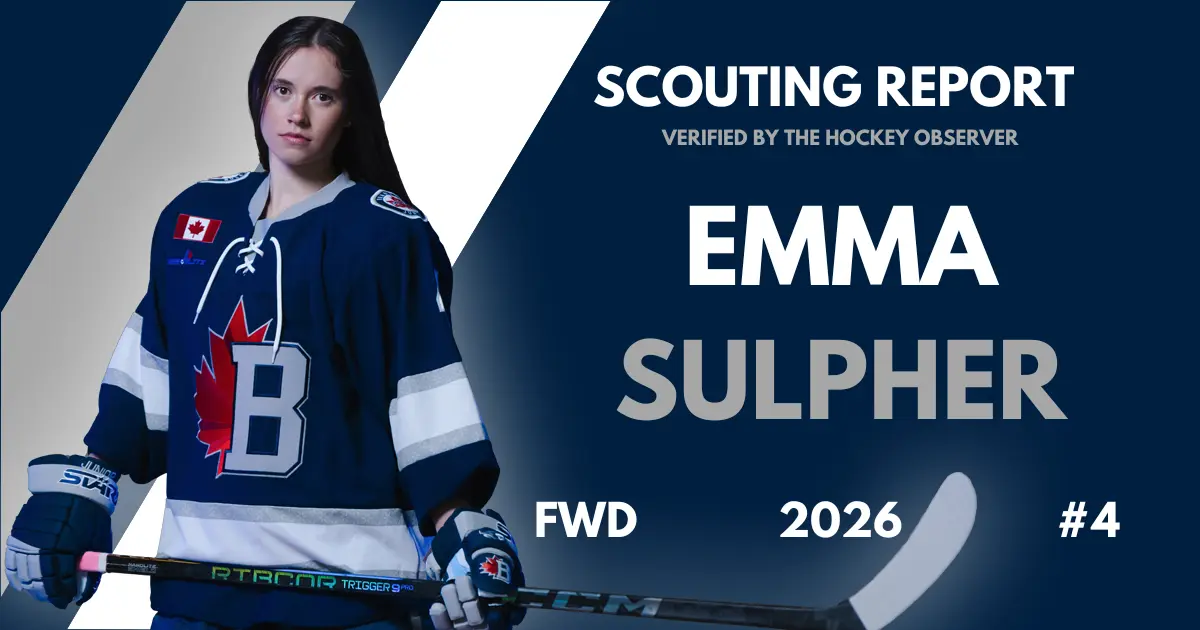
Emma Sulpher Scouting Report
Start by watching where she sets herself before the puck becomes a threat. She stays connected to her assignment, protects the middle first, and resists getting pulled into unnecessary movement. When pressure builds, she doesn’t rush — she holds position, keeps her hips open, and adjusts as the play shifts. The tell is her timing: she steps only when the puck carrier commits, turning patience into forced touches instead of chasing contact.
This is where her reads come into focus. Watch how she identifies her role on the rush — supporting underneath, stepping into pressure, or pulling the group back into a reset. Her routes stay clean, she scans early, and she consistently removes options before they fully develop. When she’s engaged here, the play feels organized rather than reactive.
Look for control rather than urgency. She uses delays, body positioning, and small changes of direction to hold pucks and let options form. She supports close to the play, slips into space as pressure shifts, and keeps possessions alive with smart touches. Most of her offence comes from reading when to wait and when to move.
Her skating base shows up immediately — strong edges, balance, and comfort changing direction with the puck. She escapes pressure without extra touches and keeps her handling efficient. Passing is clean and well-timed on both forehand and backhand, especially on the move. Her shot isn’t about power; it shows up through a quick release and accuracy when space opens up.
She’s most effective when the game tightens. On the penalty kill, she angles with control and guides plays into predictable areas rather than chasing. On the power play, she slows sequences just enough to open seams and shift defenders. Across different systems, she adjusts quickly and executes her role without shortcuts, which gives coaches confidence to use her in defined minutes.
Track how composed her game stays over the course of a night. She processes information quickly, adjusts after breakdowns, and doesn’t let one moment bleed into the next. Her compete shows up through responsibility rather than emotion, and her presence keeps shifts from unraveling. When the game compresses late, she remains composed and predictable — in a good way.
Defensive Zone
Emma Sulpher’s work in her own end runs on discipline, awareness, and a refusal to drift away from her responsibilities. Her shifts carry a consistency coaches can trust: she stays connected to her check, reads where the play is heading, and organizes herself in ways that give her group a predictable anchor.
The structure comes from how she positions herself, but the value comes from how quickly she can adjust when the moment shifts — a trait that reflects a sharp read of pressure and an understanding of what her team needs inside the chaos.
Her sense of Positioning shows up early in possessions, especially when threats rotate high or drift low into soft ice. Instead of chasing the first read, she holds the route that protects the middle, adjusts when exchanges occur, and keeps her hips open enough to react without crossing herself up.
Those habits signal someone who sees the defensive zone in layers of responsibility: protect the house, track the assignment, and adjust only when the play demands it. The reliability of those decisions settles the group around her.
The timing inside her Puck Pressure gives her defensive identity an entirely different texture. She doesn’t lunge, doesn’t overextend, and refuses to let puck carriers bait her into unnecessary movement.
When she does step, she closes with intent — quick feet, controlled angle, and just enough jump to turn a hesitation into a forced touch. When containment is the smarter answer, she shades into the passing lane and waits for the moment that swings the advantage back to her side.
The balance between pressure and patience is one of her most mature reads.
A growing commitment to Shot Blocking has begun to shape the way she handles interior threats. She’s showing more willingness to drop and take away lanes, even if her technique is still coming together.
You can see the instincts forming: recognizing when a point shot is coming, getting inside the release, and choosing whether to front or drop based on distance. As attempts increase and her mechanics sharpen, that willingness will evolve into a reliable asset — the kind that kills possessions before they reach the net-front.
Her involvement in Zone Exits rounds out the picture, because she gives her team multiple ways out of pressure. When she carries, she uses early puck pushes to build speed and create a pocket of space that wasn’t there a second earlier.
When she’s the outlet, she doesn’t stay stuck on a single lane; she fades, pivots, or widens into space that supports the breakout rhythm without clogging it. That versatility keeps exits clean and keeps her line moving forward instead of getting trapped in repeat retrievals.
The more you watch Emma Sulpher defend, the clearer her trajectory becomes. Her reads stay calm, her support stays honest, and her commitment to owning her responsibilities gives her team a stabilizing presence when the play breaks.
If the upward trend in these habits continues, she evolves into a forward whose reliability changes how coaches deploy a line.
Neutral Zone
Emma Sulpher brings a neutral-zone presence built on awareness, movement, and an ability to stay connected to the rush whether she’s above or below the puck. Her reads in this space have sharpened significantly this season — more confidence on possession touches, more composure as she surveys pressure, and far better anticipation of whether she needs to support the play, lead it, or reset it.
This zone reveals how her growing poise and problem-solving tighten her influence on both sides of the puck.
She shows that maturity immediately through her Transition Play, where the shift from exit to attack feels more intentional than ever. Earlier in her development, the puck was off her blade as quickly as it arrived.
Now she skates with her head up, scans what’s ahead, and waits a half-beat to choose the sequence that keeps her group connected. When she’s off-puck, she tracks the rush shape — deciding whether she’ll be F2 or F3 — and positions herself to extend possession rather than drifting into lanes that don’t assist the play.
Those reads carry into broken sequences as well, allowing her to reset or delay without stalling her team’s momentum.
Another part of her influence emerges in Regrouping, where she adapts cleanly to whatever the new pattern requires. When her group pulls back after an entry dies, she slides into her lane with purpose rather than waiting for the puck to find her.
She understands where the next touch needs to originate, how wide she must stretch to give her defense options, and when she can cut back into the interior to accelerate the return attack.
The interesting part is her occasional willingness to step outside the prescribed pattern when the moment calls for it — a bit of creative problem-solving that gives her team an extra option without sacrificing structure.
Her presence sharpens even further inside the demands of Neutral Zone Pressure. Whether she’s the first forward over the puck or supporting from behind, she identifies where the opposing carrier’s escape route sits and angles with enough detail to close it off.
When she’s F1 on a regroup, she doesn’t drift toward the puck; she builds speed through the route, sticks her blade in the lane, forces an early decision, and seals the wall shoulder-to-hip before rotating out.
Off the puck, she reads which threat needs to be absorbed and which lane needs to be eliminated — a big reason she works as a natural neutral-zone checker.
She finishes sequences with the same intention through her Entry Execution, where her composure with the puck turns simple rushes into controlled possessions. As the carrier, she recognizes when to take ice, when to cut back, and when to peel wide to create room for the second wave.
Her edges let her stop-start sharply, turn past a check, or delay long enough for support to arrive. Without the puck, she maintains the same discipline she uses in breakouts and transition — knowing her role, committing to it, and presenting a clean option without clogging the middle.
The only missing piece is vocal direction; her vision would elevate the entire line if she communicated what she sees before the play breaks open.
The neutral-zone picture shows a player whose influence grows every month, and the next step for Emma Sulpher is learning when to take command of the moment — using her voice, her movement, and her reads to direct the sequence rather than simply enabling it.
Offensive Zone
Emma Sulpher works the offensive zone with a calm urgency, reading pressure, sliding into space, and handling the puck in ways that stretch defenders thin. She doesn’t chase offence; she builds it — one touch, one delay, one read at a time.
The more control she has in tight spaces, the more her creativity shows, and this is the end of the rink where her confidence turns into real influence.
What stands out first is how she manages Puck Possession. She brings a small bit of deception in the way she changes speeds, shields the puck, and delays long enough for lanes to open.
Instead of overpowering defenders, she leans on body positioning and vision to buy time — slowing when the setup is forming, re-engaging when pressure is flat, and protecting the puck along the wall or below the goal line until the right option surfaces.
The only missing layer is recognizing when she can drive the middle herself. There are moments where the lane is hers, but her instinct as a passer nudges her toward distributing rather than attacking the interior.
A different strength appears when she slides into Off-Puck Support. She works close to the pile, slipping into openings, digging out loose pucks, and extending possessions that would otherwise die on a 50/50.
When an attack builds above her, she finds quiet ice to become a shooting option, or she slips into the net-front to compete for positioning and disrupt defenders.
Her movements are timed rather than random — she isn’t guessing where the play will go; she’s reading how to stay inside it.
The creative side of her identity sharpens through her Playmaking, where she elevates the players around her. Coaches with a finisher but no natural facilitator find their answer in her patience, timing, and sense for how to create something from limited space.
She waits out defenders, uses subtle weight shifts to open lanes, and feeds pucks through seams with a calmness that amplifies the scoring threats on her line.
Nothing about her creation is loud, but it is consistently effective — the kind that fills a scoresheet quietly but meaningfully.
Her Scoring Ability rounds out the picture. She may not lead a team in goals, but she finds ways to contribute. Some chances begin with her own touches — a delay into the slot, a curl off the wall, or a cutback that frees her stick for a quick shot.
Other opportunities come from her awareness around rebounds or a sudden drive off the rush when she recognizes a defenseman is on the wrong foot. There’s no singular profile to how she produces; she adapts to the moment and finishes what the play presents.
All of this points toward a player whose offensive game raises the ceiling of any line, and the next step for Emma Sulpher is trusting her ability to attack the heart of the ice with the same confidence she brings to seeing it.
Technical Skills
Emma Sulpher’s technical profile is built on repetition, detail, and the kind of long-term investment that shows up in her stride, her touch, and the cleanliness of her decisions with the puck. Nothing in this silo is accidental.
She has spent years sharpening pieces of her toolkit, and the result is a player whose skills don’t just support her game — they define it.
Her commitment is clearest in her Skating, where years of focused work show through her edge control, balance, and ability to shift across the ice without losing stability. Lateral movement looks smooth, her posture stays consistent, and her agility with the puck allows her to shake checks instead of absorbing them.
The next stage isn’t mechanical — it’s power-based. She has another gear available to her, and unlocking it hinges on continued physical maturation, targeted strength work, and deliberate top-end speed training. Her technique is in place; what she needs now is the horsepower to match it.
Stickhandling shows up in the way Emma protects space rather than tries to dazzle. Her puck control works with her edges, not separate from them, allowing her to steer pressure away from the puck.
She rarely leaves it exposed, using her feet, hips, and positioning to keep defenders off her blade and maintain control in tight areas. When pressure closes, she leans into her skating routes to create separation rather than relying on high-end fakes.
The subtle pulls and quick touches she does use aren’t flashy but they’re effective — small pieces of deception that keep her in control of the sequence.
The detail in her Passing shows up in how she manipulates the ice: small delays, angle changes, and decisions that turn simple routes into real scoring chances. She reads movement well, stays in motion, and delivers pucks with purpose — long hits through the neutral zone, slip passes below the goal line, or touch plays in stride during transition.
Her backhand touch is reliable, her saucer attempts are climbing in consistency, and the more she pairs her patience with sharper execution on that elevated skill, the more dangerous her creation becomes.
Emma’s Shooting gives her a complementary weapon — not overpowering, but efficient and well-aimed. She leans on accuracy and timing, releasing quickly and targeting open pockets before the goaltender resets.
Many of her finishes come from smart reads: far-side picks, pad-to-post placements, or quick touches off rebounds when defenders are flat-footed. She scores through recognition more than raw force, which fits the way she processes the game.
The deeper you look at her technical base, the clearer it becomes that Emma Sulpher is operating from a foundation that can scale quickly.
Strength, speed, and added force will only sharpen what she already does well, turning a refined skill set into one that drives shifts instead of simply guiding them.
Situational Play
Situational moments put players in spots where structure bends, timing shrinks, and mistakes turn into chances the other way. Emma Sulpher meets those moments with a composed urgency — recognizing the danger, sliding into the lane that solves it, and giving her bench the type of shift that resets momentum instead of bleeding it.
The core of that versatility shows in her System Play, where she can shift between styles without losing her identity. If a team runs a heavy forecheck, she leans into the grit and contact required. If the structure relies on speed, movement, and quick touches, she blends into the rhythm seamlessly.
Defensive-first environments work for her as well because she takes responsibility early, buys time for support, and keeps the puck out of dangerous areas. Her advantage is that she doesn’t just survive system changes — she elevates the group by reading her assignment honestly and executing it without shortcuts.
With the man advantage, her touches on the Power Play take on a different tone — slower when they need to breathe, quicker when a lane cracks open, always aimed at creating a grade-A look. She delays to open seams, steps into pockets that unsettle defenders, and threads passes that stretch the kill.
The next unlock is leaning into her shot when the window appears: sliding into the high slot, curling off the wall to attack the middle, or recognizing when she can drive the net instead of defaulting to distribution. Adding that assertiveness would round out a power-play threat built on touch, timing, and creativity.
On the Penalty Kill, her reads and routes give coaches immediate trust. She knows when to pressure, when to contain, and how to slide into rotations without leaving space behind her. There’s a composure to how she angles carriers and forces plays into predictable areas.
She doesn’t chase; she guides. When the puck moves low-to-high or shifts east-west, her timing on rotations stays calm and connected, which steadies the entire unit.
Game Awareness is where Emma ties it together. She senses what the moment needs — slowing frantic shifts, accelerating passive ones, and tightening her routes in sequences where one mistake can flip the matchup.
She handles heavy minutes without slipping in her habits, and her decisions put her in the right spots at the right moments.
Situational hockey reveals who can be trusted when the clock squeezes the game, and Emma Sulpher is that kind of player — the one you lean on when the next shift might decide a night or a season.
Mental Game
There’s a sharpness to the way Emma Sulpher thinks the game — a certainty that doesn’t drift, doesn’t get cluttered, and doesn’t waver when the rink gets loud or chaotic. She reads situations that let her change roles without hesitation: checker one shift, facilitator the next, defensive safety valve when the play breaks.
Plenty of players want to fit one identity; Emma shifts between several without forcing any of them. It’s a rare kind of intelligence, the type that gives coaches freedom to trust her in minutes where the next decision actually matters.
That intelligence is rooted in her Hockey Sense, which guides everything from her retrieval routes to her off-puck positioning to the timing of her entries. She doesn’t guess — she interprets. Attacks build from her patience, defensive moments settle because she moves where support is needed, and her routes reflect a player who understands not just what the play is, but what it’s about to become.
Emma’s ability to slip between roles isn’t a stylistic preference; it’s the product of someone who recognizes responsibility faster than her peers.
You see the same consistency in her Compete Level, though not in the loud, obvious way people often attach to that trait. Emma doesn’t burn herself out trying to prove she’s working — she applies pressure with purpose, shifts gears when the moment demands it, and stays in every battle long enough to influence the outcome.
She doesn’t take pauses, she doesn’t choose spots based on convenience, and she doesn’t inflate her game when eyes are on her. The compete is real because it’s measured, not manic.
She plays with a grounded presence that settles the group around her — the core of her Emotional Control. She doesn’t need to spike her energy to feel involved, and she doesn’t unravel when a read goes sideways.
A good shift doesn’t send her chasing hero touches; a bad one doesn’t drag into the next. Her reactions stay aligned with the moment — a quick nod after a mistake, a small lift after a finish, nothing performative. It’s balance without being passive.
That steadiness is the reason her Reset Ability stands out. What most players treat as momentum — good or bad — Emma treats as information. A mistake becomes a cue to adjust, not a weight that follows her.
A strong shift doesn’t change her habits; it just confirms them. She brings the same version of herself to every scenario, regardless of score, period, or pressure. Coaches value that because it removes volatility from the bench: you know exactly what you’re getting every time the door opens.
Higher levels expose mentality — some players simply manage the moments, others build on them. Emma Sulpher is in that second camp, her mindset staying sharp and composed from opening puck-drop to the final horn.