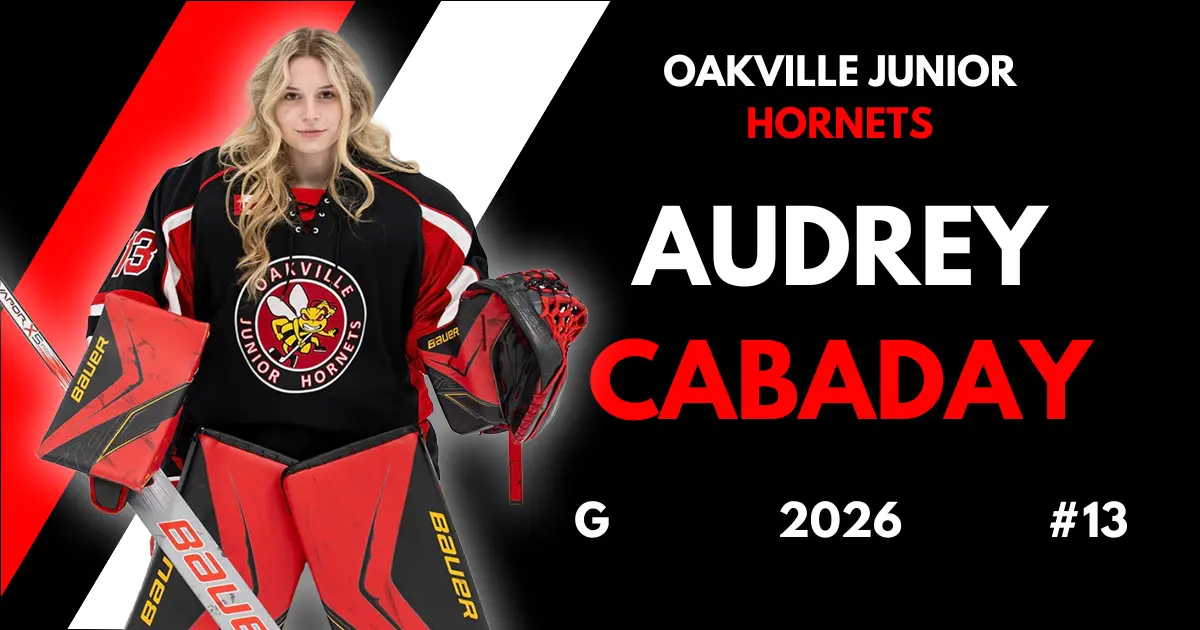
Audrey Cabaday
Player Overview
Height
5’5″
Position
Goalie
Shot
Left
Team
Oakville Hornets U22AA
School
Garth Webb Secondary School
Grad Class
2026
Programs of Interest
- Health Science
- Nursing
Academic Record
Scouting Report
Positional Foundation
Key Strengths
- Square Arrival: Audrey Cabaday sets her feet and shoulders to the puck early, arriving on angle before the release instead of sliding into it late. That early square takes time away and forces shooters to elevate or delay; the next step is trusting that arrival even more on broken rush looks instead of settling back.
- Hand Centering: Holds gloves inside her frame, quiet and available, not chasing corners before the puck commits. This keeps her balanced through releases and lets reactions come from the hands instead of the torso; widening that presence selectively could further bait shooters into lower-percentage windows.
- Pre-Shot Stillness: Stops moving before the puck moves. No extra edge noise, no shoulder drift. That stillness pulls shooters into shooting early; learning when to subtly disrupt that calm could add another layer of deception.
- Loaded Base: Carries weight through a compact crouch that stays coiled, not collapsed. The power is there before she needs it, which lets her explode without resetting; staying tall a fraction longer on distance looks would preserve extension up top.
- Upper-Body Quiet: Keeps her chest calm and head level through traffic, even when bodies lean into her space. Vision holds, balance survives contact; the next progression is recovering that posture faster after multi-save scrambles.
Areas to Refine
- Depth Hold: At times yields a half-step early when reads stretch, giving shooters extra net on clean looks. Holding ground one beat longer would force decisions sooner and reduce elevation options.
- Hand Width: Gloves can narrow during sustained pressure, shrinking visual presence. Re-establishing width between touches would close perceived lanes without changing depth.
- Base Reset: After extended sequences, the return to her ideal stance can lag by a beat. Sharpening that reset timing would keep her armed for second and third threats without relying on desperation movement.
Key Strengths
- Measured Advance: Pushes out with intent when the play stretches, closing space without drifting past her angle. That advance removes time early and forces rushed releases, keeping shooters from settling into clean mechanics.
- Controlled Retreat: Pulls back only when traffic collapses or lanes disappear, never out of habit. The retreat preserves angle integrity through screens and keeps her body connected to the puck instead of guessing around bodies.
- Rush Ownership: On clean entries, claims the top of her crease early and holds it. That depth compresses time immediately and limits shooter patience before the puck even reaches the slot.
- Angle Awareness: Reads distance as control, not just space. Adjusts depth based on puck location and threat level, keeping her body inside the play and denying shooters the illusion of extra net.
- Calm Feet: Feet stay underneath her frame while managing depth, not reaching or lunging. Balance survives late decisions, allowing her to stay upright and reactive when plays hesitate or stall.
Areas to Refine
- Two-On-One Hesitation: On 2-on-1 rushes, depth can stall between challenging the puck carrier and respecting the pass. That half-decision leaves her caught in space; committing earlier to one read removes the hesitation attackers wait for.
- Short-Side Seal: During that pause, her inside edge can settle just long enough to expose short side before the puck fully declares. Sealing that lane sooner forces the shooter to move the puck or shoot into her body.
- Backdoor Arrival: When depth freezes on the puck carrier, recovery toward the pass arrives a beat late. Earlier depth commitment would allow her to arrive set on the backdoor instead of sliding into position.
Key Strengths
- Early Square: Finds square before the puck declares. Shoulders and hips arrive on angle without drift, which strips shooters of net before they load; leaning into that same decisiveness on delayed releases tightens windows even further.
- Clean Routes: Moves on straight lines, not arcs. Lateral adjustments stay efficient, keeping her chest and stick arriving together; sharpening those routes on double east-west sequences keeps her set without bleed.
- Shoulder Discipline: Keeps shoulders level through lateral plays, avoiding tilt that opens daylight high. The look stays compact; maintaining that discipline when feet are forced wide preserves seal integrity.
- Stick Alignment: Blade tracks the puck line, not the ice. That alignment closes five-hole and feeds rebounds into controllable areas; reinforcing blade angle on late pulls reduces leak-through chances.
- Angle Hold: Once set, she holds. No reach, no last-second lean. Shooters are forced to beat her through execution, not patience; trusting that hold against hesitation moves limits bait shots.
Areas to Refine
- Delay Reads: On shooters who hesitate at the top of the zone, she can arrive square then wait flat. Introducing a subtle depth or shoulder cue would disrupt timing without breaking angle.
- Cross-Ice Reload: After a hard push, reloading square can lag by a fraction. Faster chest recovery would remove brief high-side exposure on second looks.
- Low-High Awareness: When plays threaten low then pop high, angle adjustment can trail the puck path. Earlier recognition of the pop keeps shoulders ahead of the release.
Key Strengths
- Edge Trust: Seals posts through her edges rather than panic drops. Arrives under control with hips loaded and weight underneath her, keeping balance through jams and short-side pressure.
- Seal Timing: Waits the extra beat before committing below the goal line. Forces attackers to declare hands and angle before she locks in, removing guessing from her post game.
- Pad Integration: Pads land flush to the post without flare or collapse. The seal stays tight down low, killing wrap attempts and limiting rebound escape on contact plays.
- Chest Square: Maintains chest presentation to the puck as play works below the line. Shoulders stay disciplined, vision stays clean, and short-side daylight never truly opens.
- Controlled Releases: Pushes off the post on direct, efficient routes. Movements are driven by edge pressure rather than hops or slides, allowing her to arrive square on pass-outs.
Areas to Refine
- Low-to-High Reads: When attackers threaten below the line before pulling the puck higher, she can hold the seal an extra beat. Earlier recognition of that shift would shorten her release window.
- Backside Awareness: On plays that work behind the net with weak-side support arriving late, coverage priority can stay puck-focused. Earlier backside scan would reduce delayed tap-in threats.
- Upper-Net Coverage: While the seal stays firm down low, coverage above the pad near the shoulder can sit passively when the puck carrier delays. Earlier shoulder engagement would erase the illusion shooters aim for.
Movement Patterns
Key Strengths
- Read-Driven Movement: Eyes initiate everything. Feet answer second. She slides, holds, or pushes only when the puck forces the decision, which keeps her body arriving inside the play instead of drifting beyond it.
- Edge Engagement: Loads hard into the ice, then releases without hang time. Bite shows up exactly when pressure demands it, allowing gear changes without breaking posture or bleeding speed.
- Sequence Matching: Multiple pushes don’t pull her apart. One movement leads into the next based on order, not urgency. She stays connected through east-west sequences because she’s reading what comes next, not reacting to what just happened.
- Terminal Control: Stops are decisive. No bounce. No drag. She kills momentum on the blade and holds her ground when the puck hesitates, keeping shoulders quiet and her stance intact.
- Vertical Recovery: Down never lingers. From posts or low saves, she rises in one motion — eyes first, hips under, chest back in the lane — upright before the next touch declares.
Areas to Refine
- Slide Length: In broken or outnumbered sequences, the final inch of a push can carry long. That extra travel pulls her just past center and stretches the next movement unnecessarily.
- Second Push Timing: When plays go east-west twice in quick succession, the first slide can fully commit before the second threat declares. Earlier recognition of that double layer would shorten recovery distance.
- Re-Load Delay: After hard stops in scramble sequences, the next push can arrive a fraction late. The stop itself is clean, but re-engagement lags just long enough to widen spacing on immediate follow-up threats.
Key Strengths
- Edge Bite: Loads into the ice with intent. When she commits, the blade grabs immediately and transfers power straight through the push, letting her move without wind-up or wasted glide.
- Release Timing: Comes off the edge clean. No hang, no drag. She lets go the moment the puck forces it, which keeps her from getting stuck between movements when plays change late.
- Inside Edge Use: Controls lateral movement through inside edges rather than reaching with the upper body. That keeps her chest available and her hands working forward instead of pulling across herself.
- Power Balance: Carries strength low through her hips and legs, not up through her shoulders. Even under heavy lateral pressure, her edges support her weight instead of tipping her over it.
- Edge Confidence: Trusts her blades in traffic. She’ll hold an edge through bodies, sticks, and contact rather than defaulting to drops or slides, keeping her feet active and her options open.
Areas to Refine
- Over-Bite Moments: When reacting to sudden lateral threats, edge engagement can come too hard. That initial bite can shorten glide and force an extra adjustment on the next push.
- Release Consistency: Under rapid east-west exchanges, release timing can vary slightly. Sharper consistency would smooth transitions when plays stack quickly.
- Micro-Adjustments: After strong pushes, fine-tuning with small edge checks can lag. Earlier micro-corrections would keep her perfectly centered rather than functionally square.
Key Strengths
- Vertical Exit: Comes off the post up, not out. Hips lift under her, chest stays in the lane, and she’s back on her feet before the puck finishes moving. That vertical path keeps her available instead of sliding past the next look.
- Edge-Driven Push: Releases from VH and RVH through the edge, not the pad. One seal, one load, one push. The movement carries direction and intent, not scramble.
- Single-Action Recovery: No hesitation between seal and exit. She commits once and lives with it, which shortens recovery time and prevents half-movements that bleed space.
- Square Arrival: Finds angle on the way out. Shoulders and stick arrive together, so she’s set as she moves, not after. That removes the window shooters hunt on quick pass-outs.
- Balance Through Contact: Holds posture when bodies lean or jam at the post. Contact doesn’t knock her offline; she absorbs it and still releases clean.
Areas to Refine
- Read Confirmation: On quick behind-the-net exchanges, she can wait an extra beat to confirm puck location. Earlier recognition would trigger faster exits on immediate pass-outs.
- Release Width: Occasionally exits too narrow when the puck jumps high-side quickly. Widening the first push would close space sooner on sharp-angle shots.
- Secondary Scan: After the initial release, awareness can stay puck-focused. An earlier scan for weak-side options would shorten adjustments on rapid second touches.
Key Strengths
- Low-Body Anchor: Carries her weight low through hips and legs, not up through the shoulders. That anchor keeps her upright through contact and lets movement start from the ice instead of the torso.
- Core Stability: Holds her center through lateral pushes without folding or over-rotating. Even when edges fire hard, her upper body stays stacked, keeping eyes and hands available.
- Contact Absorption: Accepts bumps, jabs, and net-front contact without losing her base. She leans into pressure instead of recoiling, which keeps her playable in crowded sequences.
- Recovery Control: When balance is stressed, she regains it through edges and posture, not desperation movement. Feet find the ice quickly, hips reset, and the body comes back underneath her.
- Extension Integrity: Even at full reach, her balance doesn’t fully abandon her. Legs extend, hands track, and the torso stays connected enough to allow a second effort.
Areas to Refine
- Over-Commit Moments: In high-chaos scrambles, full extensions can pull her weight just beyond her base. Choosing a slightly more contained reach in those moments would preserve balance for follow-up plays.
- Upper-Body Drift: During rapid lateral sequences, shoulders can drift ahead of the hips. Keeping that stack tighter would reduce recovery distance after hard pushes.
- Landing Control: After extended saves, the return to stable footing can arrive a fraction late. Sharper edge engagement on the landing would allow faster re-centering before the next touch.
Save Execution
Key Strengths
- Eyes First: Puck leaves the blade and her eyes are already locked. Head arrives before hands, before body, before any drop. Clean contact replaces reaction movement, even when plays fracture in front. Against average releases this erases chaos early.
- Head-Puck Sync: With open sightlines, her head rides the puck on a single line through space. No snap turns. No catch-up. That connection keeps her square longer and limits secondary movement. It shows most on rush shots where others drift.
- Screen Vision: Traffic builds and she doesn’t freeze or over-search. Small head shifts reopen windows; shoulders follow only enough to keep the puck alive in view. She stays tall in the eyes instead of dropping into guesses.
- Body Follows Eyes: In netfront panic, her eyes lead and the body listens. Pads, hands, and chest move only after the puck is identified. That order keeps her balanced and prevents false drops. It shows up when plays collapse inside the crease.
- Release Discipline: Stick fakes don’t pull her off line. She tracks blade to puck, waits for separation, then commits. Fewer early drops, cleaner upper-body saves, dead plays.
Areas to Refine
- Quarter-Beat Drops: On point-blank, high-tempo releases, she can arrive a fraction early into her drop. The read is right, the timing jumps ahead by half a breath. Recovery is immediate, but the early drop opens brief top-net windows.
- Late Angle Change: Shooters who pull the puck across their body late can force her eyes to adjust mid-sequence. She tracks it, but the head has to re-find the line instead of riding it clean. That costs micro-time.
- Sightline Protection: In tight scrambles, multiple sticks and skates can briefly erase the puck from view. She stays composed and tracks it back quickly, but earlier body positioning would help preserve visual lanes before congestion fully forms.
Key Strengths
- Soft Absorption: Shots hit her gear and lose energy immediately. Chest stays square, hands give just enough, pads angle without flare. The puck settles instead of jumping back into play, cutting off second attempts before they form.
- Pad Containment: Low shots pull into her pads and stay close. Contact stays compact, rebounds die below the knees, and loose pucks don’t spill into the middle. This shows consistently on point shots arriving through traffic.
- Intentional Redirection: When a clean trap isn’t available, she chooses the exit. Pads guide pucks low and wide, stick angles finish the job. The rebound leaves the scoring lane on purpose, not by bounce.
- Cover Authority: When she decides to freeze, it ends there. Covers come through bodies and sticks, glove locking down without drift. She doesn’t poke or hesitate once the decision is made.
- Immediate Reset: After contact, her base is already rebuilding. Feet stay engaged, edges underneath her, hands available. If a rebound escapes, she’s set before the next touch arrives.
Areas to Refine
- Hard Pad Travel: On heavy flank one-timers, rebounds can carry farther off the pad than intended. Angle stays correct, but force wins. Managing pad softness in those moments would shorten rebound distance.
- Glove Finality: High shots caught clean occasionally require a second clamp before full control. Possession isn’t lost, but the delay can extend sequences under pressure.
- Stick Engagement: In extended netfront play, rebounds can settle too close to her feet. Earlier stick involvement would help push those pucks out of immediate reach instead of relying on pad-only containment.
Key Strengths
- Angle Ownership: On rush shots, she arrives on depth early and holds it. Skates set, chest square, eyes level. Shooters see net shrink before the puck even leaves the blade, forcing reach attempts instead of clean placement.
- Lower Net Removal: From middle-lane attacks, the bottom half disappears. Knees drive down together, pads seal flat, stick stays tight through the five-hole. What remains up top is narrow and deliberate, not accidental.
- Frame Maximization: From an upright stance, she plays larger than her measurements. Legs anchor wide, shoulders stay aligned, hands sit forward and visible. She fills space without drifting or overextending, keeping coverage intact through movement.
- Depth Discipline: She doesn’t chase shooters past her range. Depth adjusts with angle, not emotion. When attackers pull wide, she holds the line that protects the middle instead of sliding herself out of position.
- Rush Read Control: Wing entries don’t rush her setup. She reads release cues early, matches depth to threat, and stays square through the shot. The puck hits her body because the net simply isn’t there.
Areas to Refine
- Elite Corner Threats: Against top-end shooters who can elevate cleanly from bad angles, holding aggressive depth can expose slim upper corners. The read is sound, but the margin tightens fast.
- Backdoor Awareness: On late lateral threats developing behind coverage, her initial depth can delay the secondary push. Recovery is strong, but earlier recognition would reduce how much net opens during the move.
- Post-Hold Timing: When plays pull below the goal line and stall, she can stay attached to depth a beat longer than needed. Earlier post engagement would reduce short-side exposure as attackers reset.
Key Strengths
- Airtight Drop: When she goes down, everything arrives together. Pads meet the ice flat, knees connect, stick seals the center lane. There’s no stagger or spill. The puck has nowhere to slip through once contact is made.
- Five-Hole Lock: Stick stays active through the drop, blade angle held firm instead of collapsing backward. Even under pressure, the five-hole remains closed by design, not luck. Shots aimed low-center die immediately.
- Post Integration: On lateral plays, pad, skate, and post connect clean. She doesn’t hunt the post with her hip or shoulder. The seal forms from the ice up, keeping space from reopening during rotation.
- Quiet Connection: Drops are controlled, not thrown. Upper body stays stacked, hands remain usable, eyes level. Because the seal is calm, she’s ready for rebounds without scrambling back to her feet.
- Edge Availability: Even after sealing, her edges stay alive. Hips stay loose enough to rotate or recover without a reset step. The crease stays hers after the stop, not just during it.
Areas to Refine
- Rush Drops: On sharp-angle rush shots, she can commit down early, sealing before full confirmation of release height. The bottom is secured, but it briefly exposes space above the pad line.
- Extended Holds: When plays stall at the side of the net, she can remain sealed longer than necessary. The seal is strong, but it delays vertical recovery if the puck pops back into the slot.
- Reverse Transitions: On quick reversals behind the net, seal-to-move timing can lag by a fraction. The connection is intact, but earlier edge engagement would speed the push across.
Game Situations
Key Strengths
- Early Square: Rush forms and she’s already set. Skates arrive on depth early, chest lined to the shooter’s lane, hands quiet and available. That early square forces the play to declare instead of letting it drift into options.
- Lane Hold: She commits to the shooter’s path without cheating. Depth stays high, middle stays protected, and she resists sliding herself out of the play. The pass option stays seen, not feared.
- Cross-Ice Launch: When the puck does move laterally, the response is instant. One hard push, edge bites, body arrives sealed and balanced. The save looks explosive because the read was finished before the pass landed.
- Breakaway Patience: Dekes don’t pull her first. She stays tall through hands and hips, waits out the move, forces the shooter to finish. Gloves stay alive without reaching, pads stay underneath her.
- Slot Arrival: Quick-strike looks from inside don’t surprise her. She’s already forward, chest presented, glove up and loaded. Shots hit her because she’s occupying space before the release forms.
Areas to Refine
- Delayed Pulls: Against patient scorers who hold the puck and pull late, she can bite just enough to expose the post-to-pad seam. The initial read is aggressive; the delay stretches it.
- Secondary Threats: On layered rushes where the puck carrier sells shot hard before slipping the pass, her weight can stay locked on the first lane a fraction too long. Recovery is powerful, but earlier release would shrink the window.
- High Tradeoff: By owning depth so assertively, she concedes a narrow band up top in-tight. It’s a calculated exchange, but perfect releases from close range can find daylight.
Key Strengths
- Middle Claim: Slot pressure builds and she claims the space first. Depth holds firm, chest stays square, feet set underneath her. Shooters don’t see openings develop; they see mass occupying the lane they want.
- Hands Forward: Glove and blocker stay presented in front of her body, not pinned back to reaction range. That forward hand position cuts releases short and turns quick strikes into body hits instead of reach saves.
- Release Timing: Inside the dots, she waits longer than most. Eyes stay on the puck, hips quiet, edges loaded. She doesn’t drop on stick noise. She commits on separation, not suggestion.
- Explosive Hold: When the puck snaps off the blade, she closes space fast. Chest drives into the shot, knees track underneath, hands finish forward. The save ends the play instead of extending it.
- Traffic Resistance: Bodies crash the slot and she doesn’t retreat. She leans through contact, maintains sightlines, and tracks through legs and sticks. Shots arrive late and still find her.
Areas to Refine
- High Finishers: Patient shooters who elevate late from tight range can exploit the brief window above the shoulders. Her stance is correct, but staying upright a beat longer would reduce that exposure.
- Dual-Lane Pulls: When two options present simultaneously inside the slot, she needs to let the carrier make the first move and react from there.
- Jam Recognition: On rapid stick battles at the top of the crease, the puck can shift laterally before her hands engage. Earlier hand activation would shorten those micro-windows.
Key Strengths
- Active Sightlines: Screens arrive and she doesn’t lock in place. Head shifts in small increments, shoulders follow just enough to reopen lanes. She keeps the puck in view without over-searching, refusing to surrender vision to bodies alone.
- Height Control: When vision narrows, she subtly rises. Not a stand-up panic — just enough extension to look over hips and sticks. The moment the puck clears, she drops compact and loaded, ready for release.
- Screen Sorting: Netfront traffic doesn’t blur together. She identifies the shooter through secondary bodies, tracking the true threat instead of chasing the screen itself. The first look stays honest because priority stays clear.
- Contact Tolerance: Bodies lean, sticks jab, space tightens. She holds ground through it, absorbing bumps without losing her line. Sightlines stay usable because her base doesn’t drift under pressure.
- Communication Push: Screens don’t get a free stay. She talks early, points decisively, nudges space back open. Defense responds because the message is firm and timely, not reactive.
Areas to Refine
- Hard Seals: When screens fully lock in tight, she can stay upright a fraction too long searching for vision. Earlier acceptance of the block would shorten blind travel before release.
- Late Arrivals: Screens that slide into place late can interrupt her head-and-shoulder adjustment. The read is still right, but the setup happens closer to the shot.
- Screen Resolution: At times she manages the screen instead of ending it. She holds position, tracks through bodies, absorbs the shot, then resets as traffic stays. The save is made, but the play lives longer than it needs to.
Key Strengths
- Post Ownership: Play drops below the goal line and she arrives sealed. Pad meets post clean, skate anchors, stick closes the lane. Wrap attempts die on contact because the space is already gone.
- Edge Rotation: When the puck moves behind the net, her edges bite and carry her through the turn. Hips stay underneath, shoulders stay square to the threat. She beats the pass, not the release.
- Paddle Control: Stick stays active along the ice. Jam attempts hit blade, passes meet the paddle, loose pucks get swept off the line. Nothing fancy — just precise placement that removes options.
- Seal Timing: Drops come when the puck threatens the paint, not before. Pads connect, knees track, stick stays threaded through the middle. The bottom half closes with intent, not panic.
- Goal-Line Authority: In tight scrambles near the line, she doesn’t fade backward. She drives down into the ice, claims the post, and finishes the play. The puck stops because she ends it.
Areas to Refine
- High Tradeoff: By sealing the bottom so completely, she invites shooters to aim above it from close range. The lane is narrow, but perfect releases can find daylight before her hands finish.
- Reverse Speed: On quick reversals behind the net, her initial push can lose a fraction of acceleration. The edge engages, but earlier hip turn would shorten the race back to the post.
- Stick Priority: During extended jams, pad-first coverage can take precedence. The seal holds, but earlier stick engagement would clear pucks sooner instead of absorbing repeated contact.
Puck Management
Key Strengths
- Freeze Authority: Shots into her body don’t drift or spill. She pulls pucks into her chest, locks elbows in, drops weight through her core. The whistle comes because she chose it, not because she ran out of options. Next step is learning when to delay that freeze a beat longer to draw pressure even tighter before killing it.
- Glove Absorption: Clean glove touches die instantly. No bobble, no second motion. She meets the puck early, softens the catch, brings it back to her frame so nothing hangs in space. As shooters get quicker, sharpening hand height on short-range snaps will keep those kills just as final.
- Body Seals: Low shots disappear into pads and thighs without rebounds leaking back into traffic. She leans down into the ice, closes gaps early, finishes the save with weight instead of reach. Growth comes from sealing while already scanning exits, not after the whistle.
- Whistle Timing: She understands when her group needs air. Under sustained pressure, she smothers pucks immediately, forcing resets and stopping momentum swings before they build. Expanding that instinct to read bench length and matchup context will add another layer of control.
- Stop Signaling: Every freeze sends a message. Defensemen relax, lines reset, communication sharpens. Her puck stops organize the next sequence before it even begins. The evolution is turning more of those moments into planned set plays off the draw.
Areas to Refine
- Late Freezes: On rare sequences, she holds pucks a fraction too long with bodies collapsing. The intent is control, but traffic closes fast at higher levels. Reps recognizing the exact pressure threshold will tighten that decision.
- Hand Height: High, short-release shots from inside the dots can force her hands to finish late after an otherwise clean body read. Raising set position earlier will close that window without sacrificing her seal.
- Transition Delay: After some clean stops, the next action stalls briefly before communication kicks in. The foundation is strong; the next gain is calling the reset earlier so the stop and the organization happen as one motion.
Key Strengths
- Early Reads: Dump-ins don’t surprise her. She tracks rim speed, angle off the glass, forechecker spacing — all before the puck reaches the end wall. Her first decision is made while she’s still moving, which keeps her routes direct and her timing clean. The next layer is disguising that read just long enough to pull forecheckers a step deeper.
- Set Feet: She doesn’t handle on the fly. Stops behind the net are deliberate — edges bite, hips square, hands settle before contact. That base lets her make clean touches even with pressure arriving. Building comfort releasing off imperfect footing will widen her margin under elite speed.
- Short Touches: No extra stick work. She cushions the puck, pulls it into a safe pocket, moves it immediately. One touch to settle, one to send. That economy keeps pressure from forming. Growth comes from recognizing when a third touch buys more space instead of less.
- Pressure Awareness: She knows when to leave it. If the forecheck closes hard or angles poorly, she peels off and lets her defense collect with full vision. That restraint saves possessions that goalies often give away trying to be helpful. The next step is selling that fake longer before disengaging.
- Exit Timing: When she plays it, the puck leaves her blade on her defense’s stride. Flat, early, inside their hands. The exit starts clean because the release matches their route. Extending that timing to longer rims and weak-side reverses will stretch forechecks wider.
Areas to Refine
- Release Range: Most plays stay short and safe. Under heavy pressure, that’s a strength — but lanes occasionally open for longer strikes that she passes up. Adding confidence to drive pucks past the first layer will turn retrievals into immediate transition.
- First Touch Authority: On controlled dump-ins, she often defaults to a conservative first touch that protects possession but doesn’t move the forecheck. The read is correct; the touch can carry more intent. Adding firmer first-contact pushes — even a foot of extra separation — will create cleaner exits without increasing risk.
- Deception Hold: Forecheckers read her eyes early. She shows the outlet too soon, which narrows lanes that were initially open. Holding the look an extra half-beat will force defenders to commit before she releases.
Key Strengths
- Pre-Read Scanning: Her head is active before the puck arrives. She checks pressure lanes, defender depth, and forecheck shape while moving into position. By the time the puck hits her stick, the decision is already formed, which keeps her touches clean and on time.
- Risk Filtering: She eliminates options that don’t survive contact. When lanes shrink or sticks stack, she kills the play immediately instead of forcing a rim or soft middle touch. Turnovers stay off her tape because she chooses removal over hope.
- Pressure Timing: Choices arrive before bodies do. She releases pucks while attackers are still extending, not when they’re already on top of her. That timing flattens forechecks and preserves exit spacing.
- Option Hierarchy: Her reads follow order. Strong side first, middle only when uncovered, weak side when rotation opens it. That consistency keeps defenders predictable and connected through the exit.
- Whistle Judgment: When no option clears pressure, she freezes without delay. The decision ends the play and prevents second-chance breakdowns around her crease.
Areas to Refine
- Decision Tempo: On low-pressure sequences, she can move too quickly out of possession, ending plays that could be extended. The puck leaves cleanly, but space remains unused. Learning to recognize those calm windows will increase control without adding risk.
- Forecheck Manipulation: She plays what’s there instead of pulling pressure into a mistake. Forecheckers often hold their lanes because they aren’t forced to choose. Using subtle holds or shoulder turns will create clearer separation before release.
- Outlet Variety: Exits repeat patterns when pressure is light. Defenders receive the puck where expected, which limits deception. Introducing occasional route changes will prevent forechecks from pre-loading coverage.
Key Strengths
- Early Calls: Her voice arrives before pressure does. As dump-ins turn into retrievals, she calls lanes while forecheckers are still closing. Defensemen move with certainty because the instruction is already there.
- Clear Vocabulary: Commands are short, standard, and unmistakable. “Time,” “Wheel,” “Reverse,” “Up.” Each word maps to a single action, which keeps reactions fast and eliminates second-guessing.
- Directional Precision: Calls match puck location and defender posture. She doesn’t broadcast to space; she speaks to a player. The message lands where it’s needed and shapes the first step of the play.
- Cadence Control: Her tone stays level under pressure. Even during extended shifts, the rhythm of her voice doesn’t rush or spike, which steadies the defensive group in contested sequences.
- Sequence Ownership: Communication continues through the play. She talks through retrieval into release, keeping defenders connected to the outcome instead of reacting in isolation.
Areas to Refine
- Second Option: Her first call clears the retrieval. When that option is taken away late, communication can stop there. Defenders are left to finish the play without direction.
- Up-Ice Direction: Most of her communication organizes play below the circles. It keeps exits clean and predictable. Earlier direction higher up the ice allows possessions to advance sooner.
- Command the Unit: College-level goalies use their voice to pull five players back into one idea, one plan, one response. Audrey has that ability. Now it’s time for her to own it.
Mental Game
Key Strengths
- Late-Game Reads: In closing minutes she adjusts stance depth between rushes, reading whether shots are meant to score or create rebounds. That anticipation puts her square to second chances before they exist.
- Post-Goal Response: After goals against she returns to stance immediately, eyes fixed on center ice instead of the bench or clock. That behavior prevents emotional drift during the most vulnerable shift that follows.
- Faceoff Readiness: Whistle-to-drop resets are deliberate and fast, with hands set early and feet anchored before traffic arrives. She’s prepared for immediate point shots and broken plays, not just clean wins.
- Sustained Pressure: During extended zone time she shortens pushes and seals ice low, choosing containment over reach. Rebounds stay in her body, limiting scramble sequences when defenders are stretched.
- Big-Game Saves: On momentum shots she finishes saves with authority — glove locks, pads seal, no loose energy. Those stops don’t just deny goals, they halt opponent escalation mid-shift.
Areas to Refine
- Freeze Timing: She often absorbs and plays on when freezing would fully reset defensive legs. Earlier whistles could convert survival sequences into full emotional resets for her group.
- Play Termination: Some clean saves still allow puck continuation into corners or recoverable space. Killing those plays harder would shorten shifts and protect late-game stamina.
- Early Authority: Big-moment clarity is strongest after pressure arrives. Stepping into command one beat sooner would prevent escalation entirely.
Key Strengths
- Emotional Intelligence: Audrey operates on a different emotional wavelength than most goaltenders. She understands not just what she’s feeling, but when and how that emotion should be visible. That awareness allows her to stay composed without becoming detached, and present without becoming reactive.
- Body Language Command: Whether she makes a highlight save or gives up a goal she knows she should have stopped, her body language doesn’t waver. There’s no giveaway for opponents to read and no emotional signal. That consistency denies attackers information and keeps pressure from snowballing late.
- Opponent Denial: Her emotional control creates uncertainty for the opposition. Shooters don’t know if they’ve rattled her, and repeated attempts don’t escalate her responses. Over time, that lack of emotional feedback alters how teams choose to attack her.
- Team Confidence Spillover: Teammates grow comfortable playing in front of her because they know her emotional state won’t swing with the game. That steadiness gives defenders permission to play with confidence and freedom, trusting that one moment won’t unravel the next.
- Situational Focus: Audrey understands that emotion shown too early or too late can define a game. She stays locked into the present shot, not the story around it, allowing her to move cleanly between sequences without carrying emotional residue from what just happened.
Areas to Refine
- Boundary Setting: Her ability to handle pressure and bail her team out can invite complacency. She will need to establish clearer internal boundaries around when she can be the deciding factor — and when the group must carry its share — to prevent silent resentment from building.
- Shared Accountability: When goals come, blame can drift unfairly toward the crease. Learning how to communicate expectations, before frustration surfaces, will help keep trust intact and responses measured rather than reactive.
- Thermostat Control: The next phase is emotional precision. Small adjustments in presence, timing, and communication that subtly raise or lower the emotional temperature of the group. Mastering that balance is what separates elite starters from being the absolute best in the league.
Key Strengths
- Baseline Return: Audrey’s reset doesn’t live in single moments — it lives across time. Save to save, goal to goal, shift to shift, her internal state returns to the same baseline regardless of outcome. Nothing lingers, and nothing carries forward that shouldn’t.
- Outcome Neutrality: When things go right, she doesn’t ride the wave. When things go wrong, she doesn’t sink into it. Success and error are processed the same way — acknowledged, cleared, and left behind. That neutrality keeps her available for the next challenge instead of occupied by the last one.
- Emotional Maturity: Her reset reflects a level of emotional maturity that’s rare. There’s no need to perform confidence and no need to explain mistakes away. Errors are accepted for what they are, then released. The absence of reaction is not avoidance — it’s control.
- Sustained Ceiling: Audrey doesn’t just reset downward after breakdowns; she recalibrates upward when things are going well. Her standard doesn’t drift. She sustains her ceiling without needing a reminder that she’s playing well.
- Trust Anchor: Coaches trust that she will find her way back when things go wrong. Teammates trust that she will stay steady when things go right. That consistency removes anxiety from the group and allows them to play forward instead of managing fear behind them.
Areas to Refine
- Self-Challenge: Her reset process is well established. The next phase is choosing when to test it. When breakdowns come back-to-back and the usual protocol doesn’t land immediately, the challenge becomes internal — how she adapts without abandoning who she is.
- Next Gear: Her reset has become more refined over time, it has also become quieter. Learning when to push beyond baseline — when to deliberately project instead of simply restoring balance — will expand what her reset can unlock.
- Audrey vs Audrey: Growth here no longer comes from instruction or adjustment. It comes from confrontation with herself. Identifying what she reaches for when her best habits don’t show up on a given night will define the next version of her reset ability.
Key Strengths
- Composure Transfer: Audrey’s calm doesn’t stay inside her. You feel it move outward — into the bench, into the defenders, into the pace of the game itself. Whether it’s five-on-five, special teams, protecting a lead, or surviving overtime, nothing in her body language hints at volatility. There’s no visible spike, no visible drop. Just presence. You watch the group settle because she never looks like the moment is bigger than her.
- Moment Neutrality: Big moments don’t pull anything extra out of her, and small ones don’t take anything away. The first shift of the game and the one that decides it are handled through the same internal lens. She doesn’t chase urgency, and she doesn’t relax into routine. That steadiness keeps her reactions honest — never rushed, never dulled — and stops emotion from sneaking into decisions where it doesn’t belong.
- Controlled Ferocity: When plays break down and bodies start flying through the crease, her response is violent in action but quiet in tone. She explodes to pucks, battles for space, fights through second chances — yet nothing about her posture suggests panic. Even sprawled, even extended, she stays connected to the task. It’s a rare contrast: aggression without desperation, effort without loss of control.
- Dual-Mode Identity: Audrey doesn’t rely on a single way to survive games. Some nights she wins with precision — clean reads, early positioning, efficient movement. Other nights she wins because her athletic instincts take over when plays break down. The important part is that she doesn’t have to choose. She moves between those modes without losing herself, which gives her answers when the game stops being predictable.
- Emotional Command: She doesn’t shut emotion off — she directs it. When the game needs restraint, she brings steel. When it needs resistance, she brings fire. That range shows up situationally, not theatrically. You never feel her emotion spilling into the game; it stays harnessed, purposeful. That’s why her presence carries weight without noise.
Areas to Refine
- Identity Protection: As Audrey moves into university hockey, there will be pressure to narrow her game under the language of efficiency and control. The real work will be knowing what is refinement and what is reduction. Her challenge isn’t becoming something new — it’s protecting the full version of who she already is while learning how to deploy it against faster, heavier demands.
- New Environments: She has learned how to own moments in familiar arenas. The next step is claiming that same authority in rooms that don’t know her yet — tougher opponents, tighter margins, less forgiveness. Trusting that her presence still applies, even before results catch up, will matter early.
- High Expression > Adjustment: Audrey doesn’t grow by dialing herself back. She grows by letting her strengths breathe at a higher level. The task ahead is not adjustment for safety, but expression with intent — finding ways to let her composure and competitiveness influence momentum more directly, especially when the game challenges her to do so.
Game Film & Highlights
| Date | Opponent | Game Type | Watch |
|---|---|---|---|
| Nov 9, 2025 | Ottawa Senators | Season | ▶ Watch Film |
| Oct 25, 2025 | Chicago Mission | Showcase | ▶ Watch Film |
| Sept 13, 2025 | Bishop Kearney Selects | Showcase | ▶ Watch Film |
×
Frequently Asked Question
- Audrey Cabaday plans to study Nursing, Health Sciences, or Kinesiology to pursue careers such as respiratory therapy or teaching. She will also stay connected to hockey through coaching or development work.
- Outside of hockey, Audrey stays active through gym training, spends time with family and friends, and plays school sports like cross country and field hockey.
- Audrey Cabaday trains with goalie coach Travis Smith, plays under Jay Summer and Jess Turi during the season, and trains in the off-season with BTNL.
- Coaches should know Audrey Cabaday completed the Health Care SHSM, volunteers with the Humane Society, and works as a house league goalie coach.