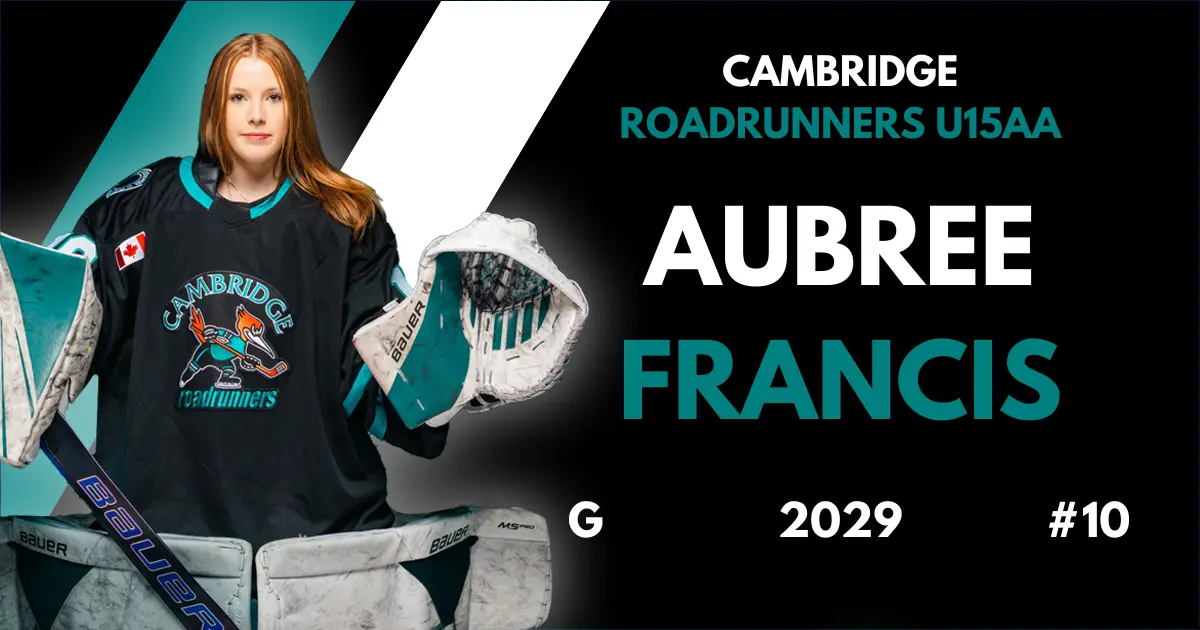
Aubree Francis
Goalie Overview
Height
5’3″
Position
Goalie
Glove
Left
Team
Guelph Gryphons U18AA
School
Thomas A. Blakelock High School
Grad Class
2029
Programs of Interest
- Business
- Kinesiology
- Physical Education
Academic Record
Scouting Report
Positional Foundation
Key Strengths
- Tall by Design: Aubree Francis sets up as tall as her frame allows without sacrificing her ready position. At 5'3", that choice is deliberate and intelligent — she extracts every inch her body gives her, arriving in a stance that presents maximum coverage. The result is a goalie who looks bigger than the number suggests.
- Hand Position: Her hands sit between mid and high — a placement that keeps her glove and blocker available across a wider response range without overcommitting in either direction. For a goalie built around forward depth and lateral tracking, that positioning makes sense: she's not asking her hands to cover for gaps, she's asking them to stay ready while her skating does the work. It fits the system she plays.
- Crease Depth: She uses her skating to come further out to the top of her crease, meeting the play as it enters the zone rather than waiting for it to arrive at her doorstep. That forward depth is what makes her stance effective — the height she presents from the top of her crease covers far more net than the same stance deeper in the paint. The two work together as one system.
- Lateral Tracking: As the play flows east to west and back, she mirrors the movement without losing her angle. The stance never breaks down during lateral shifts — she stays connected to the puck's route and her body stays square to the threat. That consistency through movement is where smaller goalies often struggle and where she quietly separates herself.
- Post Checks: Before tracking each new sequence, she confirms her starting point with a clean post check. That habit anchors everything that follows — her depth reads, her angle coverage, and her crease movement all begin from a verified foundation. It's a small detail that reflects a technically mature goalie.
Areas to Refine
- Speed Adjustment: What works at U15AA will need to arrive faster at U18AA and beyond. Her stance and depth system are sound — the next evolution is compressing the time it takes to execute them as the pace of incoming play accelerates. The technique doesn't change; the timing has to.
- Reset Speed: The element most likely to get tested first as the level climbs is reset speed — how quickly she re-establishes depth and angle after a save or scramble. Right now the pace gives her enough time to find her foundation. At U18AA and above, that window compresses. The refinement is developing the habit of reading when a sequence is ending before it fully ends, so her reset is already in motion rather than triggered by the next threat.
- Trust the Foundation: As she moves into U18AA and higher-speed environments, there will be a temptation to adjust what already works when results temporarily dip. The growth here is trusting her foundation through those stretches while staying open to the precise, targeted adjustments that a faster game will eventually demand.
Key Strengths
- Crease as a Tool: Aubree understands her crease as an active playing surface, not a safe zone to retreat into. She pushes to the top of her crease early, using depth to take space away from shooters before they've made a decision. That proactive read changes what the shooter sees when the puck arrives in the zone.
- Entry Read: As play crosses the blue line, she's already processing. Her depth adjusts in real time to the speed and angle of the entry — she doesn't wait for the threat to declare itself before moving. That early read allows her to arrive at her optimal depth point before the play forces her there.
- Size Rendered Secondary: The combination of forward depth and precise angle coverage makes her physical dimensions a secondary conversation. Shooters facing her at the top of her crease encounter a goalie who has already removed their best looks — not through size, but through positioning that leaves less net to find.
- Controlled Give: When she concedes depth on lateral plays, she does so on her terms. There's no drift or panic retreat — she reads when the play requires adjustment and gives ground deliberately, staying connected to the threat rather than reacting to it.
- Recovery to Depth: After committing on one side, her recovery back to a working depth is clean. She doesn't overextend and get caught behind herself — she resets to a functional starting point and prepares for the next layer of the play.
Areas to Refine
- Speed of Entry Read: As the level rises, puck carriers will enter the zone with more pace and less predictability. Sharpening how quickly she processes the entry — particularly on odd-man rushes where the read has to happen faster — will keep her depth control intact against higher-end play.
- Depth Under Deception: Against skilled deceptive carriers who invite commitment before changing speed or direction, her depth system will be tested in ways U15AA didn't consistently produce. Developing comfort with holding depth slightly longer on those specific plays will reduce overcommitment.
- Lateral Depth Consistency: Her depth control is strongest when the play comes straight at her. Continuing to tighten how precisely she manages depth through east-to-west sequences — particularly when the puck reverses quickly — will close the small windows that faster play at the next level will look to exploit.
Key Strengths
- Quiet Precision: Aubree's angle coverage doesn't announce itself — it simply works. She sets her body to the puck without excess movement or visible adjustment, arriving square to the threat through the accumulation of small, correct decisions made earlier in the sequence. The angles look natural because the reads that produced them were made early.
- East-West Integrity: As play moves laterally across the zone, her angles hold. She doesn't bleed coverage when the puck reverses — she mirrors the flow and stays square through the full arc of the movement. That consistency under lateral pressure is where her technical discipline is most visible.
- Short-Side Denial: Her angles close the short side without requiring her to lean or reach. The positioning does the work. Shooters probing that side find it sealed not through reaction but through where she already was — a distinction that reflects a technically precise goalie who thinks ahead of the play.
- Angle as Net Coverage: She treats angle and net coverage as one conversation, not two separate adjustments. Her depth and her angle work together so that what she covers from the top of her crease reflects a complete picture — not just the direct lane, but the lanes adjacent to it.
- Consistency Through Traffic: When screens and bodies create visual interference, her angles don't drift. She stays committed to where the geometry tells her the threat will arrive rather than reacting to what she can see in the moment. That trust in her reads keeps her square when lesser goalies are pulled out of position by traffic.
Areas to Refine
- Hold Through the Hesitation: At U18AA, skilled carriers will slow their approach to invite an early angle commitment before changing direction. The work here is learning to read that hesitation as a signal to hold rather than adjust — staying patient with her angle until the play actually declares, not when it appears to.
- Wide-to-Central Transitions: Her angles are strongest when the play develops in a straight line toward her. When pucks shift quickly from wide to central — off a seam pass or a late redirect — the angle has to complete faster than she's currently been asked to. Drilling that specific transition will close the gap between her read and her arrival.
- Perimeter Shot Recognition: As shooters at the next level become more capable from distance and sharper angles, expanding her angle reads to account for perimeter threats — not just slot and rush plays — will ensure her coverage system stays complete as the offensive range she faces widens.
Key Strengths
- Seal Without Surrender: Aubree's post positioning doesn't give anything away. She stays standing until the play asks her to drop, sealing the post through posture rather than committing early to a butterfly. That restraint keeps her upright and ready for a wider range of threats — she doesn't concede the high side before it's been earned.
- Post as Starting Point: Her post checks are deliberate and consistent, used to confirm her position before each new sequence begins. That habit turns the post into an anchor — a verified reference point that her angles and depth reads build from. It's the foundation beneath the foundation.
- Above-the-Pad Awareness: When low plays develop and she does go down, she positions herself to cover the window above her shoulder. She doesn't surrender that space when she drops — she accounts for it. That awareness reflects a goalie who has thought through the full geometry of her positioning rather than simply reacting to where the puck is.
- Standing Discipline: Her preference for staying upright through post work is a technical strength at her level. It keeps her mobile, keeps her read options open, and prevents unnecessary early commitments that skilled players at the next level would exploit. She drops when the play demands it — not before.
- Patience Under Low Pressure: When pucks are worked below the goal line and behind her net, she holds her post with patience. She doesn't lunge or overcommit to the first look — she stays anchored, tracks the play, and waits for the threat to declare itself before responding.
Areas to Refine
- Drop Decision Timing: Her standing discipline is a strength — the refinement is knowing precisely when the play has earned the drop. At higher speeds, that window between "almost ready to shoot" and "puck released" compresses. Sharpening that specific moment of decision will keep her post seal landing on time rather than a beat behind the release.
- Below-the-Goal-Line Reads: Her patience behind the net is sound, but at U18AA puck carriers will use the goal line as cover for longer and with more deliberate deception before presenting the threat. Learning to read body language and puck position together — rather than waiting for the play to fully show — will keep her ahead of what's coming rather than reacting to it.
- Post-to-Post Precision Under Pace: Her individual post seal is strong on both sides. The next layer is the transition between them when play reverses quickly behind her net. Keeping that movement compact and precisely timed — rather than simply fast — will prevent the small gaps that quick reversals at the next level are specifically designed to find.
Movement Patterns
Key Strengths
- Compact by Choice: Aubree's crease movement begins short and controlled — not because she's restricted, but because the play hasn't asked for more yet. Her lateral tracking stays tight and purposeful, covering ground efficiently without burning energy or position on movement the moment doesn't require. That economy is a technical habit, not a physical limitation.
- Range on Demand: When the play accelerates or the threat changes shape, her movement expands with it. She can lengthen her stride and increase her mobility without losing structure — the transition from compact to extended feels seamless because both modes live inside the same technical framework. She shifts gears without shifting identity.
- Square Through Motion: Everything stays technical and square as she moves through the crease. Her body doesn't open or drift when she travels laterally — she stays facing the threat, maintaining coverage through the full arc of her movement. That discipline under motion is what keeps her angles intact when lesser goalies bleed position while tracking.
- Athletic Release When Earned: When the play demands it — a delayed shooter changing angle, a scramble pulling her into a sprawl — she dips into her athleticism without hesitation. Those moments don't look like departures from her game. They look like another tool she reaches for when the technical answer isn't enough, which is exactly what they are.
- Fluid Without Thought: Her crease mobility carries no visible effort. The movement is confident, automatic, and belongs to her — not a system she's following but a physical language she's already fluent in. That ease through the crease is what makes her exciting to watch and difficult to rattle.
Areas to Refine
- Read the Setup Early: At U18AA, opposition will use creative puck movement and deliberate timing to manufacture chaos rather than simply applying speed. The next layer in her mobility is learning to distinguish between a play that is exactly what it looks like and one that is being constructed to pull her out of position. Seeing the setup forming — not just the play in front of her — will keep her movement one step ahead.
- Anticipate Creative Timing: Shooters and puck carriers at the next level will use delays, hesitations, and change-of-pace entries specifically to disrupt technically sound goalies. Developing the read for when timing is being manipulated — rather than simply reacting to what arrives — will prevent her technical movement from being used as a weapon against her.
- Expand Peripheral Awareness: Her crease mobility is excellent in direct sequences. The refinement is widening her awareness to the full picture of what the opposition is constructing around her movement — weak-side options, trailing threats, and secondary looks that are designed to arrive the moment she commits. Reading those layers earlier will make her mobility harder to exploit.
Key Strengths
- Power and Fluidity Together: Aubree's edges generate both force and flow simultaneously — she doesn't trade one for the other depending on the situation. Her pushes carry weight and her transitions carry smoothness, which means her movement through the crease feels decisive without feeling mechanical. That combination is rare and reflects a skating foundation that is genuinely exceptional for her position.
- Sharp Stops, Immediate Re-engagement: When she stops, she stops cleanly — no drift, no bleed of momentum into the wrong direction. And the moment she stops, she's already moving again. That stop-start sharpness keeps her crease movement connected across the full sequence of a play rather than arriving in isolated bursts between pauses.
- East-West Authority: Her lateral edge work is where her skating ability shows most clearly. She covers ground side to side with control and intention, staying on top of the play as it shifts without overcommitting her weight or losing her base. The edges do exactly what she asks of them in the moments that matter most.
- Edges Support the Technical Game: Her edge control doesn't exist separately from her positional system — it executes it. The reason her angles hold through lateral movement, the reason her depth adjustments arrive on time, the reason her post checks are clean is because her edges are sharp enough to put her exactly where her reads tell her to be. The skating is the delivery system for everything else.
- Confident Under Pressure: When plays close fast and space compresses around her, her edges don't tighten or stiffen. She moves with the same authority she shows in open sequences, which tells you the edge control is trained in, not situational. Pressure doesn't change how she skates — it just reveals how good it already is.
Areas to Refine
- Edges Against Deceptive Timing: Her edge control is technically sound — the next challenge is applying it against carriers who use timing manipulation to force early weight commitment before changing direction. Building the habit of keeping her edges loaded slightly longer on those specific plays will prevent her skating from being the thing a skilled opponent uses to pull her off her position.
- Secondary Push Precision: On plays that require back-to-back edge pushes in rapid succession — a lateral move followed immediately by a forward or diagonal recovery — the precision of the second push will be tested at higher speeds. Sharpening that second movement so it arrives with the same authority as the first will keep her crease movement complete through extended sequences.
- Edge Economy in Scrambles: When plays break down and her athleticism takes over, her edges can carry more force than the moment requires. Learning to solve scrambles with the smallest edge commitment that gets the job done — rather than the biggest — will leave her better positioned when the chaos clears and the next threat is already forming.
Key Strengths
- Automatic Arrivals: Aubree's post recovery has the quality of something that no longer requires thought. When the play pulls her away from the post and demands she return, she arrives — cleanly, composed, and on time. Those automatic moments reflect repetition that has moved past technique into instinct, which is exactly where post recovery needs to live at the next level.
- Composed Through the Exchange: Her recovery doesn't carry urgency or panic. The move from save or scramble back to post feels like a continuation of the same sequence rather than a separate, reactive event. That composure through the exchange keeps her poised when the play is still alive and the next threat is already forming.
- Last-Second Post Denial: Several times in viewing, she took the post away from a shooter at the final moment — arriving in time to seal a look that appeared to be there. That ability to recover and seal late without overcommitting earlier in the sequence is a high-level skill. It's frustrating for opponents precisely because it offers no clear moment to exploit before it's already too late.
- Poise Under Continuation: When plays stay alive after her initial save or recovery — a rebound, a delayed second shot, a redirect — she doesn't reset from scratch. She stays connected to the flow of the play and adjusts her post position within it, which keeps her ready for what comes next without surrendering what she just covered.
- Recovery as Part of the System: Her post recovery doesn't feel like a separate skill bolted onto her game — it functions as a natural extension of her positional foundation. The post checks, the depth reads, the angle coverage all point toward recovery as the final step in a complete sequence. She arrives at the post because everything before it was already correct.
Areas to Refine
- Recovery Against Creative Delay: At U18AA, shooters will use deliberate hesitation after drawing her into a recovery to create a second window. Building awareness for when a shooter is holding the puck specifically to disrupt her recovery timing — rather than simply being slow — will allow her to hold her position longer and deny the look they're manufacturing.
- High-Speed Rebound Recovery: Her post recovery is clean in controlled sequences. The refinement is tightening it in high-speed rebound situations where her body is already committed in one direction and the puck demands an immediate recovery in another. Developing the edge efficiency to complete those recoveries without excess movement will keep her upright and square when the second chance arrives.
- Read the Second Shooter: When her recovery brings her back to the post, her attention is naturally on the puck. At higher levels, the second shooter off the weak side will arrive into her awareness at the same moment she's completing her recovery. Building the habit of scanning for that second threat as she returns — not after she's settled — will prevent clean looks from forming in the moment between her arrival and her reset.
Key Strengths
- Balance as Identity: Aubree's body balance isn't a technical component she applies — it's who she is as a goalie. It shows up the same way in every direction, every situation, and every speed. There is no angle or movement pattern that exposes a weakness in how she carries herself. The balance is her game in its most fundamental form.
- Directional Freedom: She moves in any direction without her balance shifting or compensating. Forward, lateral, diagonal, into a sprawl — the base stays sound through all of it. That freedom of movement is what allows her technical game to express itself fully, because the foundation never gets in the way of what she's trying to do.
- Sound Under Contact and Chaos: When scrambles pull her into contact or awkward positions, her balance holds together. She doesn't lose her base when the play gets messy — she absorbs the chaos and stays connected to her crease. That stability under pressure is what keeps her technical game intact in exactly the moments it gets tested most.
- Confidence Without Thought: Her balance carries no visible effort or awareness. She isn't managing it — she's just playing, and the balance is already there. That unconscious quality is the mark of a goalie whose physical foundation has been developed to the point where it no longer competes for attention with the reads and decisions happening above it.
- Balance Enables the Wildcatter: When she reaches into her athleticism and commits to a save that takes her outside her technical structure, her balance is what allows her to get back. The sprawl, the extension, the last-second reach — none of those moments leave her stranded because the base she departs from is solid enough to return to. Her balance is what makes her wildcatter moments safe to take.
Areas to Refine
- Balance Through Manufactured Chaos: At U18AA, opposition will deliberately create sequences designed to pull her balance in competing directions — a screen that forces a lateral shift at the same moment a shot releases, or a delayed play that invites forward commitment before reversing. Her balance is strong against organic chaos. The next test is maintaining it when the chaos is constructed specifically to disrupt it.
- Recovery Balance After Athletic Saves: When her wildcatter instinct takes her into a full extension or sprawl, her recovery balance is the next moment that matters. Continuing to develop how quickly and cleanly she restores her base after those athletic commitments — so the rebound or second shot finds her upright and square rather than mid-recovery — will complete the sequence rather than leaving it vulnerable.
- Balance Awareness in Extended Sequences: Her balance holds excellently through individual plays. As sequences extend at the next level — sustained zone time, multiple shot attempts, back-to-back threats — developing the awareness for when fatigue is beginning to affect her base before it shows in her movement will allow her to self-correct earlier and maintain her standard deeper into demanding shifts.
Save Execution
Key Strengths
- Eyes Before Body: Aubree's shot tracking begins with her eyes, not her movement. She locates the puck early in the shooting sequence — off the blade load, the shoulder turn, the weight transfer — and her body follows what her eyes have already confirmed. That order of operations keeps her tracking clean and her movement purposeful rather than reactive.
- Trajectory Read: She identifies the shot's path early enough to match her response to the actual threat. High shots are handled from height, low shots are met with her pads, mid-range shots are absorbed through her chest protector. The response fits the shot because she read it before it arrived — not as it did.
- Traffic Persistence: When bodies obstruct her sightline, she doesn't stop tracking. She works through the obstruction — head moving, finding seams between screens — and stays connected to the puck's path even when she can only see pieces of it. That persistence keeps her tracking functional in the situations where most goalies guess.
- Stillness Before Commitment: She doesn't move until she knows where she is moving. That stillness in the final moment before the shot releases — holding her position, tracking the release — gives her the information she needs to commit in the right direction rather than the first direction the play suggested.
- Puck Into the Body: Every save begins with her tracking the puck all the way into contact. She doesn't look away before the save is complete — she watches it into her glove, into her pads, into her chest. That discipline through the full arc of the shot is what keeps her saves clean and her rebounds controlled.
Areas to Refine
- Tracking Through Deceptive Releases: At U18AA, shooters will use release point variation and body deception to interrupt her read before the shot fully declares. Building the habit of tracking the puck itself — rather than the shooter's body cues — will keep her shot tracking accurate when the visual information she's reading is deliberately misleading.
- High Volume Tracking Consistency: As she moves into leagues with greater shot variety and higher volume across a full game, sustaining the same quality of tracking in the third period that she brings in the first will be the next endurance test for her technical game. Developing awareness for when her tracking begins to simplify under fatigue will allow her to self-correct before it costs her.
- Tracking the Second Shot: Her tracking of the initial shot is strong. The refinement is staying connected to the puck immediately after the first save — so her tracking of the rebound or second attempt begins the moment the first shot is resolved rather than after she has reset. That continuous tracking will reduce the second-chance opportunities that skilled forwards are specifically looking to create.
Key Strengths
- Intentional Outcomes: Aubree's rebounds don't happen to her — she decides them. Whether she smothers the puck dead, redirects it to the corner, or absorbs it into her chest protector, the outcome reflects a choice made before the shot arrived. That intentionality keeps her rebounds out of dangerous ice and prevents second chances from forming in front of her.
- Redirect Away From Traffic: When a clean smother isn't available, she steers the puck away from bodies rather than allowing it to die in the middle of congestion. Those redirects give her defense a recoverable puck rather than a contested one, which extends her value beyond the save itself and into what happens immediately after it.
- Absorption Quality: On shots she absorbs through her chest protector or pads, the puck stays with her. There is no secondary bounce, no puck trickling into the crease — the save ends the play. That absorption quality reflects both technical positioning and the composure to hold form through contact rather than flinching away from it.
- Rebound as Team Tool: She understands that a controlled rebound is as much for her defense as it is for her. Her redirects and placements give her teammates a predictable starting point for the next touch, which keeps her team connected through the transition out of pressure rather than scrambling to recover a loose puck in dangerous ice.
- Dead Puck Instinct: When the play calls for it — a scramble in tight, a puck that needs to simply stop — she smothers with conviction. No half-measures, no puck left available for a second swipe. She ends the play completely and gives her team the whistle they need to reset.
Areas to Refine
- Rebound Control Under High Pace: Her rebound management is clean in controlled sequences. As the pace and power of shots increases at U18AA, maintaining the same quality of redirect and absorption under heavier, faster pucks will be the next test. Developing the physical and technical consistency to control rebounds off harder shots — not just redirect them — will keep her rebound game intact as the offensive level rises.
- Rebound Placement Precision: She directs rebounds away from traffic reliably. The next evolution is placing them more precisely — to a specific area of ice where her defense is already positioned rather than simply away from danger. That precision will turn good rebound control into a tool that actively starts her team's breakout rather than simply ending the threat.
- Second Chance Prevention: When her wildcatter instinct takes her into a full extension or sprawl, the puck doesn't always land where her technical game would have placed it. Developing awareness for where the puck will go after those athletic saves — and positioning her defense accordingly before the save is made — will close the second chance window that follows her biggest stops.
Key Strengths
- Positioning as Coverage: Aubree's net coverage is not something she achieves through size — it is something she manufactures through positioning. Her depth, her angles, and her stance setup work together as a complete system, each element reinforcing the others until the picture they produce together is larger and more complete than any one of them could create alone.
- Height Maximized: She extracts every inch of coverage her frame allows. By setting up as tall as her ready position permits and pushing her depth to the top of her crease, she presents a picture of coverage that closes shooting lanes before the shooter has processed where they are. The net looks smaller from outside because the system inside it is already working.
- Lateral Coverage Integrity: As the play moves east to west, her coverage holds. She doesn't surrender portions of the net when she tracks laterally — she stays square and maintains a complete picture of coverage through the full arc of the movement. That integrity under lateral pressure is where her system does its most important work.
- High and Low Coverage Together: She doesn't sacrifice one part of the net to cover another. Her stance and positioning account for both the high and low threat simultaneously — she doesn't drop to cover the bottom and give up the top, and she doesn't stay tall and leave the ice-level lane exposed. The coverage is complete because the positioning that produces it was built to be.
- Coverage Through Transition: When the play transitions quickly — a rush becoming a slot play, a perimeter shot becoming a scramble — her coverage doesn't fragment. She adjusts her depth and angle to maintain a complete picture of the net through the transition rather than arriving at the new threat with gaps that the speed of the change created.
Areas to Refine
- Coverage Under Sustained Pressure: Her net coverage is excellent in single-sequence plays. As sustained zone time at U18AA produces back-to-back threats from multiple angles in rapid succession, maintaining a complete coverage picture through extended pressure — rather than simplifying her positioning to manage the load — will be the next test for her system as a whole.
- Far Post Coverage on Wide Plays: When plays develop from extremely wide angles, the far post becomes the most vulnerable part of her coverage picture. Continuing to develop her awareness of far post exposure on those specific plays — and the depth adjustment that closes it — will ensure her coverage system stays complete against the full range of offensive angles she will face at the next level.
- Restore the Picture: When an athletic save pulls her outside her technical structure, the coverage picture she has built breaks momentarily. The work here is not preventing those saves — they are a strength. It is restoring the complete picture faster after them, so the net is covered again before the rebound or second shot forces the question.
Key Strengths
- Pad to Ice: When Aubree goes down, her pads seal the ice completely. There is no daylight beneath her, no gap between her pad and the post, no lane for a puck to slip through below her body. The seal is a technical habit built through repetition — it arrives automatically because it has been correct enough times that it no longer requires conscious thought.
- Upright Until Earned: She doesn't drop until the play asks her to. Her preference for staying tall through post work and slot threats keeps her mobile, her options open, and her upper net covered. When she does go down, it is because the play has earned that commitment — not because habit or anxiety sent her there early.
- Post Seal Precision: Her seal at the post is tight and deliberate. She doesn't arrive at the post and approximate her position — she arrives precisely, pad flush, body square, the short side closed before the shooter has processed that it is. That precision is what makes her post seal a genuine denial rather than a near-miss.
- Above the Pad Awareness: When she is down, she accounts for the space above her shoulder. She doesn't surrender the high side when she drops — she positions her blocker and glove to cover what her pads cannot, keeping the full picture of the net protected even from the butterfly. That awareness reflects a goalie who has thought through the geometry of her positioning rather than simply reacting to where the puck is.
- Seal as System: Her seal mechanics don't function independently — they are the final expression of everything that came before them. The post check, the depth read, the angle coverage, the stance setup all point toward a seal that arrives correctly because the sequence that produced it was already correct. She doesn't save situations with her seal — she confirms them.
Areas to Refine
- Seal Speed at Higher Pace: Her seal mechanics are technically sound at U15AA pace. As the speed of play increases at U18AA, the time between the play demanding a drop and the seal needing to be complete will compress. Sharpening the speed at which her seal arrives — without sacrificing the precision that makes it effective — will keep her mechanics functional against faster, more decisive offensive execution.
- Seal Under Movement: Her seal is strongest when she arrives into a set position. When the play forces her to seal while already in motion — tracking laterally before dropping, recovering to a post before sealing — the precision of her seal in those combined movement sequences will be tested at higher speeds. Developing the consistency of her seal mechanics under movement, not just from a stationary set position, will complete her technical game at the next level.
- Return to Precision: Every athletic save is a departure from her technical structure — and the seal that follows it is the first moment her mechanics are asked to reassert themselves. Building the habit of returning to a precise seal position immediately after those commitments — before the play has a chance to punish the gap — will ensure her technical game closes every sequence, not just the ones that stayed within its boundaries.
Game Situations
Key Strengths
- Proactive Sequence: Aubree approaches every rush as a connected sequence rather than a series of separate reactions. The post check confirms her starting point, the depth control plants her stance, and her movement patterns adjust from there — each step flowing into the next before the threat fully arrives. The rush doesn't surprise her because she has already built her answer before it declares itself.
- Trajectory Recognition: Outside shots at any angle and any height are handled with ease. She reads the trajectory early and responds accordingly — staying tall for high shots rather than defaulting to a drop that would surrender the upper net. That recognition keeps her response matched to the actual threat rather than a habit that works most of the time and fails at the wrong moment.
- Let the Puck Travel: She never reaches out or leans back to meet the puck early. She holds her position and lets the shot come to her — glove open for a catch, blocker or pad angled for a redirect, chest protector square for an absorption. That patience keeps her saves clean and controlled rather than reactive and unpredictable.
- High Shot Adjustment: When she drops a half beat early and the shot arrives high, she doesn't accept the outcome. Her shoulders activate and she adjusts mid-sequence to get a piece of a high quality chance that her initial timing didn't fully account for. That recovery within the save reflects both athletic ability and the composure to self-correct without panic.
- Calm Resolution: After rush saves, the play ends with her. No loose pucks drifting into danger, no scramble for her defense to clean up — she resolves the threat and gives her team a moment to reset and breathe. That calming quality at the end of pressure sequences is felt by everyone on the ice around her.
Areas to Refine
- Lateral Rush Reads: As the level rises, rushes will arrive with more east-west movement and faster puck transfer before the shot releases. Continuing to develop her lateral read on rush sequences — so that cross-ice one-timers and quick transfers feel as automatic as direct rush shots do now — will keep her rush read system complete against higher-end offensive execution.
- Tic-Tac-Toe Recognition: At U18AA and into junior and university hockey, structured multi-pass plays designed to move her before the shot releases will become a primary offensive weapon. Building familiarity with how those sequences are constructed — recognizing the setup before the final pass rather than reacting to the shot — will prevent the surprise factor those plays are designed to create.
- Drop Timing Consistency: Her ability to self-correct when she drops early is a strength — but the refinement is tightening the initial decision so the correction is needed less often. Sharpening the read between a shot that warrants a drop and one that is better handled from height will reduce the moments where her athleticism has to compensate for her timing.
Key Strengths
- Coverage Without Size: In the slot, her depth control and stance setup close the windows that a smaller frame would typically surrender. Shooters arriving in prime scoring territory find less net than they expect — not because she's big, but because her positioning has already accounted for where they are and what they see. The coverage is there before the shot decision is made.
- Point-Blank Composure: On shots from directly in front and at close range, her composure doesn't waver. She handles the proximity of the threat with the same calm she brings to shots from distance — no flinch, no urgency, no departure from her technical structure. The closer the play gets, the more her mental steadiness becomes a factor.
- High Shot Management from the Slot: When slot shots arrive at height, she stays connected to the threat above her pads. If she has settled into a lower position and the shot climbs, her shoulders activate and her upper body adjusts to cover the window she's given up below. That upper body awareness prevents high slot shots from becoming automatic goals against a smaller goalie.
- Team Reset After Slot Pressure: When slot threats are resolved — whether through a clean save, a smother, or a controlled redirect — the play ends on her terms. Her team exhales. The pressure that built through sustained slot sequences dissipates because she closes it out cleanly rather than extending it into secondary chances.
- Relaxed Under Proximity: Point-blank situations don't compress her game. She stays long, stays square, and trusts her positioning to do the work rather than reaching or guessing. That relaxed presence under the highest-pressure saves on the ice reflects a goalie whose composure is not circumstantial — it is structural.
Areas to Refine
- Lateral Slot Reads: High quality scoring chances that arrive through fast lateral movement in the slot — a seam pass followed immediately by a one-timer, or a quick transfer across the crease — will be the next test for her slot coverage. Building the habit of tracking that lateral movement earlier, before the shot loads, will keep her coverage intact against the fastest slot executions she will face moving up.
- Anticipate the One-Timer: At U18AA and beyond, the one-timer from the slot will arrive with more pace and less setup time than she has currently seen at volume. Developing a read for when a one-timer is being constructed — feed to the weak side shooter, weight transferring, stick loading — will allow her to begin her adjustment before the shot rather than with it.
- Pre-Scout the Sniper: As the offensive talent level rises, knowing who the dangerous slot shooter is before the puck drops becomes part of her preparation. Understanding a shooter's tendencies — her release point, her preferred lane, her go-to move under pressure — will allow her positioning to account for that specific threat rather than treating every slot shooter as the same problem.
Key Strengths
- Active Through Traffic: Aubree doesn't go passive when screens form in front of her. She stays upright and keeps her head moving to find sightlines through and around bodies — and when the play closes in and traffic builds on her doorstep, she crouches and adjusts her read to the new geometry of the play. The response changes with the situation. The engagement never does.
- Relaxed in Congestion: Heavy traffic doesn't tighten her game. She stays loose and long in her stance even as bodies stack up in front of her, which keeps her movement options open and prevents the tension that causes smaller goalies to lose their base when screens get physical. Her composure in congestion is an extension of the same composure she brings everywhere else.
- Seam Finder: She reads through screens well enough to locate the puck before it reaches her. When she finds the seam between bodies and picks up the shot early, her response is measured and appropriate — smother it, redirect it away from traffic, or absorb it cleanly. She doesn't guess. She finds the puck and plays it.
- Long Range Screen Comfort: Shots from distance through screens are handled with the same ease as clean looks. She doesn't need a clear sightline from the point to feel comfortable — she tracks through the obstruction and reads the shot off whatever she can see. That comfort with partial information keeps her effective even when the screen is well-executed.
- Crease Traffic Authority: When the puck is being contested directly in front of her — sticks battling, bodies crashing — she stays present and connected to the play. She doesn't retreat or wait for the chaos to resolve. She crouches into it, finds the puck, and makes the decision. That willingness to engage with traffic on her doorstep gives her team confidence that the front of the net is defended regardless of what is happening in it.
Areas to Refine
- Screen and Lateral Combination: The next level of screen management will involve screens designed to hold her attention while the puck moves laterally behind them for a one-timer or redirect. Building the ability to track both the screen and the puck's movement simultaneously — rather than committing fully to finding the shot through the traffic — will keep her prepared for plays that use the screen as misdirection rather than obstruction.
- Pre-Shot Read Through Bodies: She finds the seam and plays the shot well. The refinement is reading the shot type and trajectory through the screen before it releases — so her response is already loading as the puck leaves the blade rather than beginning when it emerges from traffic. That half-second of earlier information will sharpen her screen saves against faster, heavier shots at the next level.
- Sustain the Read Through Contact: When screens get physical and bodies make contact with her, the tendency is for the read to narrow to the immediate pressure rather than staying connected to the puck behind it. At U18AA, opposition will use that contact deliberately to interrupt her sightline at the exact moment the shot releases. Building the ability to sustain her puck read through physical interference — not just visual obstruction — will keep her screen management intact when the play gets its hardest.
Key Strengths
- Proactive Below the Goal Line: When pucks are worked behind her net, Aubree doesn't wait for the play to present itself. She tracks the puck carrier's movement below the goal line and positions herself ahead of where the threat is going rather than where it currently is. That proactive read keeps her ready for the pass or wrap before it arrives rather than reacting to it after.
- Post Seal on Wraparounds: Her post work below the goal line is precise and confident. Wraparound attempts find her already there — pad sealed, post covered, body square to the play's next likely direction. The seal isn't desperate or last-second. It's waiting.
- Read Puck and Body Together: She tracks the puck carrier's body language as much as the puck itself below the goal line. Where the shoulders are pointing, how the weight is shifting, how the stick is loading — those cues tell her where the play is going before the puck moves. That combined read keeps her one step ahead of the decision rather than reacting to the execution.
- Composure in the Hardest Moments: Low plays are where goalies get beat on goals that look simple from the stands. Aubree handles that environment without visible stress — her positioning is sound, her reads are calm, and her response to whatever the play produces is controlled. The difficulty of the situation doesn't show in how she plays it.
- Transition to Next Threat: After resolving a low play — a wraparound turned aside, a jam attempt smothered — she doesn't linger in the position the save required. She resets immediately, returns to her crease, and prepares for whatever the next sequence brings. That transition speed keeps her team protected through extended low-zone pressure.
Areas to Refine
- Deception Below the Goal Line: At U18AA and above, puck carriers working below the goal line will use deliberate misdirection — selling one side before reversing quickly to the other — with more sophistication and speed than she has faced at volume. Building the read for when a carrier is setting up a deceptive play rather than executing a direct one will keep her post seal on the right side of the decision.
- High-Speed Reverse Reads: When the puck is reversed quickly from one side of the goal line to the other, her post-to-post transition needs to complete before the shot loads on the far side. Continuing to develop the speed and precision of that movement — timed to the carrier's decision rather than the puck's arrival — will close the window that fast reversals at the next level are built to exploit.
- Off-Ice Preparation for Low Play Threats: As she moves into leagues with more skilled and creative forwards working below the goal line, understanding the tendencies of dangerous low-play forwards before the game begins becomes part of her preparation. Knowing how a specific player likes to work behind the net — her preferred release side, her go-to deception — will allow her positioning to reflect that knowledge rather than encountering it for the first time mid-sequence.
Puck Management
Key Strengths
- Decision Before Contact: Aubree knows what she is doing with the puck before it reaches her. The read happens during the play — hold it for a whistle, play it into space, leave it for her defense — and by the time the puck arrives the decision is already made. That processing speed removes hesitation from her puck stops entirely and keeps the play moving on her team's terms.
- Risk-to-Reward Processing: Her choices reflect an experienced read of what the situation actually requires. She doesn't default to the safe play or the aggressive play — she reads the risk and reward of what is in front of her and executes accordingly. That calibration is what separates a goalie who manages pucks from one who controls them.
- Clean Hands Under Pressure: She doesn't bobble. Whether the puck arrives clean or under pressure, her first touch is secure and her handle stays composed. There is no scramble, no second touch to settle what the first one should have — the puck is on her stick and under control from the moment it gets there.
- Pressure Recognition and Execution: When pressure arrives faster than expected, she recognizes it immediately and executes her choice without hesitation. The presence of a forechecker doesn't change her decision-making process — it accelerates it. That composure under pressure reflects a goalie who has been in those moments enough times that they no longer feel urgent.
- Play Continuation: Her puck stops don't end sequences — they extend them. Whether she holds for a whistle or plays the puck into space, the outcome keeps her team connected and moving forward. The stop is the beginning of the transition, not the end of the pressure.
Areas to Refine
- Anticipate the Bounce: Pucks that arrive with pace off the boards — rims and dump-ins with speed and unpredictable bounce — will challenge her puck stop reads at U18AA more than she has faced at volume. Developing the anticipation for how a hard rim will behave off the end boards and positioning her body accordingly before it arrives will keep her first touch as clean on those plays as it is on controlled stops.
- Shrinking Windows: As forechecks become more structured and aggressive at the next level, the window between her puck stop and the pressure arriving will compress. Continuing to sharpen how quickly she processes the forecheck picture — specifically which route is being taken away before she commits to a decision — will keep her execution clean when the margin for error shrinks.
- Stop to Pass Transition: Her puck stops are clean and her decisions are sound. The next evolution is tightening the transition between the stop and the pass — so the puck moves up ice faster after she secures it. At higher levels, an extra half-second between stop and release gives the forecheck time to reload. Eliminating that gap will make her puck stops a genuine transition weapon rather than simply a controlled possession moment.
Key Strengths
- Movement First: Aubree's retrievals begin before the puck arrives. She positions her body where she wants it — not where the puck currently is — so that when contact happens her handle is already clean and her next play is already forming. That proactive movement is what makes her retrievals look effortless. She is never chasing the puck because she was already where it was going.
- Head Up Through the Retrieval: Even as she moves to collect the puck, her head stays up and her eyes stay on the next play. She isn't looking down to confirm the handle — she trusts it. That trust allows her to be processing her decision at the same moment she is completing the retrieval, which is what gives her transitions their pace and purpose.
- Next Play Already Decided: By the time the puck is on her stick, she already knows where it is going. The retrieval and the decision happen simultaneously rather than sequentially — she doesn't collect and then think, she collects while thinking. That overlap is what keeps the play flowing rather than pausing at her feet while she processes her options.
- Body as Shield: She positions herself between the puck and the pressure as she retrieves, using her body to protect the handle and buy the fraction of a second she needs to execute her next play cleanly. That positioning keeps her retrievals from becoming turnovers even when the forecheck arrives early.
- Proactive Identity: There is a confidence in how she retrieves pucks that communicates to everyone watching — including her own defense — that this moment is already handled. Her teammates read that confidence and move accordingly, which turns her individual retrieval into a collective transition before the puck has even left her stick.
Areas to Refine
- Board Reads: Pucks rimmed hard around the boards with pace and unpredictable bounce are the retrieval that will challenge her most at U18AA. Developing the read for how a hard rim behaves off the end boards — and adjusting her body positioning to account for that bounce before it happens — will keep her retrieval consistency intact against the dump-in strategies that higher-level teams use specifically to disrupt goalie puck handling.
- When the Forechecker Arrives: Her retrievals are composed when the forecheck arrives at a manageable pace. As forechecks become faster and more physical at the next level, developing the ability to complete a clean retrieval with a forechecker arriving at full speed — not just at pressure — will keep her proactive approach intact when the margin between retrieval and contact disappears.
- Expand Retrieval Range: Her retrievals are strongest when the puck is in her immediate area. Continuing to develop her comfort and confidence retrieving pucks at the edges of her range — deeper in the corner, tighter to the boards — will give her team more options on dump-ins and prevent forechecks from winning pucks simply by placing them in areas she is less comfortable reaching.
Key Strengths
- Simple in Execution, Smart in Design: Aubree's play decisions look uncomplicated because they are well-made. Placing the puck behind the net, sliding it to the side, moving it up for a pass, or leaving it clean for her defenseman to collect with momentum — each choice is the right one for that specific moment and it arrives without visible deliberation. The simplicity is the intelligence, not the absence of it.
- Decision Before the Play Arrives: She makes her choice while the play is still developing rather than after it has fully presented itself. By the time the puck reaches her stick her decision is already locked, which removes the hesitation that turns good puck handling into turnovers at higher levels. The play flows because she was ready for it before it got there.
- Flow Preservation: Every decision she makes keeps her team moving forward. Whether it is a leave for her defenseman or a placement behind the net, the outcome gives her teammates a puck they can use with momentum rather than one they have to recover and reset from. Her decisions are team decisions — they account for where her players are and what they need, not just what is safest for her.
- Defenseman Read: She knows when to leave the puck for her defenseman and when to play it herself. That read — understanding when her defense has a better angle, more momentum, or a cleaner play available — reflects a goalie who sees the full picture of the breakout rather than just her own piece of it. Her willingness to leave the puck when it is the right call gives her defense confidence and her team structure.
- Transition Starter: Her play decisions don't just end the pressure — they start the transition. The placement she chooses, the timing she uses, the option she selects — all of it is designed to put her team in the best possible position to move the puck up ice cleanly. She is not managing the situation. She is initiating the next play.
Areas to Refine
- Last Option Clarity: As forechecks become more structured and arrive faster at U18AA, the plays that are available to her will narrow more quickly than she has experienced at volume. Developing a clear hierarchy of decisions for high-pressure situations — so that when options disappear she knows immediately which one remains — will keep her play decisions sound when the forecheck is designed specifically to take her best options away.
- Passing Range and Velocity: Her play decisions are smart and her placement is clean. The next evolution is adding pace and range to her passing so that the decisions she is already making correctly can be executed faster and over greater distance. Getting the puck up ice quicker after she has made the right call will convert good decisions into genuine transition advantages at the next level.
- Coming Out Under Pressure: Challenging out of her crease to slow a developing play — stepping out to meet a puck carrier, cutting off a rim before it reaches the corner — is a high-end skill that will become increasingly valuable as she climbs levels. Developing the read for when coming out is the right play and the confidence to execute it under pressure will add a dimension to her decision-making that coaches at the junior and university level specifically look for in their goalies.
Key Strengths
- Loud When It Matters: Aubree's communication carries. When her defensemen are making retrievals, her voice reaches them clearly — loud enough to be heard from the stands, directional enough to be useful in the moment. She isn't making noise for the sake of it. She is delivering information that changes what her teammates do next and she delivers it at a volume that ensures it lands.
- Verbal and Visual Together: Her communication operates on two channels simultaneously. Her voice directs her defensemen through retrievals and breakouts while her visual cues — a point, a look, a gesture — flag threats around the net that words alone might not reach in time. That dual communication keeps her teammates informed across the full picture of what is developing around them.
- Threat Identification: She calls out soft ice threats — players taking up dangerous positions around her net that could cause problems for her and her teammates. That awareness and willingness to communicate it turns her into an extra set of eyes for her defense, giving them information they don't have from their position and allowing them to close threats before they become chances.
- Timing of Communication: She communicates when the information is useful — not after the play has already forced the decision. Her calls arrive early enough for her teammates to act on them, which is what separates communication that helps from communication that simply describes what is already happening. She is directing play, not narrating it.
- Composure in Her Voice: The same composure she brings to her positional game carries into how she communicates. Her voice doesn't carry panic or urgency — it carries information. That calm in her communication keeps her defense steady in exactly the moments where an anxious goalie would send the wrong message to the players in front of her.
Areas to Refine
- Communication Under Sustained Pressure: Her communication is strong in controlled sequences. As sustained zone time at U18AA produces longer, more complex defensive sequences, maintaining the same quality and volume of communication deep into those stretches — when fatigue is pulling at everyone's awareness — will keep her directing play rather than going quiet at the moments her defense needs her voice most.
- Expand the Communication Map: Her current communication covers retrievals and net-front threats effectively. The next evolution is expanding what she communicates — breakout options she can see that her defense cannot, weak-side threats developing before they arrive, opposition tendencies she has picked up during the game. Widening the information she shares will make her communication a genuine tactical asset rather than a positional awareness tool.
- Build Shared Language With Defense: As she moves into new environments at U18AA and beyond, developing a quick, clear shared language with each new defensive pairing — specific calls that everyone understands and reacts to instantly — will tighten how her communication translates into collective action. The faster her defense can process and respond to what she is telling them, the more valuable every word she says becomes.
Mental Game
Key Strengths
- Dialled From Drop of Puck: Aubree's situational awareness doesn't build through a game — it arrives at the opening face-off and stays there. She brings the same focused read to the first sequence of the first period as she does to the final minute of a tied game. That consistency of attention is the foundation every other mental strength she has is built on.
- Technical Game as Awareness: Her situational awareness and her technical system are the same thing operating together. The post check, the depth read, the angle coverage — each of those habits is also an act of situational processing. She isn't reading the game and then applying her technique; she is reading the game through her technique, which is why neither one breaks down when the situation changes.
- Puck Management Reads the Room: Her decision to hold the puck for a stoppage or keep it moving reflects an awareness that extends beyond her crease and into the full picture of what the game needs in that moment. She knows when her team needs a breath and when they need a transition window, and she reads that difference without being told. That game-intelligence in her puck management is situational awareness expressed as action.
- Threat Hierarchy in Real Time: When multiple things are happening around her net simultaneously, she processes them in the right order. Screens, slot threats, low plays, and second shooters don't arrive as equal demands — she reads which one is the actual threat and responds accordingly, while staying aware of what hasn't declared itself yet. That hierarchy keeps her from being pulled out of position by what the play wants her to see rather than what it is actually doing.
- She Knows What the Game Needs: Situational awareness at its highest level isn't just about reading the play — it is about reading what the game itself requires in that moment. Tied game, one goal lead, final two minutes, momentum shifting — Aubree processes those variables and adjusts her approach accordingly. When to hold the puck and give her team a breath. When to keep it moving and capitalize on a transition window. When to protect and when to push. That intelligence operates above the technical game and below conscious thought, which is exactly where it needs to live to be useful.
Areas to Refine
- Read the Setup, Not Just the Play: Her current awareness excels at reading what is directly in front of her. As she moves into U18AA and higher-level environments, opposition will construct sequences specifically designed to look like one thing while building toward another. Developing the awareness for when a play is being manufactured — the deliberate timing, the patience in the setup — rather than simply developing organically, will keep her one step ahead of the most sophisticated offensive systems she will face.
- Know What You're Showing: Every goalie has tendencies — movements, timing patterns, and positional habits that repeat often enough for a well-prepared opponent to recognize and exploit. The refinement here isn't about fixing what works. It is about developing the awareness to know what she is showing the opposition over the course of a game — which habits are becoming readable, which patterns are being tracked — and adjusting before they become a liability. The goalies who are hardest to beat at the highest level aren't just technically sound. They are aware of what they are giving away.
- Be Present for All 60: She brings the same technical pedigree to every situation from opening face-off to final buzzer — that standard is already established. The refinement is developing the mental discipline to own each moment consciously rather than simply moving through it. Score, period, momentum, what the game has become — processing that bigger picture in real time and letting it sharpen her reads and decisions as the game evolves will take her from a goalie who shows up ready to one who is always exactly where the game needs her to be.
Key Strengths
- Nothing Given Away: Aubree's body language provides no information to the opposition. Goals, scrambles, tight calls, sustained pressure — none of it shows in how she carries herself between plays. That emotional neutrality removes a weapon from the other team's hands entirely. There is nothing to feed off because there is nothing to find.
- Composure as a Team Asset: The steadiness she projects doesn't stay with her — it travels to the players in front of her. When pressure builds and her team is being tested, her composure communicates that the situation is already handled, which keeps her defense playing their game rather than reacting to the moment. Her emotional control is one of the most quietly influential things she does on the ice.
- Rev and Recover: She can raise her intensity when the moment requires it and bring it back down when the game settles — without either shift affecting her technical execution or her reads. That range of emotional register within a controlled framework is a rare and high-value skill. She isn't passive, and she isn't running hot. She is always operating at exactly what the moment needs.
- No Overcommitment to the Moment: Whether the sequence is high-stakes or routine, her emotional investment in it stays proportional. She doesn't pour more into a big save than a clean stop, and she doesn't let a tense situation pull her into an emotional state that the game hasn't earned yet. That is what keeps her technical game intact from the first period to the third.
- Insecurity Has No Address: There is no moment in her game where an opponent can locate doubt, hesitation, or reactivity in how she presents herself. The confidence she carries isn't performance — it is the natural expression of a goalie who has prepared well, trusts her reads, and has nothing to prove in the moment because her habits have already proven it. That absence of insecurity is a competitive advantage she holds through every sequence of every game.
Areas to Refine
- Hold Your Ground When It Stays Hard: Her emotional control is excellent through individual challenging sequences. As she moves into higher-level environments where adversity can extend across multiple periods — sustained zone time, back-to-back goals against, a game where nothing seems to resolve cleanly — continuing to develop the depth of her control through those longer stretches will ensure her composure holds as a structural feature rather than a situational one.
- Rev It With Purpose: Her ability to rev her game when the moment calls for it is a strength — the refinement is learning to direct that elevated intensity to the precise technical and tactical adjustments the situation requires, rather than simply raising her overall engagement. Channelling the intensity into a specific read, a specific movement adjustment, or a specific communication shift will make those elevated moments more precise and more productive.
- Match the Inside to the Outside: Managing what the opposition sees is already a strength. The next layer is developing an internal emotional processing system — a mental framework for staying centred when a difficult sequence is still live — so that the composure she presents externally is matched by the clarity she carries internally. The external game is already where it needs to be; the internal architecture behind it is the next evolution.
Key Strengths
- Zero Is the Only Number: Big save or goal allowed, net-front scrum or clean shot, she starts from zero every time. The reset isn't calibrated to the difficulty of what just happened — it is the same reset, applied to every play, regardless of weight or complexity. That uniformity is what makes it reliable. She doesn't have a more demanding reset for harder moments because she never needed one.
- Habits Do the Talking: She doesn't reset through effort or will — she resets through the same technical habits that have been running through every sequence of the report. The post check, the depth confirmation, the stance setup — those aren't just positional tools. They are her reset. By the time her technical foundation is re-established, the last play is already behind her and the next one has her full attention.
- Nothing to Prove in the Moment: Her reset is clean because she carries no residue from what just happened. A great save doesn't make her feel invincible. A goal against doesn't make her feel exposed. She has already proven what she is capable of through the preparation and habits she brings every time she steps on the ice — the individual moment doesn't have the power to redefine her, so it gets released cleanly.
- The Process Is the Reset: Most goalies reset through will — they tell themselves to let it go and hope it works. Aubree resets through process. The post check confirms her starting point. The depth adjustment plants her stance. The angle read loads the next sequence. By the time those steps are complete the last play has no room left to occupy — the process displaced it. That is a reset that works under any circumstance because it doesn't depend on how she feels. It depends on what she does.
- The Reset Is the Edge: The consistency of her reset isn't a coping mechanism — it is a statement. The opposition never gets the benefit of a goalie who is still processing the last play when the next one starts. Her reset speed and uniformity communicate that the previous sequence has no more influence on what is coming than any other moment in the game. That is a specific competitive advantage that compounds over the course of sixty minutes.
Areas to Refine
- Reset When the Game Won't Stop: Her reset is strong when the game gives her a natural pause between sequences. As she moves into U18AA environments with faster zone entries, faster second chances, and less recovery time between threats, continuing to develop the speed of her reset — so it completes fully even when the next play is arriving before the last one has fully resolved — will keep her zero-based approach intact at a higher pace.
- Reset the Goals You Didn't See Coming: Her reset is clean after sequences she reads and handles within her technical structure. The refinement is developing the same clean release after goals that arrive outside her system — deflections, lucky bounces, plays that her preparation could not have prevented. Those moments carry a specific type of residue that is harder to release because the cause isn't clear. Building a reset that works equally well on those goals will complete her emotional framework.
- Study Your Own Reset: The reset she brings to every game is already a strength — the refinement is studying it away from the game so it keeps getting better. What does her reset actually look like on film? Is the process as clean and consistent as it feels from inside it? Are there specific situations — unconventional goals, back to back threats, physical scrums — where the reset takes a beat longer than it should? The goalies who develop the strongest mental habits are the ones who study them with the same honesty they bring to their technical game. The reset works. Now she needs to know exactly why.
Key Strengths
- The Same Goalie, Every Time: The Aubree Francis who shows up for a regular season start is the Aubree Francis who shows up for a provincial championship. The preparation, the technical execution, the composure, the communication — none of it shifts based on the size of the stage. That consistency is not the absence of big-game elevation. It is the highest form of it. She doesn't need a bigger game to find her best game, because her best game is already what she brings every time.
- Preparation as Presence: Her big-game presence doesn't come from arrival-day adrenaline or pregame rituals that only work once. It comes from the preparation she puts in before the game ever begins — the habits she has built, the technical foundation she has developed, and the clarity she brings about what her job requires. By the time the puck drops in a showcase or championship environment, she has already been there for weeks.
- Quiet Confidence Under a Spotlight: There is no performance in how she carries herself at elevated events. The confidence she brings into a high-stakes game is the same quiet, structural confidence she carries in every other situation — not a heightened version of it, not a display for scouts or recruiters, just the same preparation expressing itself the same way. That authenticity under a spotlight is what serious evaluators are looking for and very few goalies actually have.
- Adjustment Mid-Game, Mid-Moment: She reads what the game is asking and adjusts within it — without departing from her technical foundation or her competitive identity. During the bigger moments, where opposition quality is higher and the game moves faster, her ability to make those targeted adjustments while staying grounded in her system is what keeps her standard consistent even as the challenge rises.
- The Foundation Holds When It Matters: Everything that has been established in this report — the positional discipline, the crease mobility, the save execution, the puck management, the communication, the emotional control — all of it shows up in her biggest games the same way it shows up in every other one. The foundation doesn't elevate. It holds. And a foundation that holds under the highest pressure is worth more than one that occasionally peaks under it.
Areas to Refine
- Study the Level Above: The next evolution of her big-game preparation is looking upward — studying how elite collegiate and professional goalies approach high-pressure environments, how they prepare mentally, how they handle adversity, how they manage the weight of a big game without letting it change who they are. That knowledge doesn't come from playing at that level yet. It comes from watching it deliberately, absorbing it honestly, and integrating what she finds into her own framework before she arrives. The goalies who hit the ground running at the next level didn't wait until they got there to understand it.
- Let the Big Game Teach You: Her consistency across high-stakes environments is a strength — the refinement is developing the discipline to extract information from those games that feeds her preparation for the next one. What did the opposition show her that she hadn't seen before? What adjustment did she make mid-game that she wants to have ready from puck drop next time? Treating every elevated game as a data point — not just a performance — will compound her big-game intelligence over time.
- Commit to the Ceiling, Not the Comfort Zone: The early signals of a goalie who can reach the highest level of this game are already visible in her performance and her presentation. The refinement ahead isn't technical — it is a decision. How far does she want to take it? The goalies who become starters at the collegiate level and beyond are the ones who learn from the best, absorb the challenges around them, and commit to the farthest version of what they believe they can become. The foundation is there. What she builds on top of it is entirely up to her.
Game Film & Highlights
| Date | Opponent | Game Type | Watch |
|---|---|---|---|
| Jan 11, 2026 | Waterloo Ravens | Highlights | ▶ Watch Film |
×
Frequently Asked Questions
- Aubree Francis wants to pursue a career in business or physical education while staying connected to hockey by coaching younger athletes.
- Outside of hockey, Aubree Francis plays soccer, golf, and softball, and trains year-round.
- Aubree Francis trains off-ice with Cam Goosen and works with goalie coaches Ryan Munce and Richard Faulkner.
- Aubree Francis prides herself on being a resilient, competitive, and coachable athlete who embraces challenges and is known for building strong relationships in every locker room she has been a part of.